After the AI Slop Debate, Where Should Game Creation Tools Go?
July 5, 2026
Have you noticed how fast the phrase "AI slop" became part of the creative internet?
It used to sound like a throwaway insult. Now it shows up whenever people talk about AI images, AI video, AI articles, AI games, AI apps, and all the little pieces of content that seem to appear everywhere without much care behind them.
And honestly, I get why the phrase caught on.
People are tired of work that feels mass-produced but not really made. They are tired of games that look impressive for three seconds and then feel hollow. They are tired of screenshots that promise a whole world, but when you click, there is no authorial hand, no structure, no taste, no reason to stay.
So after two posts about AI game creation and no-code visual novel tools, this third one has to ask the harder question:
If everyone can generate more, what should creation tools help us make better?
Because the answer cannot simply be "more content."
For story games, visual novels, interactive fiction, and small creator-led projects, the next wave of tools has to care about something deeper than output volume. It has to care about intention, revision, trust, and the creator's ability to shape a playable experience without losing their own voice.
That is where the future gets interesting.
🧪 AI Slop Is Really a Conversation About Intent
When people complain about AI slop, they are not only complaining that AI was used.
Sometimes they are. The debate is emotional, and there are real concerns about training data, labor, disclosure, platform spam, and creative ownership. Those concerns matter.
But a lot of the reaction is also about something more basic:
Did anybody actually make a choice here?
That is the feeling people are looking for when they play a story game. They want to sense that someone decided where the scene begins. Someone decided why this character hesitates. Someone chose the first option in the menu, and the second one, and the little pause before the next line appears.
AI slop feels bad because it often removes that sense of choice.
It may have nice lighting. It may have a dramatic character. It may have a menu button, a title screen, and a moody background. But if everything feels like it arrived from the same average cloud of generated material, the player starts to wonder whether there is anything underneath it.
For game creation tools, this is a warning.
The future is not just about making generation faster. Faster generation can be useful, sure. A creator may need placeholder backgrounds. A writer may need help exploring scene variations. A small team may need rough UI copy, localization drafts, or quick test assets.
But speed without intent turns into noise.
Good tools should help creators answer questions like:
1️⃣ What am I trying to make the player feel?
2️⃣ Why does this choice exist?
3️⃣ What changed between the first draft and this version?
4️⃣ What did I keep because it mattered?
5️⃣ What did I remove because it was just filler?
Those questions are not glamorous, but they are where a game starts to become authored.
✍️ The Next Tool Layer Is Revision, Not Generation
Generation gets attention because it is easy to demonstrate.
You type a prompt, something appears, and everyone can understand the magic trick. That makes it perfect for social clips, investor decks, product launches, and "look what I made in ten seconds" posts.
Revision is much less dramatic.
Revision is changing one line because the character suddenly sounds too confident. Revision is moving a choice three beats later because the player needs more context. Revision is deleting a scene you liked because it slows down the route. Revision is realizing that the funny option should not be the safe option.
For visual novels, revision is not optional. It is the work.
That is why game creation tools should not treat AI output as the finish line. They should treat it as material.
A rough scene can be useful if the creator can open it, understand it, adjust it, test it, and own the final shape. A generated branch can be useful if the tool shows where it connects and lets the writer rewrite the choice text. A draft background can be useful if it helps the creator block the mood before replacing it with final art.
The danger is when tools skip the middle.
"Describe a game and get a game" sounds exciting until the creator wants to change the exact moment that makes the story work. If the only way to revise is to prompt again, the creator is not really editing. They are gambling.
Story creators need tools that make the middle visible:
1️⃣ drafts,
2️⃣ structure,
3️⃣ dependencies,
4️⃣ preview,
5️⃣ feedback,
6️⃣ revision history,
7️⃣ publish controls.
That layer is less flashy than instant generation, but it is far more valuable for anyone who wants to finish a real project.
🎮 Games Need Playability, Not Just Assets
One reason AI slop becomes obvious in games is that games cannot survive as images alone.
A still image can trick you for a moment. A trailer can hide a lot. A screenshot can look polished while the actual experience is thin.
But the moment someone plays, the truth comes out.
Does the first click do what they expect? Does the choice matter? Does the scene flow? Does the interface respect the player's time? Does the story keep track of what happened? Does the game know where the player is?
This is where story-game tools have to be practical.
They cannot only create assets. They have to help creators turn material into a playable loop.
For a visual novel, that means the tool should make it easy to:
1️⃣ write a scene,
2️⃣ attach character and background assets,
3️⃣ connect choices,
4️⃣ preview the exact moment,
5️⃣ test routes,
6️⃣ share a playable build,
7️⃣ revise after feedback.
That sounds simple, but it is the difference between a pretty pile of content and a real experience.
The AI slop debate is useful here because it reminds us that creation is not the same as accumulation. A folder full of generated images is not a game. A thousand lines of generated dialogue are not a story. A map of disconnected scenes is not a player journey.
The tool has to help the creator assemble, test, and refine.
Otherwise, it only produces more stuff for the pile.
🔍 Trust Is Becoming a Feature
There is another direction tools cannot ignore: trust.
Creators care about what they can use. Players care about what they are supporting. Platforms care about policy. Communities care about credit. Teams care about whether they can safely publish something without regretting it later.
So future game creation tools will need to make trust feel normal, not scary.
That might mean clearer asset ownership. It might mean places to record where art, music, scripts, or AI-assisted drafts came from. It might mean better controls around disclosure. It might mean export notes for teams. It might mean keeping creator decisions visible instead of burying everything in one mysterious generated package.
This does not have to feel like paperwork.
The best version is quiet and helpful. The tool should simply make it easier to know:
1️⃣ What did I upload?
2️⃣ What did I generate?
3️⃣ What did I edit by hand?
4️⃣ What do I have permission to publish?
5️⃣ What should I disclose to my audience?
That matters because AI-assisted creation is not going away. But the tools that survive will be the ones that help creators use assistance responsibly, without making every project feel legally or emotionally muddy.
Trust is not just a policy feature.
Trust is part of the creative experience now.
🧰 Tools Should Become Workbenches, Not Content Factories
Here is the image I keep coming back to:
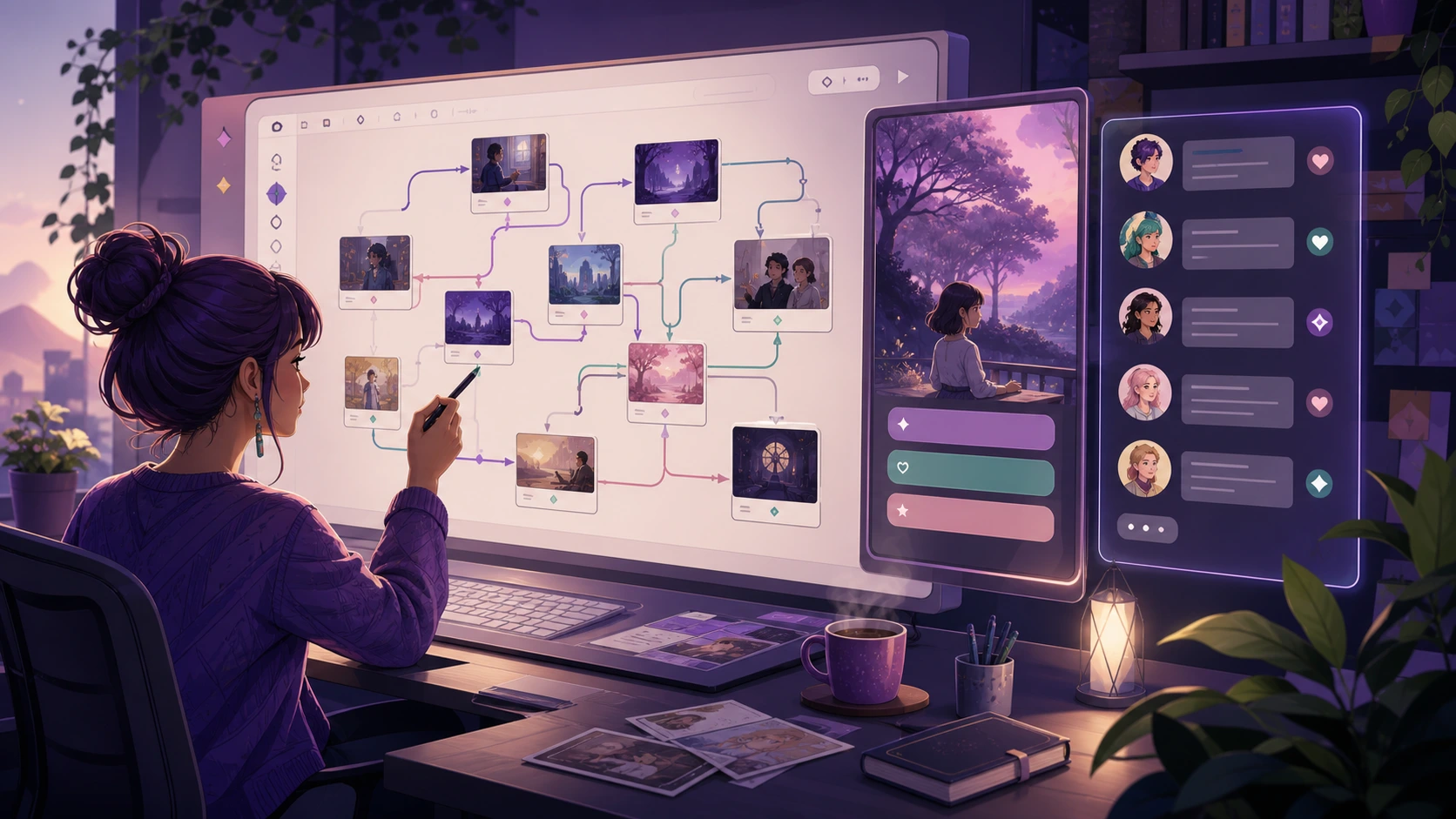
A good creation tool should feel like a workbench.
Not a vending machine. Not a slot machine. Not a black box that spits out a finished thing and tells you to be impressed.
A workbench is where you lay things out. You compare versions. You keep the pieces that matter. You throw away the parts that do not. You step back, test the shape, ask someone else to try it, then return and adjust.
That is exactly what many story creators need.
They do not need a tool that constantly says, "Want me to generate the whole thing?"
They need a tool that says:
Here is your scene. Here is your branch. Here is what the player will see. Here is what changed. Here is where the story breaks. Here is the fastest way to test it.
That is much more respectful.
It treats the creator as the author, not as a prompt operator.
And for visual novels, that distinction matters a lot. The emotional power of the format comes from small choices. The timing of a line. The placement of a background. The order of a route. The way a player realizes that a choice was not as simple as it looked.
Those are not things you want to surrender to a content machine.
You want a tool that helps you notice them.
💜 Where Novelez Fits After the Noise
This is why Novelez's direction matters in the middle of the AI creation debate.
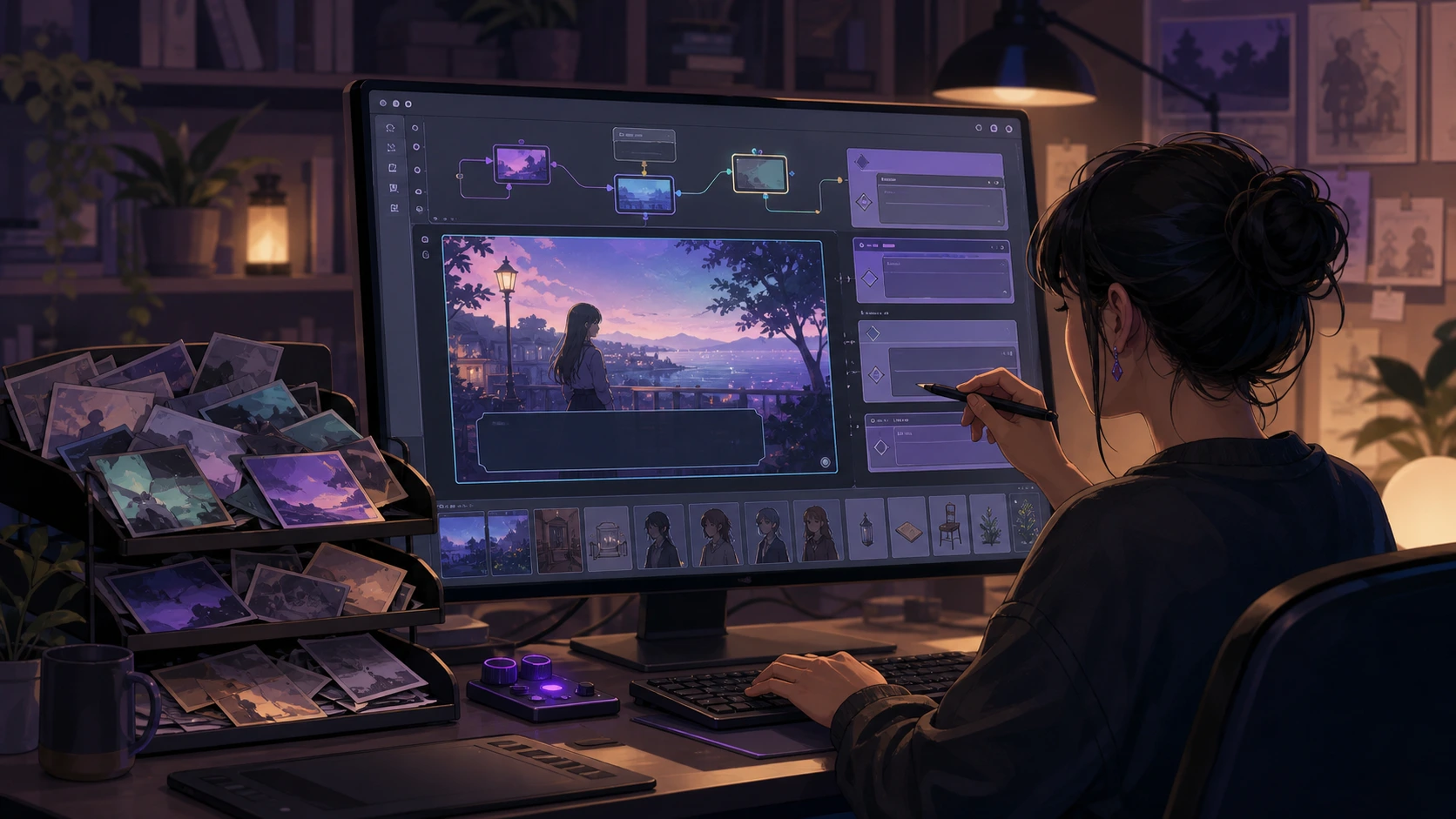
Novelez is not trying to make the creator disappear behind automation. The point is to help story creators build playable visual novels without letting technical setup swallow the whole project.
If you think in scenes, characters, choices, routes, and emotional beats, the tool should meet you there.
That means the most important feature is not "one prompt to make a game."
The more important promise is:
1️⃣ make the scene visible,
2️⃣ connect the choice,
3️⃣ preview the moment,
4️⃣ share a playable version,
5️⃣ revise without losing control.
AI can still have a place in that world. It can help with rough ideas, placeholder material, brainstorming, localization drafts, and production support.
But it should support the creator's workbench, not replace it.
Because after the AI slop debate, the tools that feel best will probably be the tools that give creators more authorship, not less.
🌱 The Future Is Smaller, Cleaner, and More Human Than the Hype
The loudest version of AI game creation says everything will be instant.
Instant worlds. Instant characters. Instant games. Instant publishing. Instant scale.
Maybe some of that will be useful. I am not against speed. Most creators need less friction, not more.
But the best creative tools usually do more than accelerate. They protect the part of the work that is fragile.
For visual novels, the fragile part is the creator's voice.
A story can survive simple art if the choices feel honest. It can survive a small scope if the pacing works. It can survive a limited asset library if the characters feel alive.
But it has a much harder time surviving when every part feels averaged out.
So maybe the next question is not, "Can AI make a whole game?"
Maybe the better question is:
Can our tools help more creators make games that still feel like someone cared?
That is the direction worth building toward.
Start with one scene. Keep the choices intentional. Test the playable version. Revise what feels false. Keep what feels alive.
That is how a story game becomes more than content.
That is how it becomes yours.
July 5, 2026