In the Age of AI Game Creation, the Real Opportunity Isn't Auto-Generation. It's Creator Tools.
July 3, 2026
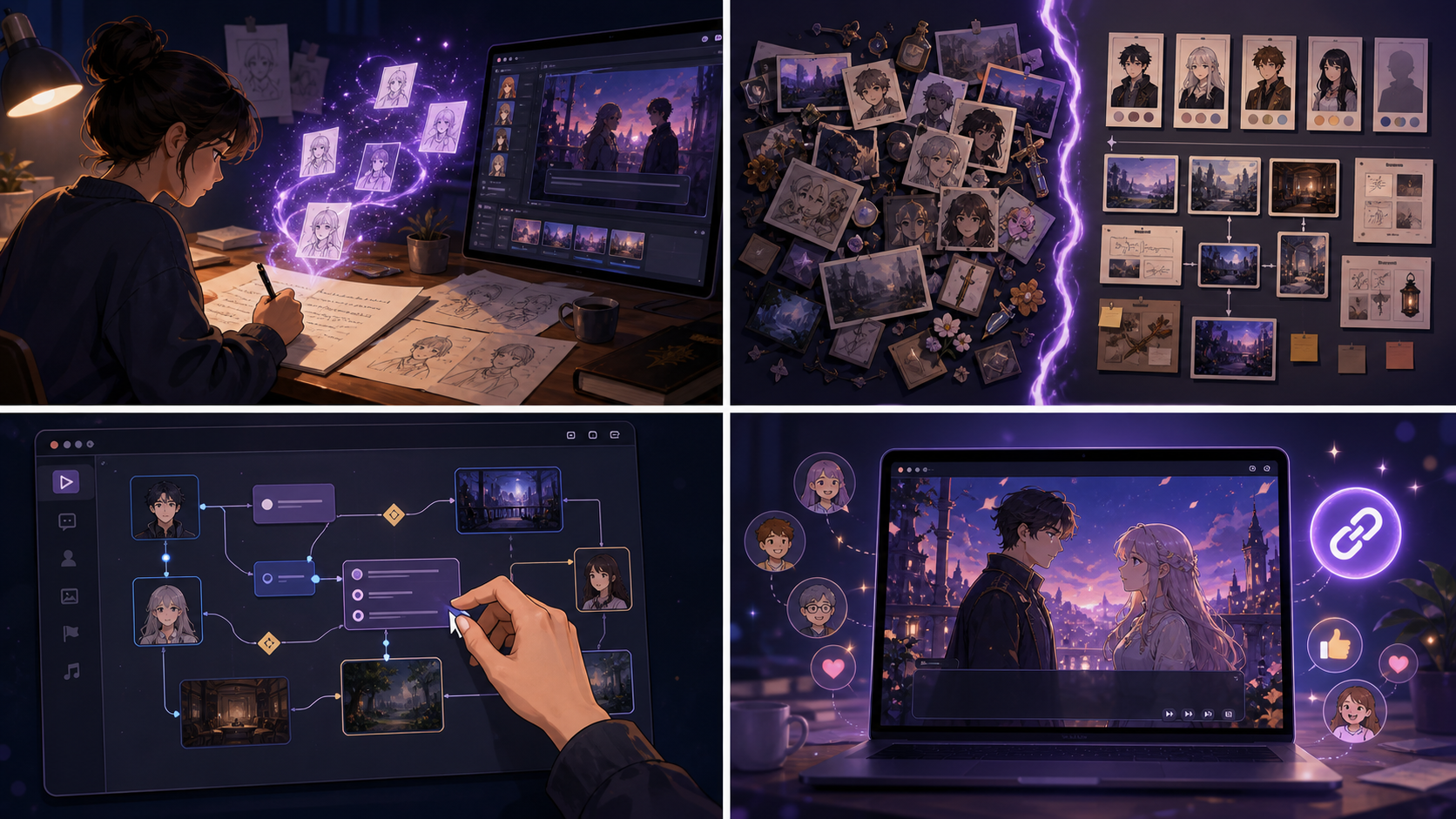
Have you noticed how fast "AI game creation" went from futuristic idea to everyday conversation?
One year, people were asking whether AI could help brainstorm a scene. Now every week brings a new tool promising to turn a prompt into a game, a trailer, a character, a quest, or a whole playable prototype. It sounds exciting. Honestly, parts of it are exciting.
But if you spend even a little time around game developers, visual novel creators, or story communities right now, you will hear another word just as often: slop.
Not because people hate tools. Most creators use tools all the time. They use templates, engines, asset packs, writing apps, references, spreadsheets, Discord communities, and half a dozen small shortcuts that make creative work possible.
The frustration is more specific than that. People are pushing back against work that feels automatically produced but not meaningfully made. The kind of project where a model generated the surface, but nobody shaped the taste, the pacing, the characters, the emotional logic, or the reason the thing should exist.
That distinction matters a lot.
Because the real opportunity in AI game creation may not be "generate the whole game for me." It may be something quieter and more useful:
Give creators better tools, so they can turn their own stories into playable work faster.
The AI Game Boom Is Real
Let's not pretend nothing is happening.
AI is already part of the game industry. The latest industry conversations are not about whether AI will appear in pipelines. It already has. Developers are using it for ideation, code assistance, placeholder art, localization drafts, QA support, documentation, marketing copy, and quick prototypes.
Google Cloud's 2025 games research, for example, reported broad AI workflow adoption among game developers. GDC's 2026 State of the Game Industry survey showed a more conflicted picture: generative AI is widely present, but many game workers are increasingly skeptical of its impact. That tension is the story.
AI is spreading because it can reduce blank-page friction.
It can help a solo creator explore "what if?" faster. It can rough out ten variations of a scene. It can suggest a branch you did not think of. It can draft a side character profile. It can turn a messy paragraph into a cleaner outline. For a small team or a writer working alone after midnight, that matters.
But speed is not the same thing as authorship.
And in games, especially story-driven games, authorship is not a decorative detail. It is the whole product.
Why "Generate Everything" Runs Into Trouble
The backlash is not imaginary. It is becoming part of the creative environment.
Steam's AI disclosure conversations show that players increasingly want to know what they are looking at. If a visual novel uses AI-generated anime-style art, many players want that disclosed. That does not automatically mean the work is bad. It means trust now includes transparency.
On itch.io, several visual novel jams have drawn a much harder line. The Make Visual Novel Assets!! Jam 2026 says generative AI cannot be used to create submission components, including writing, illustration, scripts, thumbnails, or temporary placeholders. Other VN jams have made similar calls.
Godot has also announced contribution-policy changes after frustration with low-quality AI-assisted submissions. Their concern was not "nobody may ever use a tool." Their concern was maintainability, accountability, and whether contributors understand what they are submitting well enough to fix it.
That pattern keeps repeating:
- People do not want low-effort output sold as craft.
- They do not want artists, writers, and developers erased from the process.
- They do not want unclear disclosure.
- They do not want a flood of content that looks finished but cannot be responsibly maintained.
So the problem is not simply "AI." The problem is automation without ownership.
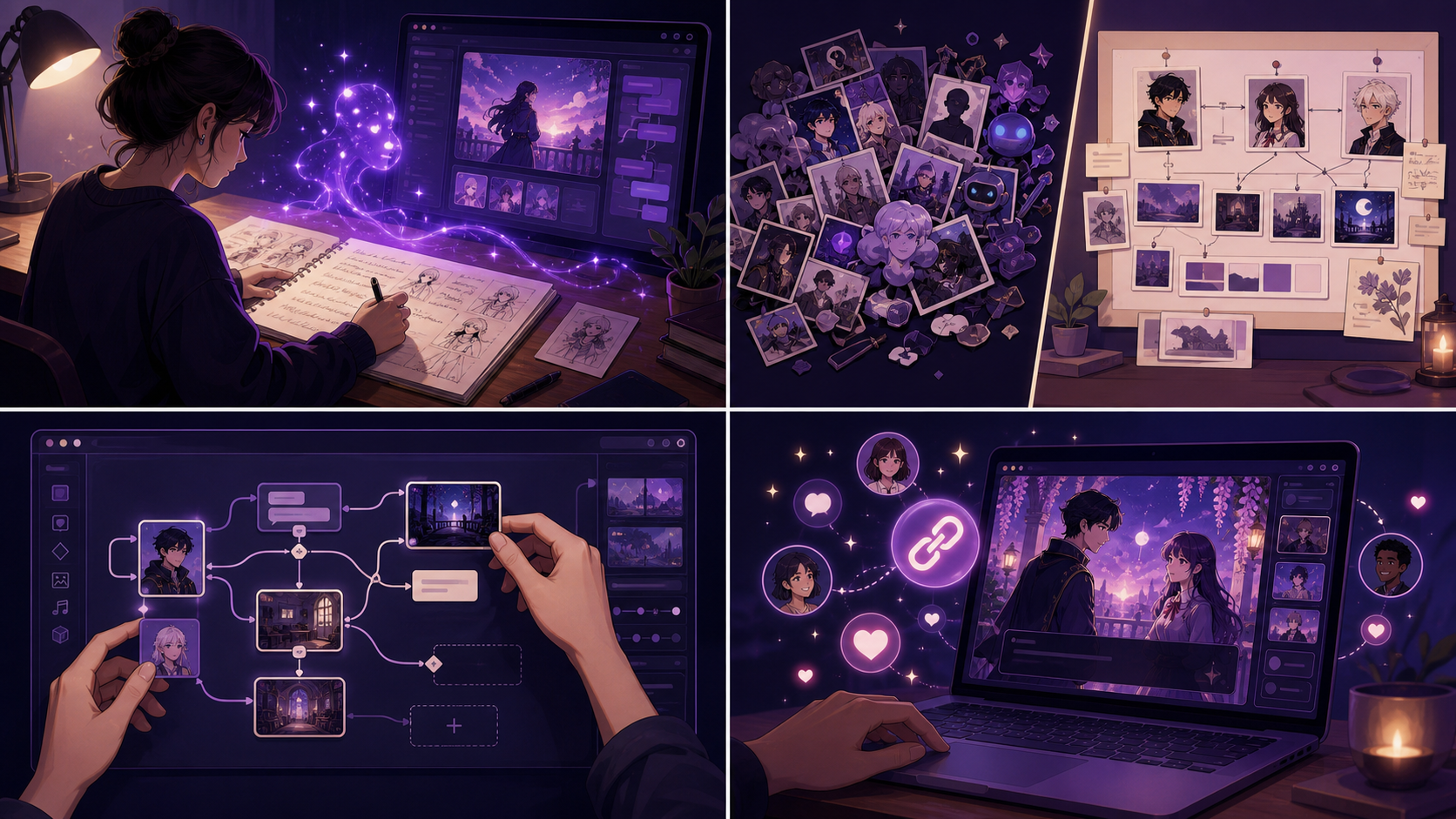
Visual Novels Make This Even More Obvious
Visual novels are a great lens for this debate because they look simple from the outside.
A character on screen. A dialogue box. Some choices. A background. Maybe music. How hard can it be?
But anyone who has tried to make one knows the answer: harder than it looks.
A good visual novel depends on structure. Who speaks when? What does the player know at this point? Which choice changes the relationship? Which branch is only flavor, and which one changes the ending? When should a secret be revealed? Does the player feel responsible for the outcome, or are they just clicking through a script?
Those are not just "content generation" problems.
They are design problems. Writing problems. Pacing problems. Taste problems.
AI can help suggest material. It can give you options. It can save you from staring at an empty page. But the moment the work becomes interactive, someone still has to decide what the player is actually doing and why it matters.
That "someone" should be the creator.
A Creator's Tool Is Different From an Auto-Generator
This is where the distinction gets important.
An auto-generator says:
"Give me a prompt. I'll make the thing."
A creator's tool says:
"Bring your idea. I'll help you shape it, organize it, test it, and share it."
Those sound similar until you actually try to make something.
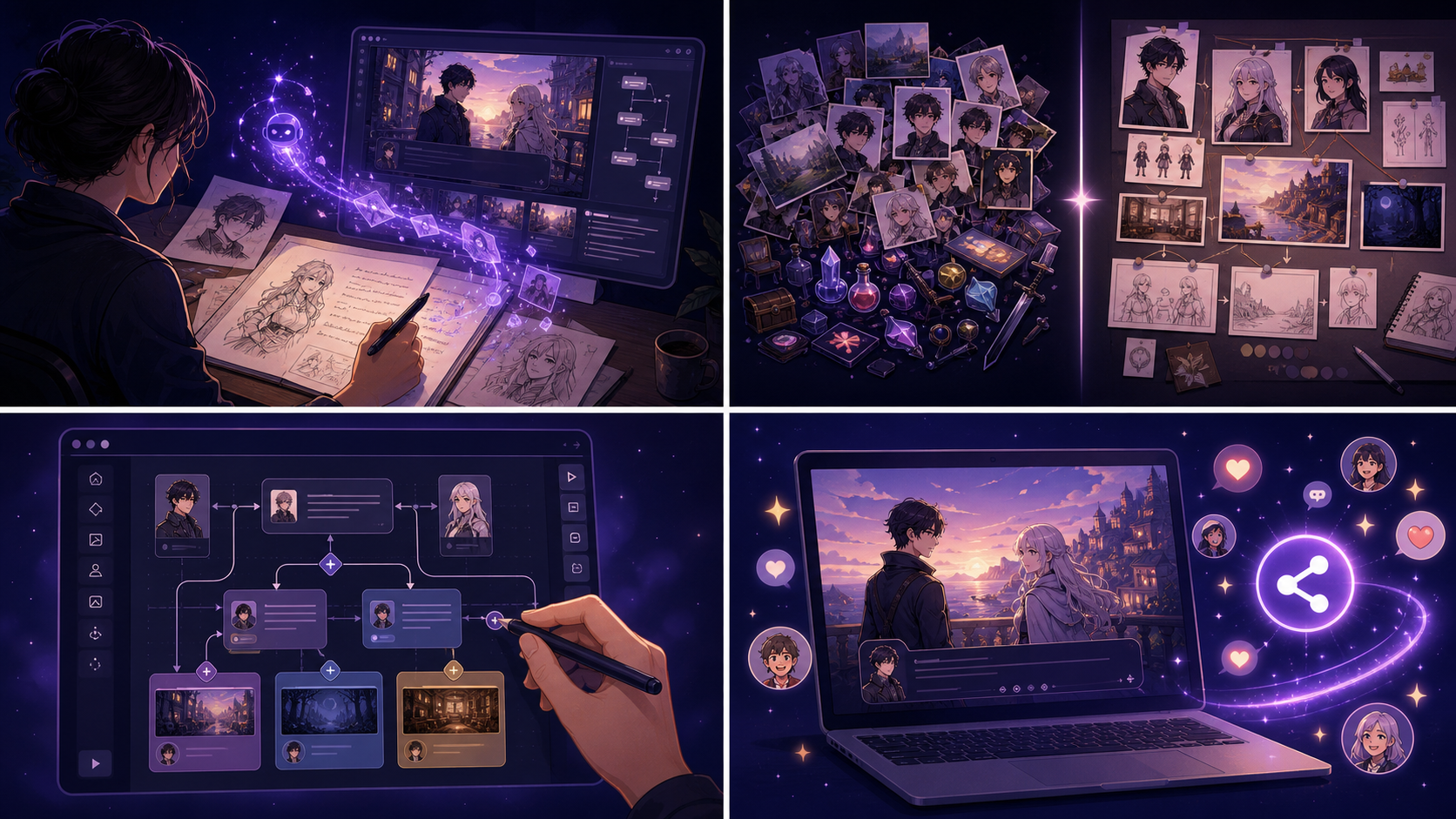
If you are writing a visual novel, you may not want a machine to decide your characters' emotional arc. You may want help turning your outline into scenes. You may want a clean way to connect branches. You may want to see whether a choice lands where you intended. You may want to preview a scene quickly without learning scripting syntax. You may want to send a playable link to a friend today, not three weeks from now.
That is not replacing the creator.
That is removing the friction around the creator.
And for story-first creators, that friction is often the real reason projects never leave the notebook.
The story exists. The characters exist. The ending maybe even exists. But between the document and the playable game, there is a long hallway full of setup, scripts, file formats, engine conventions, exports, broken builds, and "I'll figure it out later."
Most people do not quit because they have nothing to say.
They quit because the path from story to playable work is too heavy.
The Best AI Tools Will Keep the Human Hand Visible
One useful way to think about AI in creative tools is this:
Can the audience still feel a person making decisions?
Not every brushstroke has to be handmade. Not every line of code has to be typed from scratch. Not every placeholder has to be perfect. But the finished work needs a point of view.
In a visual novel, that point of view shows up in small places:
- The choice that looks harmless but quietly changes the relationship.
- The character who says "I'm fine" in a way that makes the player worry.
- The route that refuses to reward the obvious answer.
- The background that appears one scene earlier than expected, so the player feels something before they understand why.
- The ending that only works because the creator knew what emotion they wanted to leave behind.
AI can assist around those decisions.
It can offer alternatives. It can clean up rough wording. It can help generate a quick scene draft. It can suggest where branches might split. It can help a solo creator move faster.
But the taste has to come from somewhere.
That is why creator-controlled tools feel like the right direction. They let AI be useful without pretending the human part is optional.
What This Means for No-Code Game Creation
No-code game creation is sometimes described as "making things easier." That's true, but it is not the whole story.
The better version is this:
No-code tools change who gets to start.
Before, a writer with a visual novel idea often had to become a beginner programmer first. Or they had to find a technical partner. Or they had to spend weeks learning a tool before they could even feel whether their story worked as a game.
That is a strange tax to put on a story.
If the creator's main skill is writing characters, building emotional choices, or imagining a world, the tool should help them reach the playable version as quickly as possible. Not because the technical work has no value, but because the first playable draft is where the real learning begins.
You only understand a choice when someone clicks it.
You only understand pacing when a player pauses, skips, laughs, or says, "Wait, I want to go back."
You only understand whether a character works when the player starts caring.
So a good no-code visual novel tool should not just be a simpler engine. It should be a bridge from private story to playable feedback.
Where Novelez Fits
This is the space Novelez is built for.
Novelez is not trying to say, "Let AI make your story so you don't have to."
The better promise is:
If you have a story, Novelez helps you turn it into something playable without making you become a programmer first.
You can build scenes, connect choices, organize branches, add characters and backgrounds, and share the result as a playable visual novel. The point is not to hide the creator. The point is to make the creator's work easier to shape and easier to show.
That matters even more in the current AI climate.
Because the strongest creative tools of the next few years will probably not be the ones that shout "we generated everything." They will be the ones that make creators feel more capable, more in control, and more willing to finish.
The future of AI game creation may be less about replacing the maker and more about clearing the path between:
- I have an idea.
- I made a scene.
- Someone played it.
- I want to make the next one better.
That loop is where creative momentum lives.
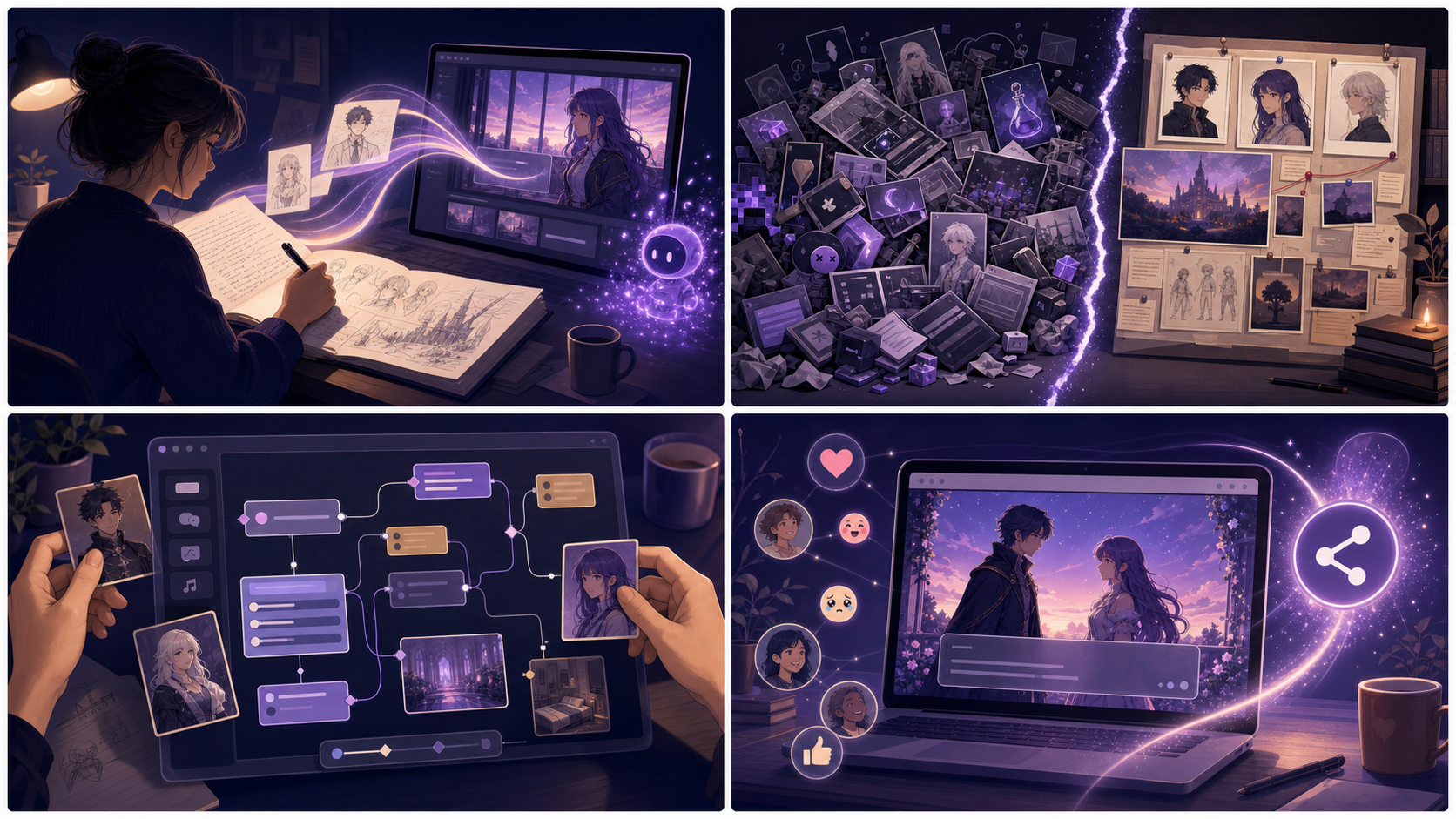
So, Should Creators Use AI?
That's probably the wrong question.
A better question is:
Who is making the creative decisions?
If AI helps you explore, draft, organize, convert, or test your idea, it can be a useful assistant. If it becomes a way to avoid caring about the work, players will feel that too.
People do not remember a visual novel because it technically contains characters, backgrounds, and choices.
They remember it because a choice made them hesitate. Because a character felt real. Because an ending landed. Because the creator cared enough to shape the experience.
AI can make starting easier.
No-code tools can make building easier.
But the story still needs a person at the center.
And honestly, that is good news. It means the opportunity is not reserved for the biggest studio, the fastest model, or the loudest auto-generation demo.
It is still open to the person with a story they cannot stop thinking about.
If that is you, start small. Make one scene. Add one choice. Let someone play it.
Your story does not need to be automatically generated to become a game.
It needs a tool that helps you make it real.
July 3, 2026