How Do You Playtest Every Route in a Branching Visual Novel?
July 11, 2026

Have you ever fixed one route in your visual novel, clicked through it again, and somehow broken a completely different ending?
That is the strange thing about branching stories. A small choice near the beginning can change a scene much later. A route can look perfect in your flow chart and still fail when a real player reaches it with the wrong flag, the wrong relationship value, or an unexpected sequence of choices.
The bigger your story becomes, the more tempting it is to test by memory: pick a few choices, reach an ending, and hope the other paths still work.
That is usually when the missing scene, impossible choice, and mysterious dead end show up.
The good news is that route testing does not need to become a giant spreadsheet nightmare. You need a small map, repeatable test passes, and a way to describe exactly how a bug happened.
Here is a practical way to do it.
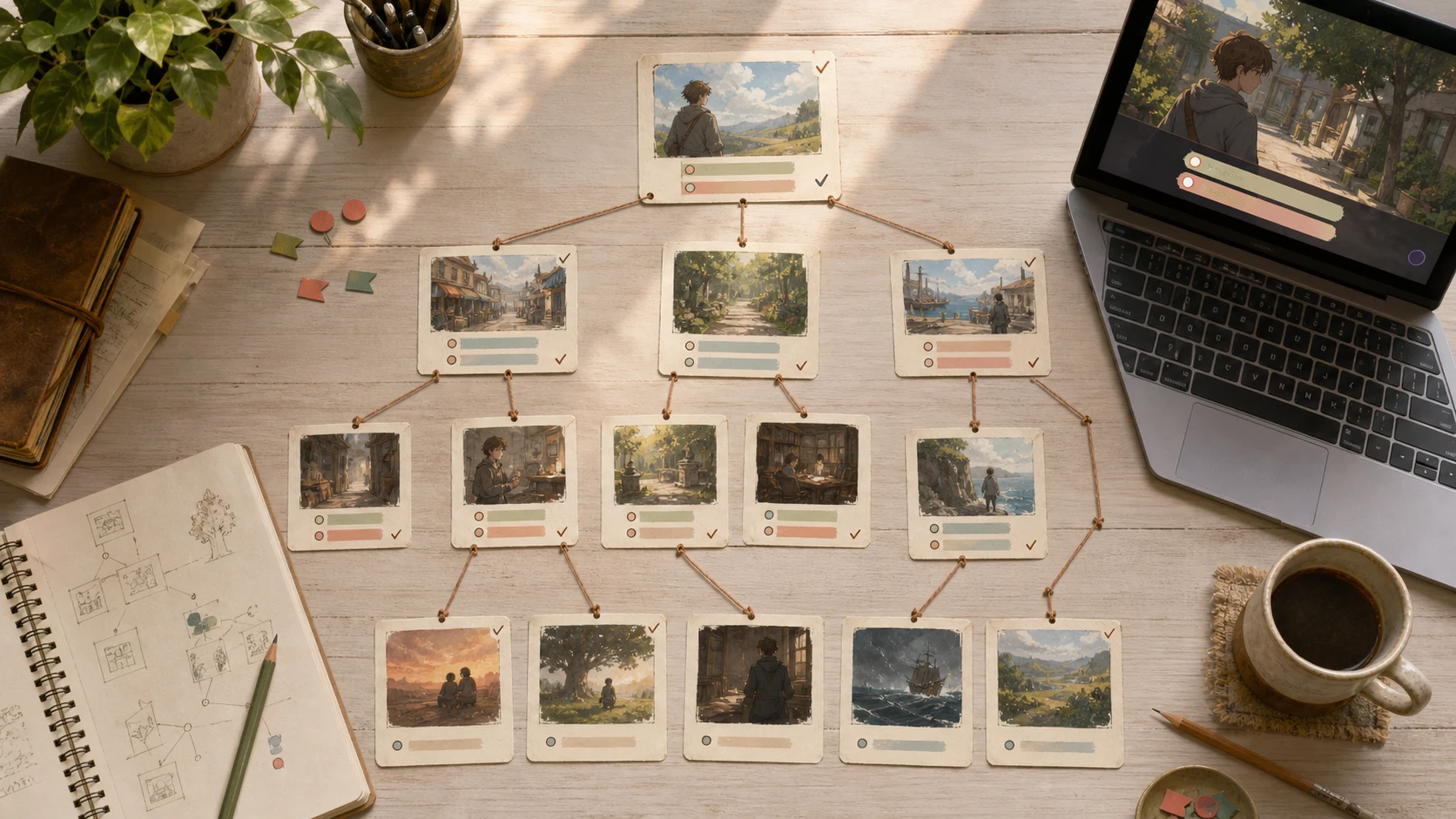
🗺️ Start With a Route Inventory, Not a Perfect Flowchart
Before you playtest, write down what must be reachable.
Do not begin by documenting every line of dialogue. Start with the major promises your game makes:
1️⃣ Every route entry point.
2️⃣ Every important branch.
3️⃣ Every ending.
4️⃣ Every shared scene that changes based on an earlier choice.
5️⃣ Every condition that can lock or unlock content.
This is your route inventory.
For a short mystery story, it might be as simple as:
- Trust Mina or investigate alone.
- Find the key before the library closes.
- Confront the caretaker or stay quiet.
- Reach the truth ending, escape ending, or false accusation ending.
That list is already useful. It tells you what the player must be able to do without forcing you to describe the whole story again.
Now give each route or ending a short test label. Something like Mina / Key / Confront / Truth is much easier to reproduce than “the good ending I reached yesterday.”
The goal is not administrative perfection. The goal is to make every important path visible enough that none of them can quietly disappear.
🚪 Test Entry, Middle, and Exit Separately
A route can fail in three different places.
The player may never enter it. They may enter correctly but lose the state halfway through. Or the route may play perfectly until the ending sends them to the wrong result.
That is why one complete click-through is not always enough.
For each important route, check three moments:
1️⃣ Entry: Did the correct earlier choices unlock this route?
2️⃣ Middle: Do route-specific scenes and dialogue stay consistent?
3️⃣ Exit: Does the final condition lead to the intended ending and next screen?
This makes bugs easier to understand.
If the entry fails, inspect the choices and conditions that lead into the route. If the middle changes unexpectedly, look for a state value that was overwritten or never set. If the exit fails, inspect the last decision and ending condition instead of replaying the whole game without a theory.
You are turning “this route feels broken” into a smaller question you can actually answer.
🧪 Change One Variable Per Test Pass
Imagine your scene has two earlier variables: whether the player found a letter and whether they trusted a character.
If you change both at the same time, you may reach a different scene, but you will not know which change caused it.
Instead, keep one test path as your baseline.
Run it once with:
- Letter found: yes
- Trust: yes
Then change only one thing:
- Letter found: no
- Trust: yes
After that, test:
- Letter found: yes
- Trust: no
This sounds methodical because it is. It is also much faster than wandering through random combinations and trying to remember what changed.
You do not need to test every possible combination with equal intensity. Focus first on variables that change routes, endings, character availability, or important shared scenes. Cosmetic variations can come later.
And keep a known-good save or restart point before each major branch when your tool allows it. A repeatable starting point turns a fifteen-minute replay into a two-minute check.
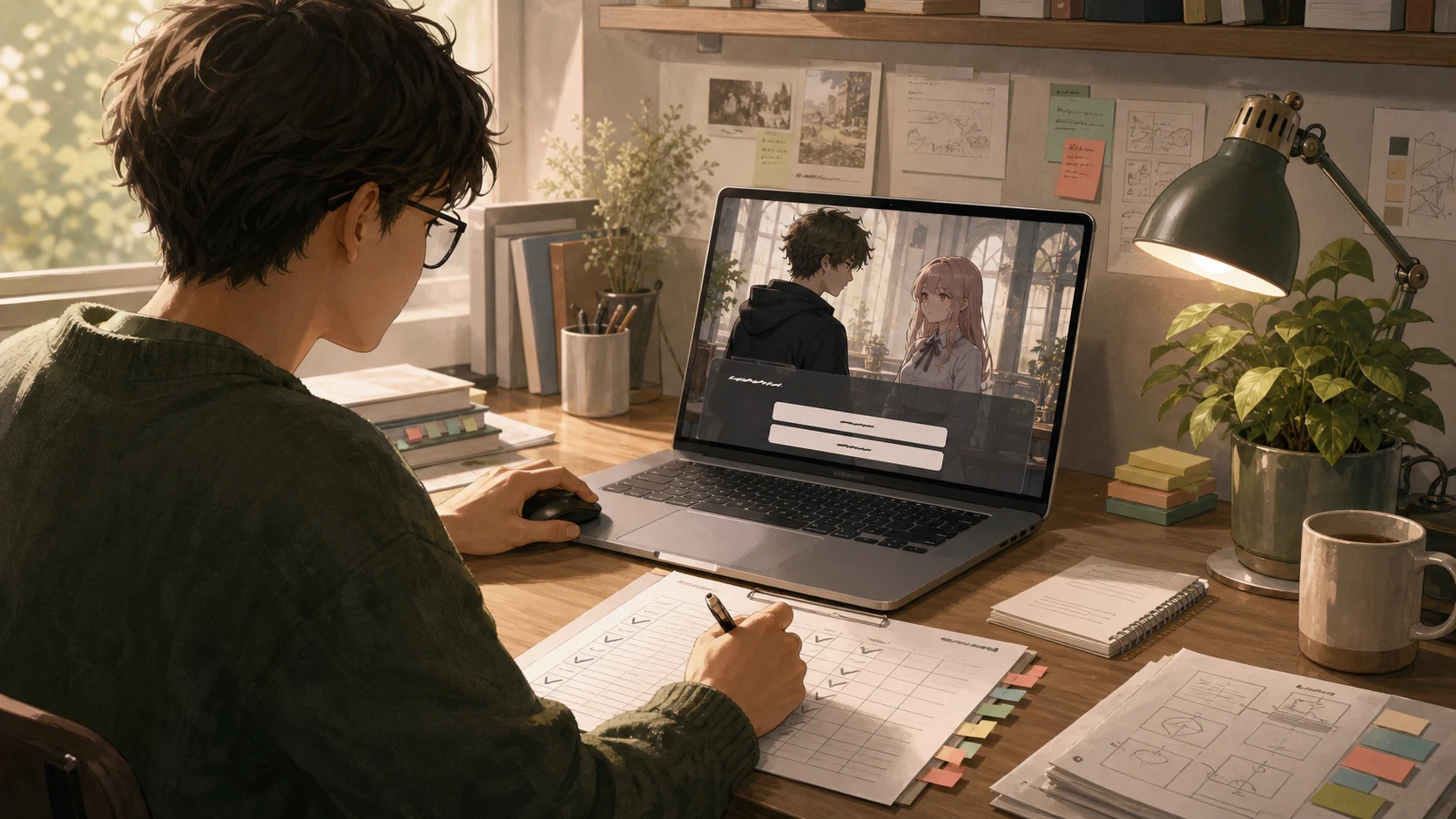
🧭 Test the Unpopular Choice on Purpose
Creators naturally click the choices they like.
You trust the charming character. You inspect the obvious clue. You apologize after the argument. Then you test that path again because it feels like the “real” story.
Players will not cooperate.
Someone will refuse the quest, ignore the clue, choose silence, return to the previous location, or make the least emotionally sensible decision just to see what happens.
So give yourself one rule:
During QA, choose the option you least want to choose.
This is especially important for:
1️⃣ Refusal choices.
2️⃣ Repeated visits to the same scene.
3️⃣ Choices made in an unexpected order.
4️⃣ Low-relationship versions of important conversations.
5️⃣ Paths that skip an item or clue the main route usually collects.
These are not edge cases in the player's mind. They are part of the freedom the interface offered them.
If an option is visible, the story should have a deliberate response to it—even if that response is short.
📝 Write Bug Reports as Routes, Not Feelings
“The ending is wrong” is a real problem, but it is not yet a useful bug report.
A useful route bug note includes:
1️⃣ Where the test started.
2️⃣ Which choices were made.
3️⃣ What state or item the player should have had.
4️⃣ What happened.
5️⃣ What should have happened instead.
For example:
“Started at Chapter 2. Did not take the key. Trusted Mina. Chose to confront the caretaker. The truth ending played, but the false accusation ending should have played because the key clue was missing.”
Now you have a route you can reproduce.
Screenshots help, but the choice sequence matters more. A screenshot shows where the story ended up. The route tells you how it got there.
When you fix the bug, replay the same sequence first. Then test one neighboring route to make sure the fix did not close another path.
That small regression check catches a surprising number of problems.
👀 Give Outside Playtesters a Mission
“Play my game and tell me what you think” sounds friendly, but it produces vague feedback.
One tester says it was fun. Another says it was confusing. Neither remembers the exact choices that caused the confusing part.
Give each tester a small mission instead:
- Try to reach the coldest version of the relationship.
- Avoid collecting the obvious clue.
- Refuse help whenever possible.
- Find one ending without using the creator's intended route.
- Revisit locations and repeat choices to look for broken state.
People become much better testers when they know what kind of trouble to look for.
You can also ask them to note only three things: the last choice before a problem, what they expected, and what happened. That is enough to begin reproducing most route bugs.

🌿 Let the Visual Structure Do Some of the Remembering
Branch testing gets exhausting when the whole story lives only in your head.
This is where a visual flow earns its keep. In Novelez, you can structure scenes and choices as connected nodes, inspect the route shape, and then play the result in the browser. The editor does not replace thoughtful QA, but it gives you a shared view of the story and the playable result.
That makes a practical loop possible:
1️⃣ Find the branch in Flow View.
2️⃣ Confirm the condition and destination.
3️⃣ Run the route in the browser preview.
4️⃣ Record the exact choice sequence.
5️⃣ Fix, replay, and check one neighboring path.
You are no longer asking your memory to hold the entire game at once.
And that is the real goal of a good playtest process. It should reduce uncertainty, not create more paperwork.
✨ A Tested Route Is a Promise You Can Keep
Every visible choice makes a small promise: this path goes somewhere on purpose.
Players do not need every branch to become a completely different game. They do need the story to remember what they did, keep its conditions consistent, and deliver the ending they earned.
So before you call your next build finished, make a route inventory. Check entry, middle, and exit. Change one important variable at a time. Choose the awkward option on purpose. And write every bug as a reproducible route.
You will catch more problems with fewer random replays—and your branching story will feel much more trustworthy when it reaches a real player.
July 11, 2026