Why Do AI-Converted Characters Sound Alike, and What Should You Fix First?
August 26, 2026

You convert a story draft, open the first playable conversation, and discover that three supposedly different people speak like one careful narrator. They use similar sentence lengths, explain their feelings with the same clarity, and answer every question directly. The names change, but the voice does not.
This does not mean the whole conversion failed. Novelez has already done useful structural work by organizing source material into scenes, dialogue, characters, and choices. The problem is narrower: the source gave the conversion enough information to tell events apart, but not enough to tell speakers apart.
Do not regenerate the entire project first. Keep the route and scene structure that work, choose one short conversation, and diagnose the dialogue there. A focused repair reveals whether the missing information belongs in the character definition, the scene purpose, or the individual lines.
Is the problem really character voice?
Start with evidence instead of a general feeling. Pick a scene where at least two important characters want different things. Hide the speaker names and read the lines aloud. If you can still identify most speakers, the voices may be fine and the real problem may be pacing or exposition. If every line could move to another character unchanged, you have found a voice problem.
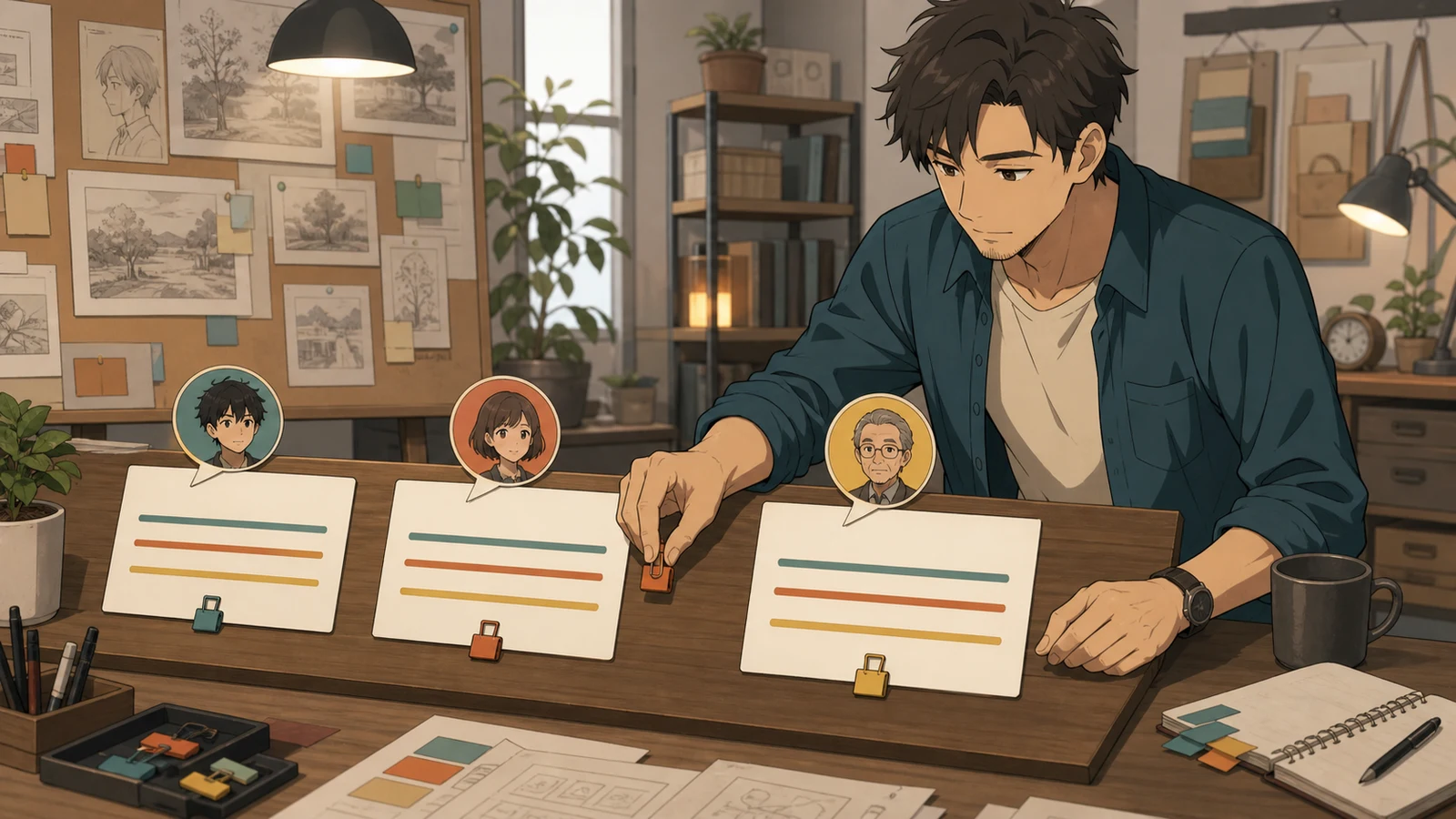
Look for three repeating signals. First, every speaker uses the same sentence length and level of politeness. Second, each person states what they feel instead of protecting, disguising, or redirecting it in a different way. Third, questions receive complete answers even when the relationship should make honesty difficult.
Also check whether the source draft caused the sameness. Prose often summarizes a conversation in one narrative voice: one person objects, another explains, and they eventually agree. Conversion can turn that summary into dialogue, but it cannot recover distinctions that were never present. If the original material does not show how each person avoids a topic, chooses words, or handles silence, editing only the final punctuation will not solve it.
Fix the character rule before the line
A useful character note is not a pile of adjectives. "Quiet, kind, intelligent" can describe thousands of people and gives an editor little to test. Write a rule that changes what the character does in a conversation.
For each major speaker, record four things. What do they want from other people in this scene? What will they refuse to say directly? What do they do when uncomfortable? Which kind of word or sentence would they never use? These constraints create visible differences.
One character may answer a personal question with a practical task. Another may fill silence with unnecessary detail. A third may use the other person's name only when angry. Those are not decorative verbal tics. They connect speech to pressure, relationship, and intention.

Now rewrite only one exchange. Keep the plot facts unchanged and make each reply obey its speaker's rule. If the scene becomes easier to identify without names, the diagnosis was correct. Apply the same rule to the remaining lines in that scene before moving elsewhere.
Avoid solving the problem by giving everyone a catchphrase. Repetition makes a speaker recognizable for a page and exhausting for a chapter. The stronger distinction is a pattern of decisions: who asks, who deflects, who notices concrete details, who speaks in conclusions, and who leaves a thought unfinished.
Give the scene opposing jobs
Characters still sound alike when the scene asks all of them to perform the same task. If every line exists to deliver background information, every speaker becomes a tour guide. Voice improves when the participants have different jobs inside the exchange.
Write one sentence for each person's immediate aim. One wants an invitation. One wants to end the meeting without admitting fear. One wants to confirm a suspicion while appearing casual. The scene can deliver the same plot information, but each line now has a direction.
This also helps you cut explanatory dialogue. A person trying to hide something should not volunteer a neat summary. Someone seeking reassurance may repeat a question after receiving a technically correct answer. A character who wants control may choose when to leave a silence. The friction between goals creates subtext without asking the prose to announce it.
If a scene has no opposing aims, decide whether it needs dialogue at all. A short narration block or a visual transition may carry neutral information more cleanly. Saving dialogue for moments when people affect one another makes their differences easier to hear.
Repair in the editor, then listen in preview
Novelez presents conversion, visual editing, browser preview, and publishing as one flow. Use that sequence as a repair loop. Keep the converted scene order if it works. Edit the character notes and dialogue where the specific problem appears. Then play the conversation without stopping.

Reading lines in an editor encourages you to judge them one at a time. Playing them reveals rhythm. You hear when both characters deliver equally polished paragraphs, when a reply arrives too quickly for the emotion, or when three explanations in a row stop the scene. The preview also shows whether a shorter line leaves an awkward pause or whether a choice appears before the player's question has formed.
Use one pass for one concern. First listen only for speaker identity. Next check whether the scene's facts and route consequences remain intact. Finally inspect pacing, assets, and choice timing. Mixing every concern into the first pass makes it difficult to know which change improved the scene.
Do not replace every converted line simply because it came from automation. Preserve lines that fit the character and do their dramatic job. The goal is not to erase the tool's involvement. It is to make the playable result answer to your decisions.
A small repair test
Before revising the whole project, run this test on one scene:
- Choose a conversation with two characters and a clear disagreement.
- Hide names and mark every line whose speaker is impossible to identify.
- Give each speaker one conversational goal and one avoidance rule.
- Rewrite the smallest exchange that exposes the difference.
- Play it once for voice, then once for route facts and timing.
- Keep the rule only if it improves more than one line without becoming a catchphrase.
If the test works, carry the character rules into later scenes. If it does not, the real problem may be that the scene has no conflict, arrives at the wrong point in the route, or exists only to explain information. That is valuable news too, and it is still cheaper than rebuilding every scene.
Which converted conversation in your project is hardest to identify with the speaker names hidden, and what single thing would each person refuse to say plainly there?