Steam Now Has Achievement Sets. Should Your Visual Novel Use Them?
October 21, 2026
A visual novel's Steam achievement list tends to read like a table of contents nobody asked for: one line per ending, one per character route, one for filling the CG gallery. Then a paid after-story ships a year later, and every player who had reached 100 percent quietly drops back below it. On October 15, 2026 (Pacific time), Valve opened a beta of Steam Achievement Sets, and it changes how that list can be organized.
What did Valve actually ship?
Two posts went out together: a player-facing one on Steam News and a developer one on Steamworks Development. The details live in the Steamworks achievements documentation. For a visual novel, these are the parts that matter:
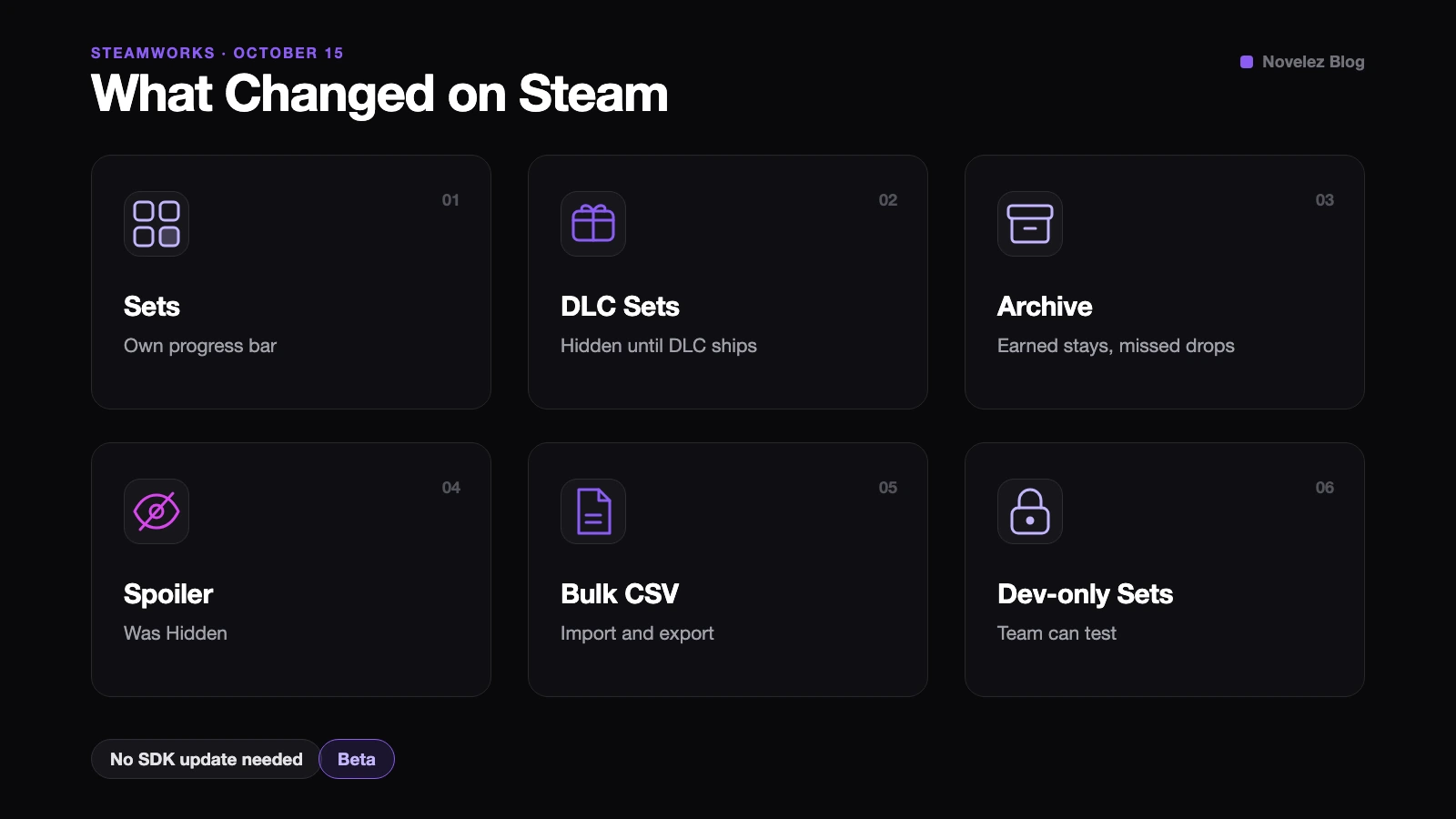
- Sets. Achievements can be grouped into named sets. Each set gets its own progress bar and its own "set complete" trophy on the player's profile. Valve's documentation suggests grouping by mode, character, chapter, or event.
- DLC sets. A set tied to owning a DLC. It never counts toward base game completion, and it stays hidden until the DLC is released.
- Archiving. Achievements, or whole sets, that can no longer be earned can be archived. Players who earned them keep them on their profile; players who missed them stop needing them for completion.
- Spoiler achievements. What Steam used to call hidden achievements are now spoiler achievements. Their names and descriptions stay masked until unlocked or revealed, and they are left out of the store page's achievement panel.
- A rebuilt editor. Bulk import and export through CSV and image files, bulk moves between sets, automatic grayscale locked icons, warnings for missing translations, and developer-only sets that only your team can see.
You do not have to touch your game to use any of this. Valve says existing API names and unlock calls keep working, and sets are configured entirely in Steamworks. In a Ren'Py project with Steam support installed, achievement.grant() keeps syncing to the same Steam achievement names, as described in the Ren'Py achievement documentation. The whole feature is labeled beta, so expect details to shift.
How should a visual novel split its achievements?
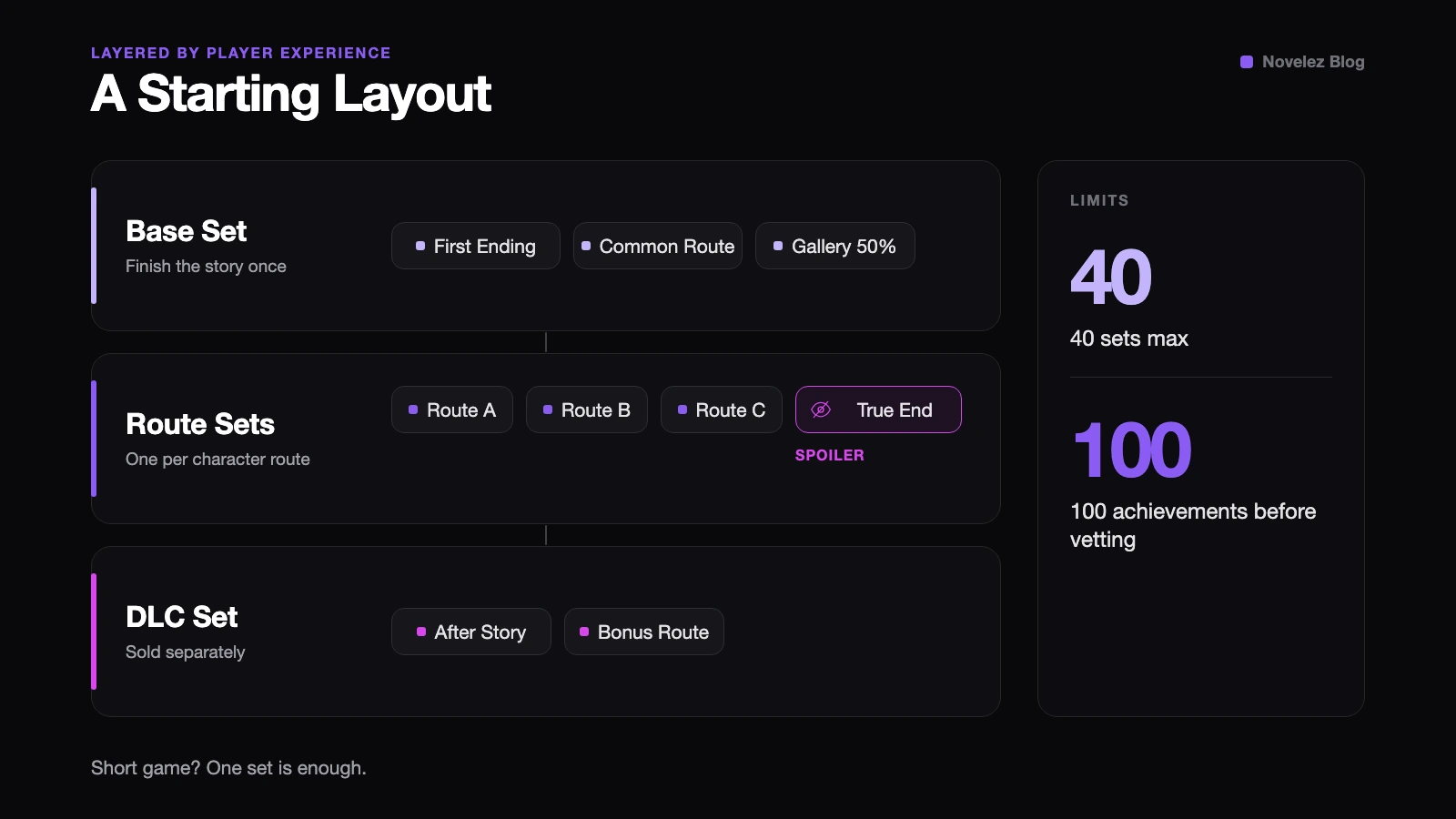
Start with the limits, because they shape the answer. An app can have 40 sets, base set included. An app that Valve has not vetted yet is capped at 100 achievements, and archived achievements still count toward that cap. Completing any one set is enough to put a game in the player's Completionist Showcase, and Windows Central pointed out that games with many sets can inflate profile counts. A pile of two-achievement sets makes "complete" mean very little.
Here is the layout I would start from. It is my reading of the documentation applied to typical visual novel structures, not something Valve recommends:
- Base set. Things a player earns by simply finishing the story once: leaving the common route, reaching a first ending, opening half the gallery.
- One set per route. Worth it when there are three or more character routes and each has its own endings and event CGs. A player who only cares about one character gets a progress bar that means something.
- A DLC set for anything sold separately. After-stories, bonus routes, side stories. Owners see a separate goal; everyone else keeps their base completion.
A short visual novel with two routes and a handful of endings is usually better off with the base set alone. Splitting ten achievements into three sets adds clutter without adding information.
While you are in the editor, go through every ending achievement and decide whether it should be a spoiler. A true ending or a twist ending's name belongs behind the flag. "Entered Mina's route" probably does not.
What changes if the game is already on sale?
Moving achievements is where you can hurt existing players. The documentation spells out two cases. Moving achievements from a visible set to a hidden one hides them from people who already unlocked them. Moving achievements into a set that players already have progress in may break their completion. The editor warns before either move, but the warning is easy to click through.
Adding is gentler. A player who completed a set stays complete even if you add to it later. Even so, Valve notes that new achievements in an already released set may not display naturally and suggests a new set instead. If you ship a free epilogue patch, give it its own set rather than wedging it into the base set.
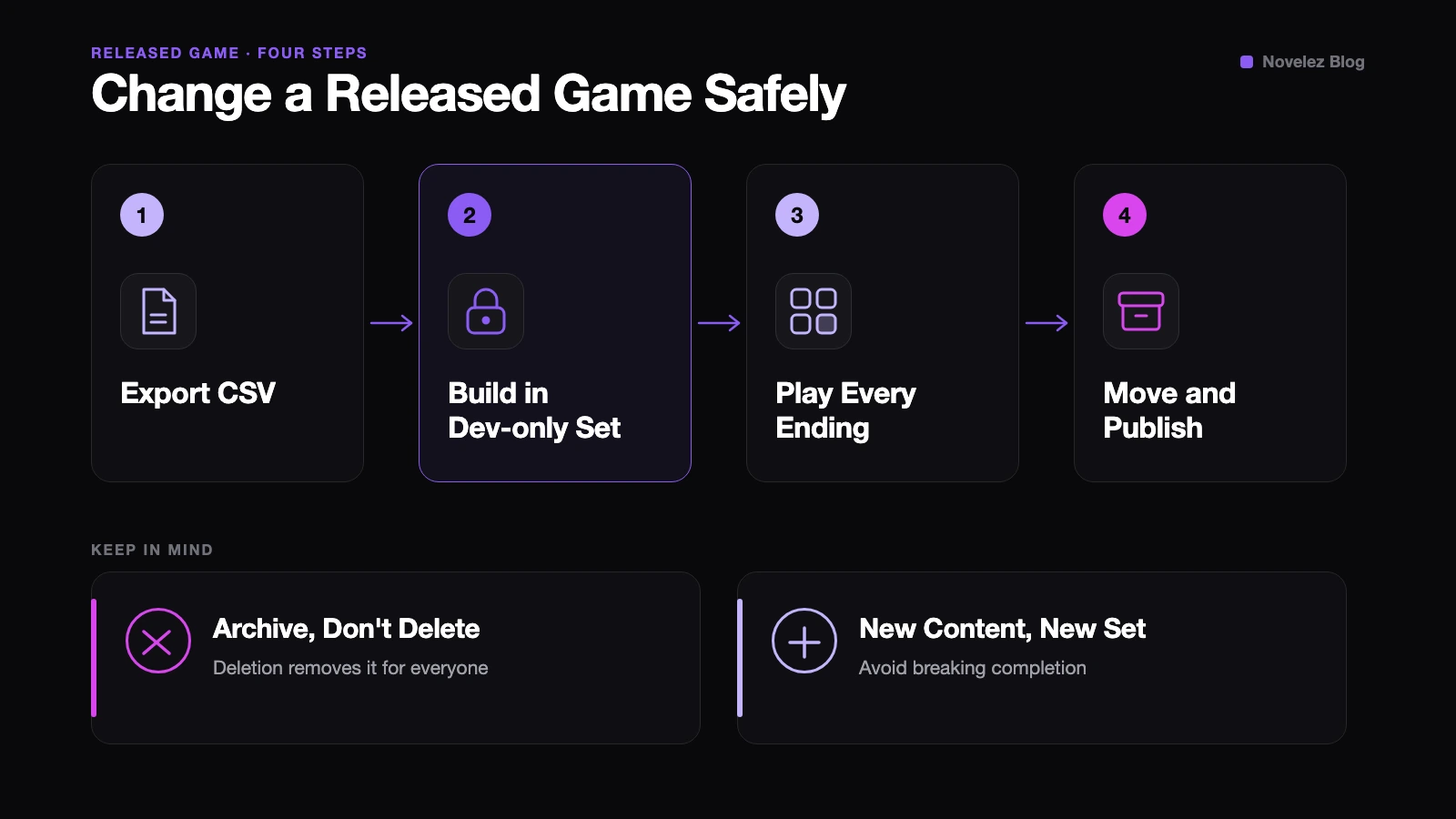
Deleting and archiving are not interchangeable. Deleting an achievement removes it for everyone, including the players who earned it, and adding it back later does not restore their unlocks. For content that is gone, such as a limited Halloween scene or a route you cut, archive instead. Archiving does not change the game, though. You still need to remove the unlock call from your script yourself.
Before anything goes public, build the new layout in a developer-only set. Only your team can see or unlock it, whether or not the game is released. Play to every ending, confirm each unlock fires, check the icons (256 by 256 PNG is recommended, and the editor can generate the gray locked version), switch through every language you support, and only then move the achievements into a public set.
Is it worth doing now?
There is no rush. The feature is in beta, and if you do nothing, your existing achievements simply sit in the base set and behave exactly as before. Three moments make it worth the hour:
- You are preparing a DLC. A DLC set lets you add achievements without touching anyone's base completion.
- Some achievements can no longer be earned. Archiving them lets new players reach completion again.
- You have not released yet. Designing the list with sets in mind from the start avoids every moving problem above.
How are the achievements in your visual novel organized today: by ending, by route, or as one long list? And if you have marked ending achievements as hidden before, did players thank you or go looking for a guide anyway?