How Many Backgrounds Does Your Visual Novel Need?
August 24, 2026
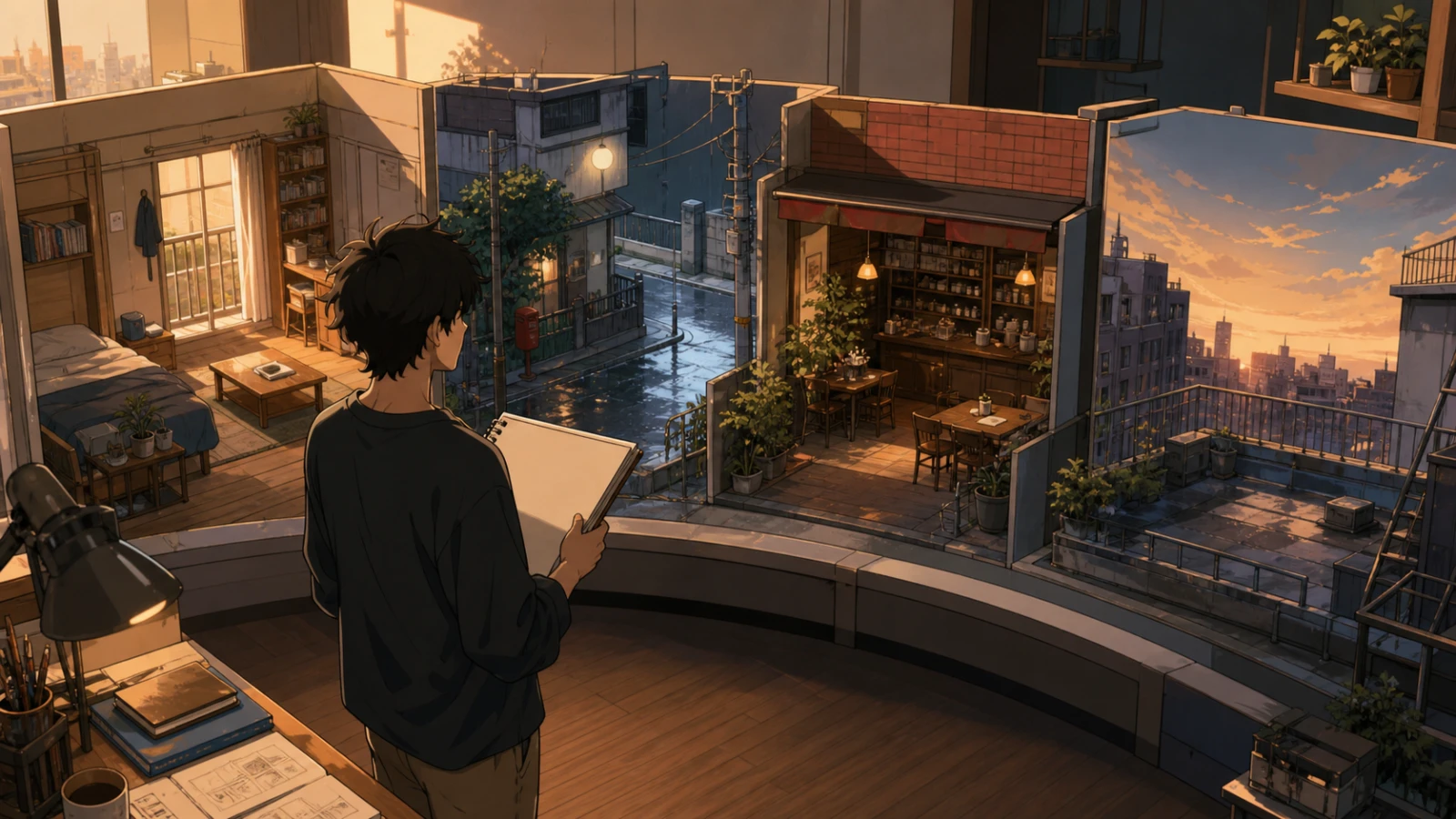
A solo creator can finish a thirty-scene visual novel with six backgrounds, or still feel short of art after commissioning twenty. The difference is not the scene count. It is whether the script keeps returning to a small set of places or asks for a fresh camera setup every few minutes.
That makes “How many backgrounds?” a production question rather than a genre rule. The useful answer comes from a location pass through the script, followed by a separate decision about states such as night, rain, damage, or a different point of view. If you count those things too early, the art list swells. If you count them too late, important scenes arrive with nowhere convincing to happen.
Here is a way to get a number you can budget before polished art begins.
Count places before you count scenes
Start with the script or outline and mark where every scene physically happens. Use ordinary names: bedroom, school corridor, station platform, cafe interior. Do not give the same place a new label just because the chapter changes.
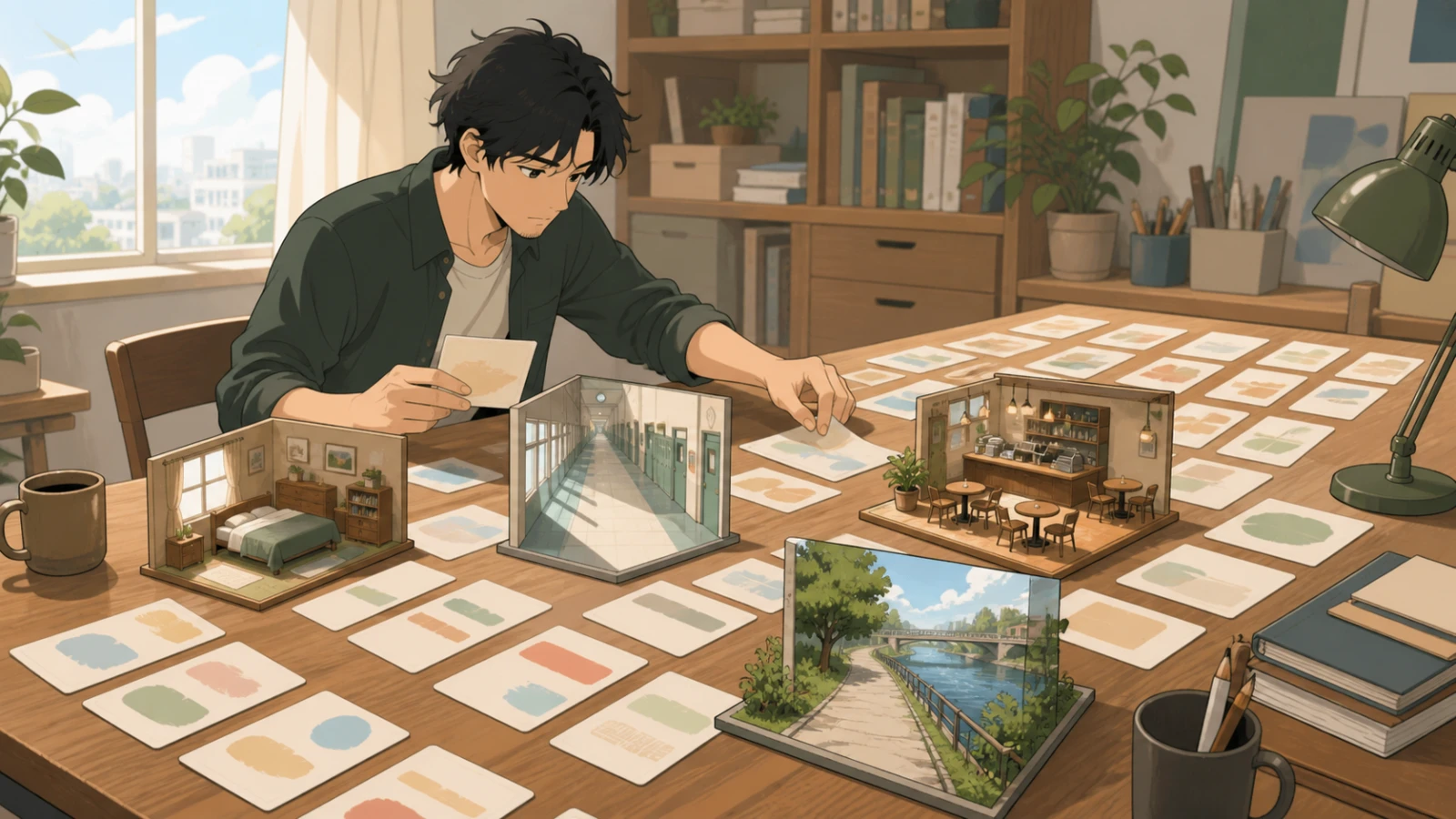
A scene is a unit of story. A background is a reusable camera view of a place. Ten conversations in the same cafe can use one background if the table, viewpoint, and visible exits still make sense. One chase through a station may need three because the concourse, platform, and footbridge are visually different spaces.
This first pass should produce a location ledger. For each place, note the scenes that use it, who appears there, what action must fit on screen, and whether the composition needs clear room for character sprites and dialogue. The ledger reveals two expensive habits quickly: locations that appear once for no strong reason, and locations whose names differ even though they could be staged in the same room.
For a small first public section, six to ten base views is often enough to create a real sense of place when the story is deliberately contained. That is a planning range, not a quality target. A locked-room mystery may need fewer. A road story can need more even at the same word count. The script decides.
What deserves a separate background?
Create a new base background when the player needs new spatial information. Moving from a bedroom to a kitchen usually qualifies. Turning from the cafe counter toward a back door may qualify if the door matters to the scene. A closer crop of the same table usually does not; camera movement or a crop can often carry it.
Ask a practical question: if the old image stays on screen, will the action become confusing or emotionally false? If two characters are supposed to hide behind a stairwell that does not exist in the current view, you need another view. If the only change is that they sit down, you probably do not.
Do not commission every mentioned place. A character can talk about an office without the story visiting it. Establishing art is worth its cost when it orients the player, changes the mood, supports blocking, or returns often enough to become familiar. Otherwise one sentence can do the work.
Is night a new background or a variant?
Time, weather, and story damage sit in a second list. They are not free, but they are usually cheaper and safer to plan after the base locations are stable.
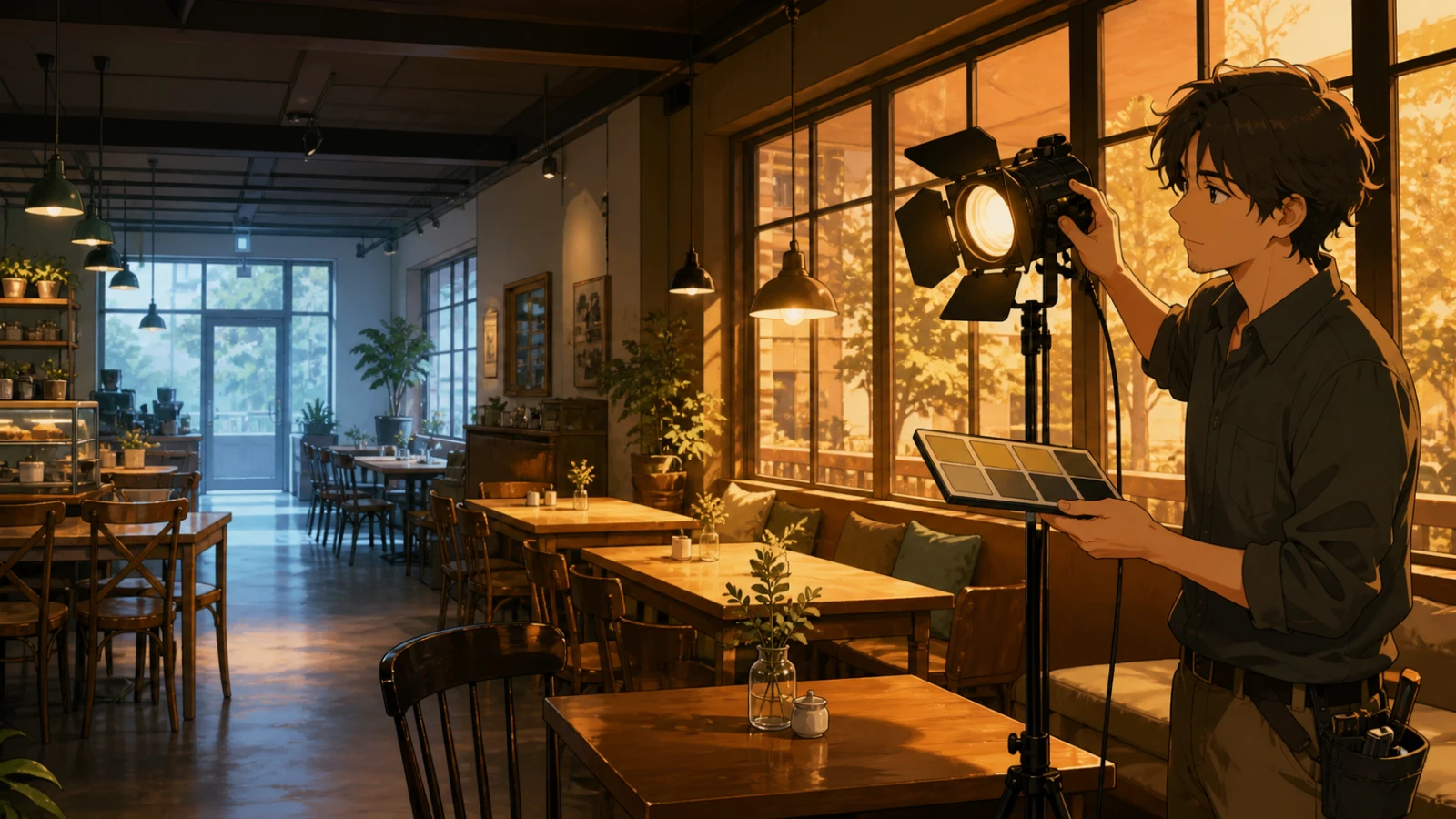
A color and lighting adjustment works when the geometry stays the same. Morning, afternoon, and evening in a bedroom can share one drawing if windows, lamps, and shadows are prepared for variation. Rain can sometimes be an overlay plus a darker grade. A closed shop may need only changed lights and a lowered shutter.
A variant becomes a new background when the event changes the space itself. A festival fills the street with stalls. A storm breaks the window and moves furniture. A flashback shows the building before renovation. Those are not filters; the player is seeing different visual information.
Keep variants tied to story beats. “It might be nice to have sunset” is not enough. “The confession begins in late afternoon and ends after the lights come on” gives the change a job. One purposeful transition can feel richer than five decorative palettes that appear once.
Reuse should feel intentional, not cheap
Players notice repetition most when nothing in the framing responds to the story. Reuse the same place, but change how it is occupied. A character can stand near the window in one scene and avoid it in the next. A foreground chair can disappear when the room is prepared for guests. Sound, sprite position, and the time of day can change the emotional reading without another painted location.
Consistency matters more than raw variety. A compact set of backgrounds with the same horizon logic, camera height, line density, and color treatment feels like one world. Fifteen unrelated asset-pack images may cover more locations and still make the story feel assembled from leftovers.
Before buying or commissioning anything, choose a visual specification. Record canvas ratio, safe areas behind the dialogue interface, expected character scale, camera height, and whether foreground objects may overlap sprites. Give every artist or generation pass the same specification. Fixing those rules after the art arrives costs more than removing a location now.
How do you turn the ledger into a budget?
Give each entry one of four labels: essential base, useful base, essential variant, optional variant. Then estimate cost and time at the level you can actually deliver. A background you draw yourself still has a time cost. A stock image still has a license-check and style-matching cost. An AI-assisted draft still has selection, correction, consistency, and disclosure decisions around it.
Fund the essential bases first. They should cover the entire story in an ugly but playable form before optional variants receive attention. Placeholder art is useful here because it tests whether staging works without pretending the final list is settled.
Look for reuse after the playable pass, not before it. If two apartments need the same camera angle and differ only in decoration, they may share a structural base with changed props. If merging them would erase an important class difference or character trait, keep both. Reuse is a design choice, not an automatic cut.
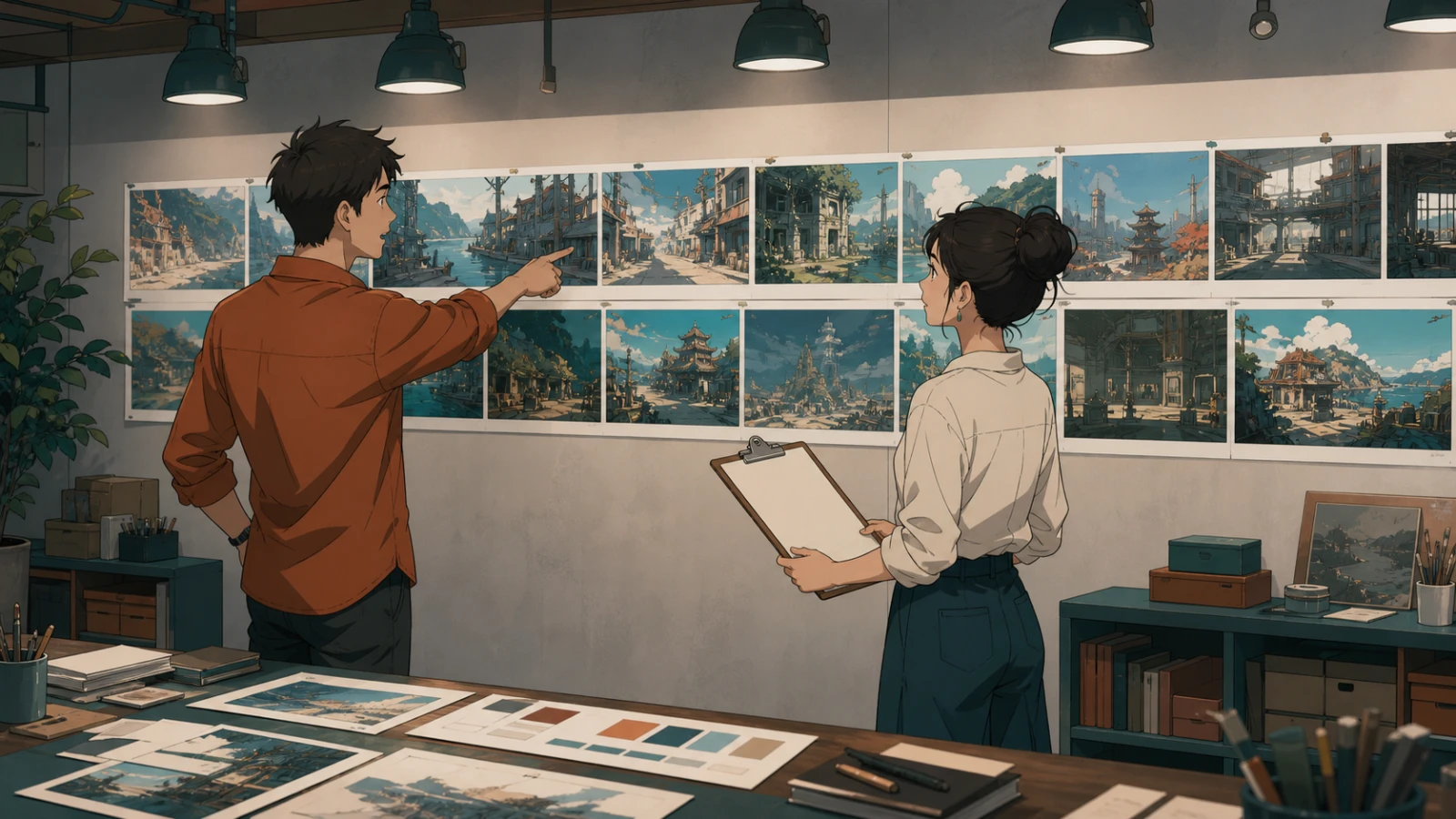
Finally, review the whole set at thumbnail size. Repeated compositions become obvious there. So do missing transitions, inconsistent perspectives, and a palette that accidentally gives every location the same mood. This wall review is the moment to remove one redundant view and strengthen one location the player will remember.
How does Novelez help with this plan?
Novelez does not decide which locations your story needs, and it does not make inconsistent background art coherent by itself. The location pass still belongs to the creator.
What it can reduce is the friction of testing the list. Background files can live with the project, scenes can be arranged in the visual editor, and the story can be previewed in the browser while the art is still placeholder quality. That lets you walk through the complete route and notice that a hallway is missing, a cafe is used only once, or two scenes could share the same room before final art is locked.
Because the playable structure is visible, the background ledger does not have to remain a spreadsheet detached from the story. Add the essential bases, run the opening, then replace placeholders as the list stabilizes. The useful number is the one proven by the playable route.
A final background check
- Every scene names a physical location.
- Each base background represents a camera view, not merely a chapter label.
- One-use locations have a clear story reason.
- Day, night, weather, and damage are listed as variants until geometry changes.
- Character scale and dialogue safe areas match across the set.
- Essential bases cover the full playable route before optional art begins.
- Licenses allow the way the final visual novel will be distributed.
- The complete set has been reviewed together at thumbnail size.
- Placeholder art has been replaced or intentionally retained before release.
There is no ideal background count hidden in the genre. There is only a story, a set of places it truly visits, and the camera views needed to make those visits clear. Count that version, and the art budget becomes something you can finish.