How Many Endings Does Your First Visual Novel Actually Need?
July 13, 2026

How many endings should your first visual novel have?
It sounds like a simple planning question, but it can quietly decide whether your project gets finished. One ending may feel too linear. Five endings sound exciting. Ten endings look impressive in a pitch. Then you start writing the exclusive scenes, checking every route, preparing different backgrounds and expressions, and suddenly your “small first game” has become several games sharing one title screen.
Here’s the reassuring answer: your first visual novel probably needs fewer endings than your imagination wants, and more purpose behind each one than your feature list suggests.
You do not need a huge route tree to make players feel that their choices mattered. You need a clear story promise, a manageable amount of unique content, and endings that leave meaningfully different emotional aftertastes. Let’s work out what that looks like.
🎯 Start With the Promise, Not the Number
Before you decide whether the game needs two endings or six, ask a more useful question: what experience are you promising the player?
Maybe the story is about whether two people can trust each other again. Maybe it is a mystery where the player decides how much truth they are willing to expose. Maybe it is a gentle slice-of-life story about choosing to stay, leave, or finally speak honestly.
Each of those promises suggests different endings. A trust story might need a reconciliation ending and a separation ending. A mystery might need the truth revealed, the truth buried, and a dangerous partial answer. The slice-of-life story may feel complete with one strong ending plus a short alternate scene.
Notice what is happening here: the endings are not trophies. They are answers to the central question of the story.
If two endings answer that question clearly, adding a third because “visual novels are supposed to have lots of endings” may only dilute the idea. If one ending makes every earlier choice feel cosmetic, then a second ending may be exactly what the story needs.

🌿 One Strong Ending Is Still a Real Visual Novel
Creators sometimes worry that a visual novel with one ending is not interactive enough. It can be. Choices can shape dialogue, reveal different details, change relationships, or alter the tone of a scene without producing a completely separate finale.
Think of the ending count and the choice count as different controls. You can have many expressive choices leading to one carefully earned conclusion. You can also have only a few choices that lead to three sharply different endings. Neither structure is automatically better.
For a first project, one main ending plus one alternate ending is a very practical shape. The main ending expresses the clearest version of the story. The alternate ending shows what changes when the player fails to protect a relationship, misses a clue, or chooses a different value. That is enough contrast to make the player reflect without doubling every chapter.
Three endings can also work well when each one represents a distinct stance: hope, compromise, and refusal; truth, comfort, and uncertainty; connection, independence, and obsession. The important part is that you can describe the role of each ending in one sentence.
If you cannot explain what an ending adds, it may be a variation, not a whole ending. A changed line, portrait, or epilogue card can carry a variation far more cheaply than a new route.
🪵 Keep the Trunk Long and the Branches Short
The biggest scope mistake is not having several endings. It is giving every ending a separate story too early.
Imagine a two-hour visual novel with three endings. If most scenes are shared and the routes diverge near the final act, you are still building roughly one game with three conclusions. If the routes split after the opening, you may be writing, illustrating, implementing, and testing almost three different games.
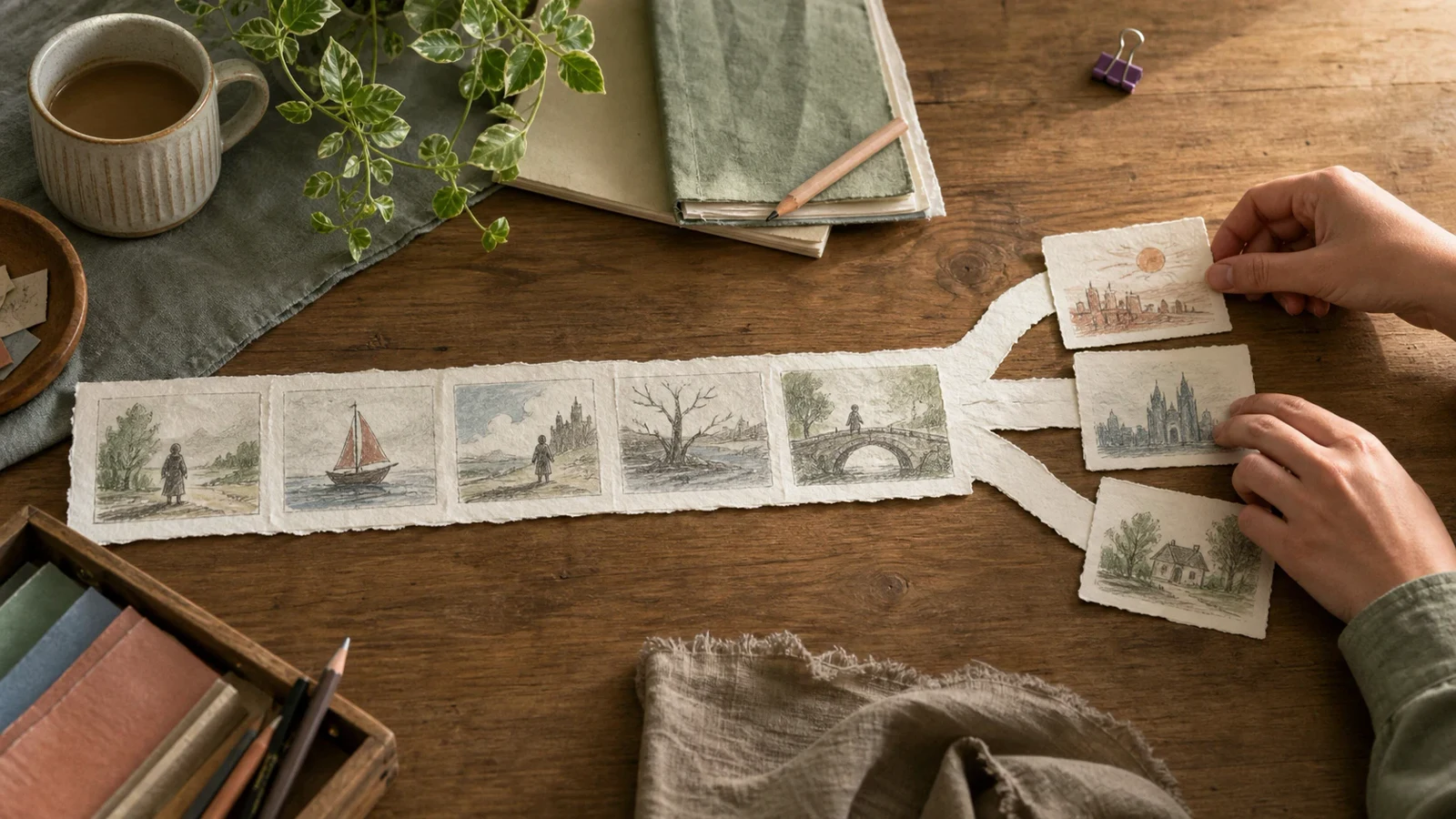
A useful first-project structure is a long shared trunk with smaller branches near the end. Early choices can still matter. They can set variables, change a relationship, unlock a clue, or alter which later conversation appears. The visible route split does not need to happen immediately for those decisions to have weight.
This structure gives you room to build anticipation. The player sees consequences accumulate, while you reuse locations, character art, music, and core scenes. Then the final branch pays off the pattern of decisions.
Try making a tiny scope sheet before drafting every scene. For each ending, list only what must be unique: the decision point, the final confrontation or confession, any exclusive art or music, and the epilogue. If the list keeps expanding backward into the first chapter, stop and ask whether those scenes truly need to be exclusive.
🧮 Count Unique Scenes, Not Just Endings
“Three endings” sounds small. “Three endings with eight unique scenes, two exclusive locations, four new expressions, and separate music cues” is a more honest description.
That is why an ending budget should count production work, not labels. Look at each planned ending and estimate what it adds across writing, visual setup, implementation, and testing. You do not need perfect numbers. You only need enough clarity to notice when one ending costs as much as the rest of the game.
This also helps you protect the parts that matter. Maybe the bittersweet ending deserves a completely different final scene, while the hopeful and hopeful-secret endings can share the same location and most of the dialogue. Maybe two outcomes can use one scene with different character expressions and a changed closing paragraph. Reuse is not cheating. It is direction.
Players remember whether the ending felt earned, not how many unique background files were created for it.
There is another hidden cost too: every unique scene creates another place where a flag can be wrong, a portrait can disappear, or a line can contradict a previous choice. Keeping the ending set focused makes both writing and testing more deliberate.
💌 Give Every Ending a Different Emotional Job
An ending should do more than change the last event. It should reinterpret what the player has been doing.
Suppose your story follows a character trying to save a fading hometown. In one ending, the town survives because the protagonist accepts help. In another, the protagonist preserves the town but loses the relationships that made it meaningful. In a third, the town changes, but the community carries its memory forward.
Those endings are not merely “good,” “bad,” and “true.” They offer different answers to the same question: what does saving a place actually mean?
That is much stronger than three finales where the same scene plays with a different score or one extra line. The production scope can remain modest, but the emotional contrast feels large.
When reviewing your ending list, give each one a short emotional job:
1️⃣ Fulfillment: the player sees the promise of the story completed.
2️⃣ Cost: the player gets what they wanted and understands what it demanded.
3️⃣ Reframing: the player discovers that the original goal was incomplete or mistaken.
You do not need all three. The labels are simply a way to test whether each ending earns its place.

✂️ Know What to Cut Without Flattening the Story
If the project is growing too large, do not immediately remove every branch. First look for endings that perform the same emotional job.
Two romance endings may both say, “the couple stays together, but the future is uncertain.” Keep the stronger one and turn the other into a dialogue variation. Two failure endings may punish different mistakes but leave the player with the same feeling. Combine them, then reflect the specific mistake inside the shared scene.
You can also move optional material into the journey. A side character’s exclusive epilogue might become an earlier bonus scene. A secret ending may work better as a post-credits beat attached to the main ending. A cosmetic variation can be expressed through the final portrait, background, or one changed paragraph.
Cutting does not have to make the story less responsive. Often it makes the real contrasts easier to see.
🧭 A Practical Starting Point
If this is your first visual novel, start with one main ending and one meaningfully different alternate ending. Build the shared story first. Make sure both endings answer the central question in different ways. Only add a third ending when you can state its unique emotional job and its production cost still fits your schedule.
In Novelez, you can sketch that shape in the Flow editor, keep the shared scenes connected, branch near the payoff, and preview each route in the web player. The tool does not decide how many endings your story needs. It helps you see the structure early enough to make that decision before the project becomes difficult to change.
Start small, but do not think small. A visual novel with two memorable endings can stay with a player much longer than one with ten endings they can barely tell apart. Build the contrast you can finish, then let your next project grow from what you learned. 🎬
July 13, 2026