How Do You Write Visual Novel Dialogue That Sounds Like a Real Character?
August 9, 2026
How Do You Write Visual Novel Dialogue That Sounds Like a Real Character?
Have you ever written a conversation that looked fine in your document, then watched it fall flat inside the game?
Nothing is obviously wrong. The grammar works. The characters exchange the information the scene needs. Yet every line feels as if it came from the same careful narrator wearing different name tags.
Visual-novel dialogue has a demanding job. It needs to sound like a person, reveal what that person wants, move at a comfortable reading rhythm, leave room for art and sound, and survive the moment when a player can choose what happens next.
The good news is that you do not have to solve all of that in the first draft. A stronger method is to write the scene for meaning, then revise it through a few focused passes: purpose, voice, subtext, screen rhythm, and playable response.
🎯 What changes because this conversation happens?
Before polishing individual lines, identify the change created by the exchange.
A useful conversation usually changes at least one thing:
- a character learns or misunderstands something;
- a relationship becomes warmer, colder, safer, or more uncertain;
- a plan is made, blocked, or quietly abandoned;
- the player notices a clue;
- a choice becomes emotionally possible;
- a character reveals what they will protect, even if they never say it directly.
Write the change in one plain sentence. For example: "Mina enters wanting permission to leave, but exits realizing Jun expected her to stay." That sentence gives every line a direction.
Now ask what each speaker wants during the scene. Mina may want permission without having to ask. Jun may want a promise without admitting that he is afraid. Their words can circle around the same subject while their goals pull in different directions.
If both characters only transfer facts, the scene may read like a meeting note. Give each person a reason to shape, delay, soften, challenge, or avoid the information.
🗣️ Can you identify the speaker without the name box?
A distinct voice is not a collection of catchphrases. It is a pattern of choices.
For each important character, choose a small voice fingerprint:
1️⃣ Sentence shape: Do they answer directly, build long explanations, or stop before the important word?
2️⃣ Attention: Do they notice emotions, practical details, status, risks, jokes, or sensory changes first?
3️⃣ Pressure response: When uncomfortable, do they become formal, sarcastic, quiet, overly helpful, or suddenly precise?
4️⃣ Relationship shift: How does their speech change with a stranger, a rival, a younger sibling, or someone they love?
5️⃣ What they refuse to name: Some characters avoid weakness. Others avoid blame, money, family, or the future. Avoidance can be more recognizable than vocabulary.
Do not apply every trait to every line. That turns voice into a costume. Use the fingerprint as a revision lens, then let the character speak simply when the moment calls for it.
Try the hidden-name test. Remove the speaker labels from a short exchange. If every line could belong to anyone, rewrite only the most important beats until the voices separate. You do not need to make every sentence eccentric. One precise observation, one kind of deflection, or one characteristic silence can be enough.
🌊 What are they saying underneath the words?
People rarely state their full goal and fear in the same sentence. They test the room. They protect pride. They offer an ordinary object when "I'm sorry" feels too exposed.
Build subtext from three parts:
- surface topic: what the characters appear to discuss;
- private goal: what each person wants from the exchange;
- friction: why they cannot simply ask for it.
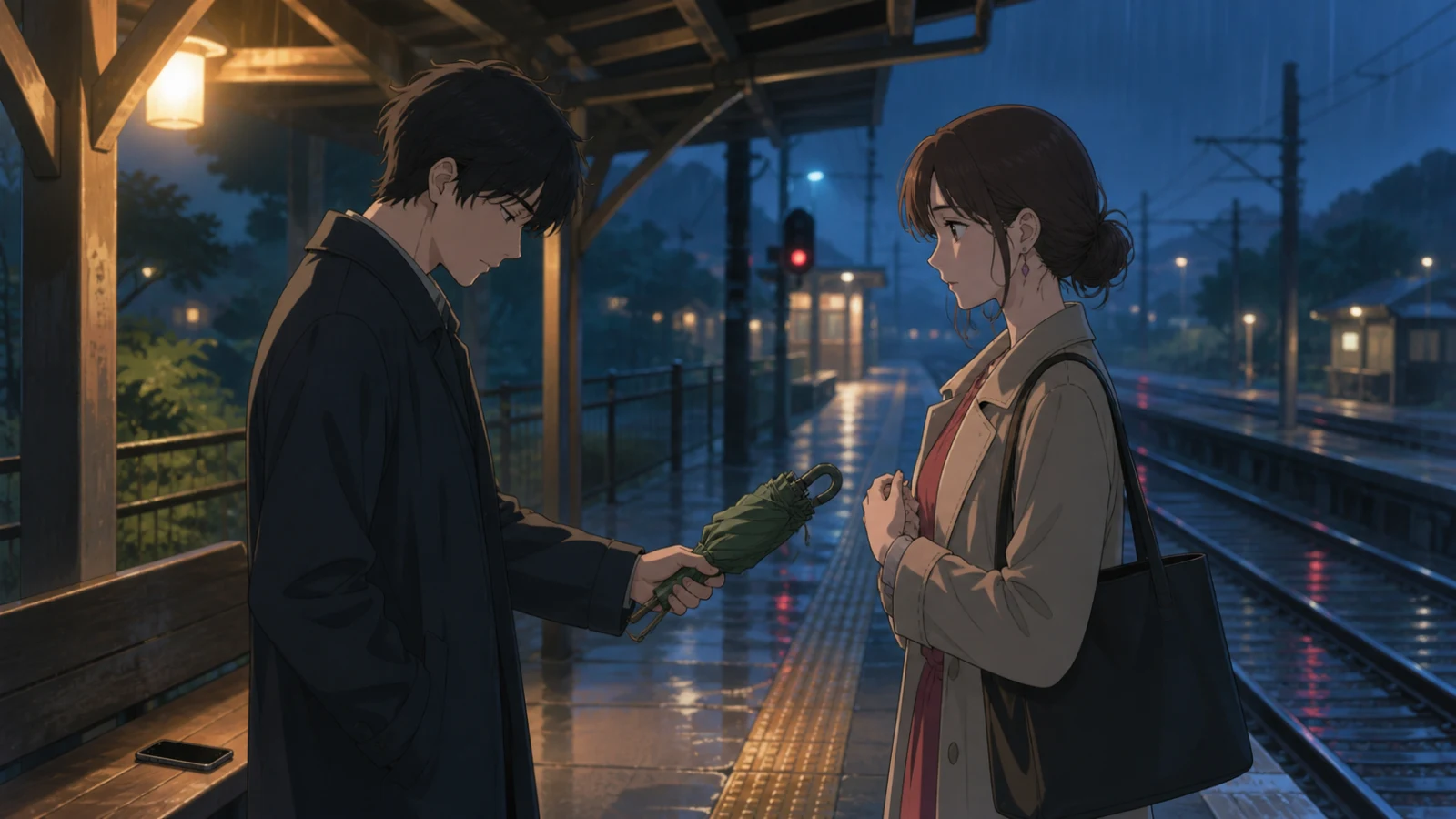
Imagine two characters discussing whether it will rain. On the surface, they are talking about the weather. One wants the other to walk home with them. The other is still hurt by yesterday's argument. The umbrella becomes a safe way to make and test an invitation.
The scene does not need to hide everything. Confusion is not depth. Give the player enough concrete behavior to sense the real issue: a delayed answer, an object held out and pulled back, a familiar nickname replaced by a formal name, or a question answered with a different question.
Then decide when the subtext breaks. A conversation becomes satisfying when something can no longer stay underneath. It might surface as one honest sentence, a refusal, a choice, or a silence that changes what follows.
✂️ Does every line need to stay on screen?
Spoken language contains repetition, filler, false starts, and polite transitions. Fictional dialogue needs some of that texture, but a visual novel asks the player to click through each displayed beat.
Read the scene one box at a time. For every beat, ask:
- Is this a new thought, reaction, turn, or emotional pressure?
- Does the line give the portrait, background, music, or pause room to contribute?
- Is the sentence short because the moment is sharp, or broken up only to create extra clicks?
- Would combining two lines make the exchange feel more natural?
- Would splitting one long line let a reaction land before the explanation continues?
A line break is direction. It controls when the player sees the next expression, hears a sound, notices a background change, or realizes that the other person did not answer.
Avoid making every box the same length. Uniform rhythm feels mechanical. A tense scene may use brief turns and one unexpectedly long confession. A relaxed scene can wander, then snap into focus when a dangerous detail appears.
Use silence carefully. A pause can be an animation, a change in expression, ambient sound without text, or simply a short line followed by no immediate explanation. Writing three dots in every emotional moment makes different silences feel identical.
🔀 Do choices sound like something this protagonist would do?
A choice is part of the dialogue, not a menu attached afterward.
Weak choices often repeat one meaning with different wording, or offer a "good," "bad," and obviously foolish answer. Strong choices express different intentions:
- ask for the truth;
- protect the relationship;
- change the subject;
- challenge the premise;
- reveal a vulnerability;
- stay silent and let the other person continue.
The option text should help the player predict the emotional direction without spoiling the exact line. If the button says "Tell her the truth," the spoken response should feel like that intent, not a surprising insult the player could not foresee.
After the choice, let the conversation remember it. The branch does not always need a separate ending. A changed expression, a later word choice, a small piece of information, or a warmer callback can make the player's intent visible.
Also read every option in the protagonist's voice. If the protagonist is cautious, three suddenly witty menu lines will feel as if a different writer entered the room.
🎭 Can the art and sound carry part of the line?
Visual-novel dialogue is surrounded by performance tools. Use them.
If the portrait already shows anger, the line may not need "I'm angry." If the background reveals that the room is empty, the narrator does not need to inventory every missing chair. If the music has stopped, a plain question can feel more threatening than an explanatory paragraph.
This does not mean replacing clear writing with random effects. Give each change a job. An expression can contradict polite words. A sound can interrupt an avoidance pattern. A background transition can reveal that time passed while neither character solved the problem.
Keep the most important emotional evidence in more than one channel when accessibility or clarity requires it. A critical clue should not exist only in a tiny visual detail or a sound cue the player can miss.
🧪 How do you test dialogue instead of merely rereading it?
Read the scene aloud first. You will hear repeated sentence shapes, explanations nobody would say, accidental tongue twisters, and lines that run out of breath.
Then put it inside the player.
Test one complete conversation and note:
1️⃣ Where did you click before finishing the line?
2️⃣ Where did you wait because the next beat arrived too quickly?
3️⃣ Could you tell what each person wanted before the scene ended?
4️⃣ Did any choice misrepresent the response that followed?
5️⃣ Did an expression, sound, or background repeat information the text already stated?
6️⃣ Could a reader tell who was speaking if the name box disappeared for a few lines?
Ask another person to play without explaining the scene. Do not ask only whether they liked it. Ask what changed, what each character wanted, and what they expected each choice to do. Their answers reveal whether the dialogue communicated its shape.
🌱 How can Novelez help with the dialogue pass?
Novelez is a browser-based, no-code visual-novel creation tool. You can arrange scenes, dialogue, choices, conditions, assets, and timing in the visual editor, then preview the result in the built-in player.
That makes the writing pass concrete. You can place a rough conversation in context, change a portrait on the exact beat where a character's mask slips, compare two choice phrasings, and hear whether a music cue leaves enough room for reading.
The practical order is simple: write the change, separate the voices, find the subtext, direct the screen rhythm, then play the conversation before polishing the rest of the script.
✅ A dialogue revision checklist
Before you call a conversation finished, check:
1️⃣ What changes because this exchange happens?
2️⃣ What does each speaker want, and why can they not ask for it directly?
3️⃣ Can the main voices be distinguished without relying on catchphrases?
4️⃣ Does each text-box beat earn its click?
5️⃣ Do the choices express different intentions and accurately preview the responses?
6️⃣ Are art, expression, sound, and silence doing useful work without duplicating every sentence?
7️⃣ Did the conversation pass both an aloud read and an in-player test?
Dialogue starts feeling alive when the characters stop serving the outline and begin pursuing something from each other. Give them a goal, a reason to hesitate, and enough playable space for the player to notice the difference.
August 9, 2026