Making Visual Novels Without Code: What Should Story Creators Watch in 2026?
July 4, 2026
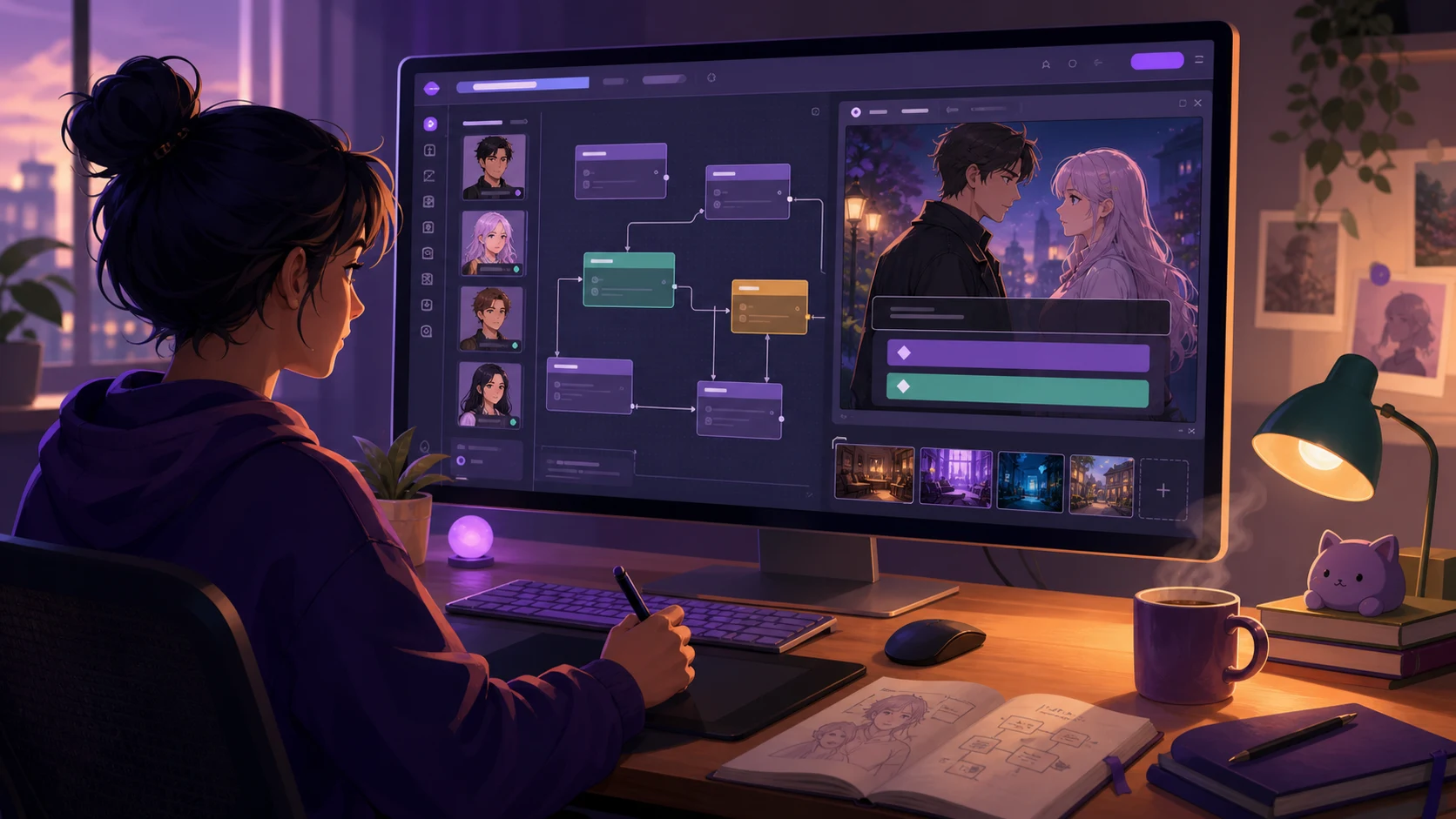
Have you ever had a visual novel idea sitting in your notes for way too long?
You can picture the first scene. You know which character walks in. You know the choice the player should see. You may even know the ending that will hurt in exactly the right way.
And then the practical questions arrive.
Which engine should I use? Do I need to learn scripting? How do I connect branches? Where do I put backgrounds? How do I test choices? What happens if I want to share a tiny playable draft before the whole thing is finished?
That gap between "I have a story" and "someone can play it" is where a lot of visual novel projects quietly stop.
So when people talk about no-code game creation in 2026, I don't think the most interesting question is, "Can tools make everything for us?"
The better question is:
Can more story creators finally reach the playable version of their own ideas?
Because that is the part that feels different right now.
✨ The Big Shift: No-Code Is Moving From Toy to Workflow
No-code game tools used to sound a little unserious to a lot of creators.
Maybe they were fine for simple experiments. Maybe they were good for classroom projects or quick prototypes. But if you cared about story structure, polish, ownership, exports, or long-term editing, you probably still expected to hit a wall.
That wall is getting more interesting in 2026.
Across the game creation space, the conversation has shifted from "Can I make something without code?" to "Can I actually keep working on this after the demo?"
That difference matters.
A prompt toy can be fun for an afternoon. You describe a game, it gives you something playable, and for a moment it feels like magic. But story creators usually need more than a magic trick. They need to revise. They need to add a scene after the first scene. They need to rename a character without breaking half the project. They need to understand what belongs to them. They need to change one choice without regenerating the whole experience.
Visual novels make this especially obvious because the work is never just one asset or one prompt.
It is a chain of creative decisions:
1️⃣ Who is speaking right now?
2️⃣ What does the player know at this point?
3️⃣ Which choice changes the route, and which choice only changes the emotional flavor?
4️⃣ When should the story slow down?
5️⃣ Where does the player feel responsible?
That is why the best no-code tools are not just trying to remove code. They are trying to make the story itself easier to shape.
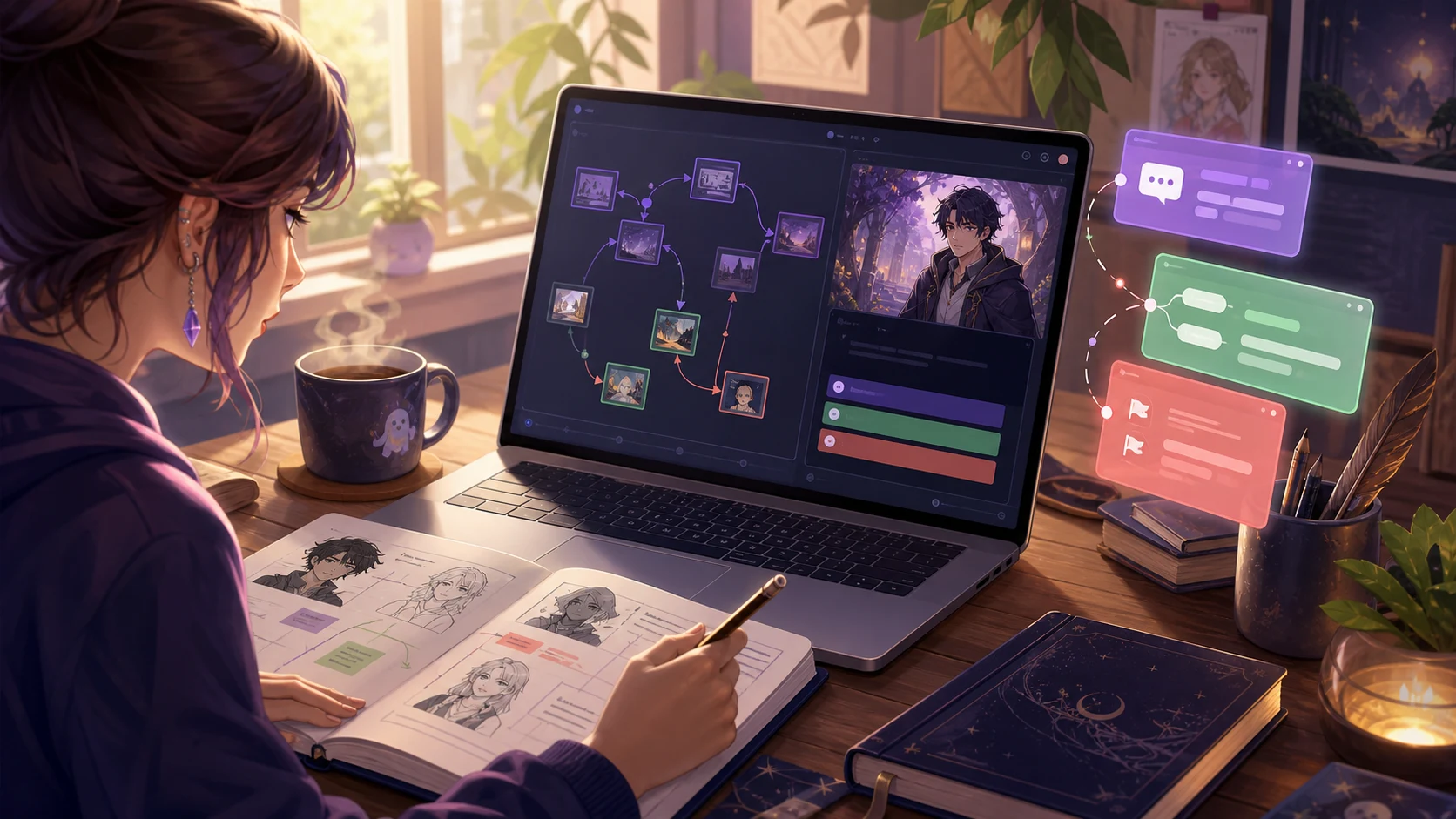
🧭 Story Creators Need a Map, Not Just a Blank Page
If you write prose, a blank document can work. It may be intimidating, but it is still a familiar space. You type the next line. Then the next one.
Interactive stories are different.
The moment a player can choose, your story stops being one straight road. Now it has branches, loops, optional scenes, hidden conditions, route changes, and tiny emotional consequences that may not pay off until much later.
You can absolutely plan that in a document. A lot of creators do. But the further you go, the harder it becomes to feel the shape of the story.
This is where no-code visual novel tools can become genuinely useful.
Not because they make the writing "easy." Writing is still writing. Characters are still hard. Pacing still takes taste. Endings still need care.
But a good tool can make the structure visible.
You can see where a choice leads. You can notice that one route has five scenes while another has one. You can spot the moment where a character disappears for too long. You can test whether the player reaches the scene you thought they would reach.
That visibility is huge for story-first creators.
Because most people do not abandon a visual novel because they dislike the story. They abandon it because the project becomes hard to hold in their head.
When the tool gives you a map, the story becomes easier to keep alive.
🛠️ AI Is Everywhere, But Control Is the Real Feature
Let's be honest: in 2026, AI is part of almost every creative tool conversation.
Game creators are using AI for brainstorming, placeholder art, code help, localization drafts, testing notes, marketing copy, and fast prototypes. New AI game builders and no-code engines keep appearing, and a lot of them promise some version of "describe your game and get a game."
That promise is tempting.
It is also incomplete.
For a visual novel creator, the important question is not just whether AI can produce material. It clearly can. The important question is whether the creator still has control over the work.
Can you edit the scene directly?
Can you keep the branch logic?
Can you replace a rough draft with your own line?
Can you choose when AI helps and when it stays out of the way?
Can you tell what is yours, what is assisted, and what needs disclosure?
Those questions are becoming more important because audiences are also changing. People are more aware of AI-generated content now. They can feel the difference between a story that was shaped with intention and a pile of generated material that nobody really owned.
So the winning tools for story creators may not be the loudest auto-generators.
They may be the tools that say:
You stay in charge. We help you move faster.
That is a much healthier promise.
🎮 The First Playable Scene Matters More Than the Perfect Plan
There is a moment every visual novel creator needs to reach:
Someone else clicks through the scene.
Not reads the outline. Not listens to you explain the route. Not says the character concept sounds cool.
Actually clicks.
That is when you learn things you cannot learn from a document.
You learn whether the opening is too slow. You learn whether the first choice feels meaningful. You learn whether the player understands who the characters are. You learn whether the joke lands, whether the tension survives, whether the branch feels like a real consequence or just a menu option.
This is why no-code creation matters so much for visual novels.
If it takes weeks to reach the first playable scene, you may over-plan yourself into exhaustion. You keep polishing an idea that has never been touched by a player.
But if you can build one scene, preview it, adjust it, and share it quickly, the project changes shape.
Now you have a loop:
1️⃣ Write a small scene.
2️⃣ Add a choice.
3️⃣ Preview it.
4️⃣ Share it with one person.
5️⃣ Learn what to fix.
That loop is where momentum comes from.
It is also where a creator starts to feel like, "Oh, this is real."
🌱 Small Creators Are Building in Public
Another trend worth watching is how small creators are working.
A lot of indie projects no longer grow in private until some perfect launch day. They grow through screenshots, playable snippets, Discord feedback, itch.io builds, short clips, devlogs, and tiny public updates.
That does not mean every creator has to become a full-time marketer. Please, no.
But it does mean the first shareable version matters.
For story creators, a playable scene is more powerful than a pitch. A short branch with one real choice can show tone, pacing, character chemistry, and mood better than a paragraph ever could.
This is especially true for visual novels because the experience is not just the script. It is the script plus timing, layout, backgrounds, character presence, and the feeling of making a choice.
No-code tools fit this style of work because they lower the cost of showing something early.
You do not need to wait until you understand every part of an engine. You do not need to build a complete game before anyone reacts. You can test the smallest playable unit and let that feedback guide the next one.
For many creators, that is the difference between "maybe someday" and "I posted the first scene tonight."
🧩 The Tool Should Match the Kind of Story You Are Making
Here is the part that is easy to skip: not every no-code tool is good for every creator.
Some tools are made for platformers. Some are made for 3D prototypes. Some are made for party games, education, mobile loops, or general game logic.
Those can be great tools. They may still be the wrong home for a visual novel.
If your project is story-first, you should look for different things.
You want choices that are easy to connect. You want scenes that are easy to reorder. You want character and background management that does not fight you. You want preview to be fast. You want publishing or sharing to be simple. You want the tool to understand that a branching conversation is not the same thing as a physics puzzle.
Most of all, you want a tool that lets you think like a story creator.
That means the interface should help you answer questions like:
1️⃣ What happens before this choice?
2️⃣ What changes after this choice?
3️⃣ Which route is the player on?
4️⃣ What does this character know right now?
5️⃣ Can I test this exact moment without replaying everything?
Those are visual novel questions.
When a tool is built around those questions, the creator spends less energy translating the story into someone else's technical model.
💜 The Human Hand Still Has to Stay Visible
There is a reason visual novels survive every tool shift.
The format is simple enough for small creators to enter, but expressive enough to carry huge feelings.
A visual novel can be built from a few backgrounds, a handful of character sprites, and a dialogue box. But that does not make it shallow. It means the creator's choices are more exposed.
One pause matters. One line matters. One branch matters.
That is why no-code tools should not erase the person behind the story.
They should make that person more visible.
The creator should still decide what the scene means. The creator should still decide what the player is allowed to know. The creator should still decide whether a choice is kind, cruel, funny, manipulative, or quietly devastating.
AI can help draft. Templates can help organize. No-code workflows can remove setup pain.
But the taste has to come from somewhere.
In a good visual novel, you can feel the creator arranging the emotional pressure. You can feel that someone cared about the exact moment a choice appeared. You can feel that the ending was not just generated; it was aimed.
That human hand is not a weakness.
It is the reason the story works.
🚀 Where Novelez Fits in This Trend
Novelez is built for the creator who has a story but does not want the technical setup to become the whole project.
The idea is simple:
If you can think in scenes, characters, and choices, you should be able to make a playable visual novel.
That does not mean the tool writes the story for you. It means the tool gives your story a place to become interactive.
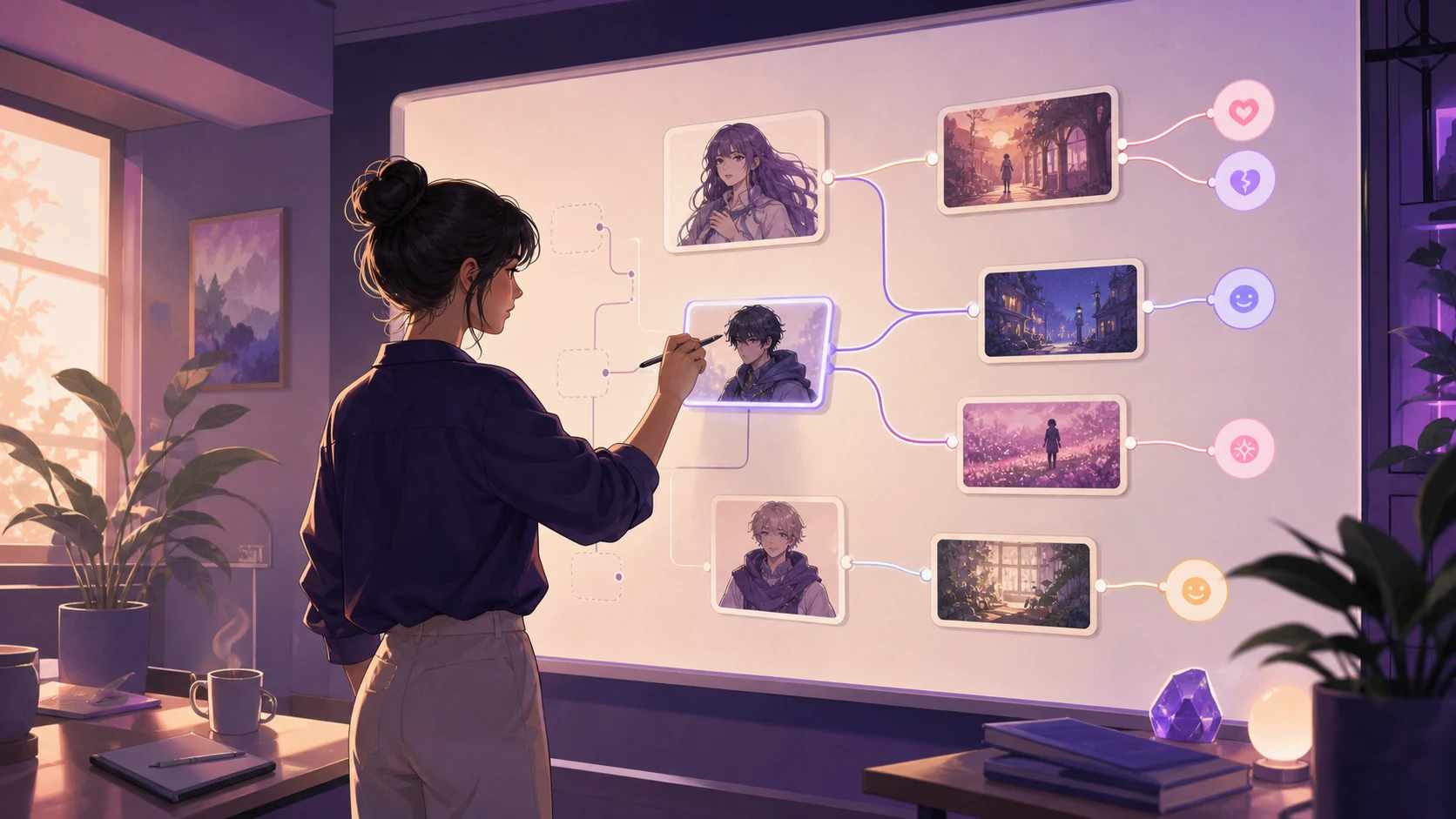
You can build scenes, connect choices, manage characters and backgrounds, preview the flow, and share the result as something people can actually play. The point is not to make the creator disappear. The point is to help the creator reach the playable version faster.
That is why no-code visual novel creation feels so important in 2026.
The market is full of tools that promise speed. Speed is useful. But for story creators, speed is only valuable when it protects control.
The real win is not "I generated a game."
The real win is:
1️⃣ I finally made the scene.
2️⃣ I tested the choice.
3️⃣ Someone played it.
4️⃣ Now I know what to write next.
That is a creative loop worth building around.
🎬 So, Should You Start With No-Code?
If you are a story creator, yes, at least try it.
Not because no-code tools magically solve writing. They don't.
Try it because a playable scene teaches you different things than a notebook does.
Start small. One location. Two characters. One choice. One ending, or maybe two if you are feeling brave.
Do not begin by planning a giant route map that scares you away from your own idea. Begin with the smallest piece that lets someone feel the story.
In 2026, the creators who benefit most from no-code tools may not be the people trying to automate every part of making a game.
They may be the people who use better tools to stay closer to the story.
And if your visual novel has been sitting in your notes for months, that might be the sign you need.
Make one scene.
Let it become playable.
Then listen to what the scene teaches you.
July 4, 2026