Steam's Personal Calendar Is Now Permanent: When Should Your Visual Novel Show Its Release Date?
October 27, 2026
If your visual novel already has a Coming Soon page on Steam, you've probably wondered when to commit to an exact release date. On October 23, Valve moved the Steam Personal Calendar out of Steam Labs and made it a permanent part of the store, and it published developer documentation alongside it that makes the timing question a lot more concrete. The calendar first appeared as a Labs experiment in October 2025, and Valve says it spent eleven months refining it with feedback from players and developers.
The new Personal Calendar documentation spells out which games appear, for whom, and from when. Below I keep what the documentation says apart from my own reading of it, and finish with a release-date schedule for a small visual novel.
Where does the calendar show up, and how far ahead does it look?
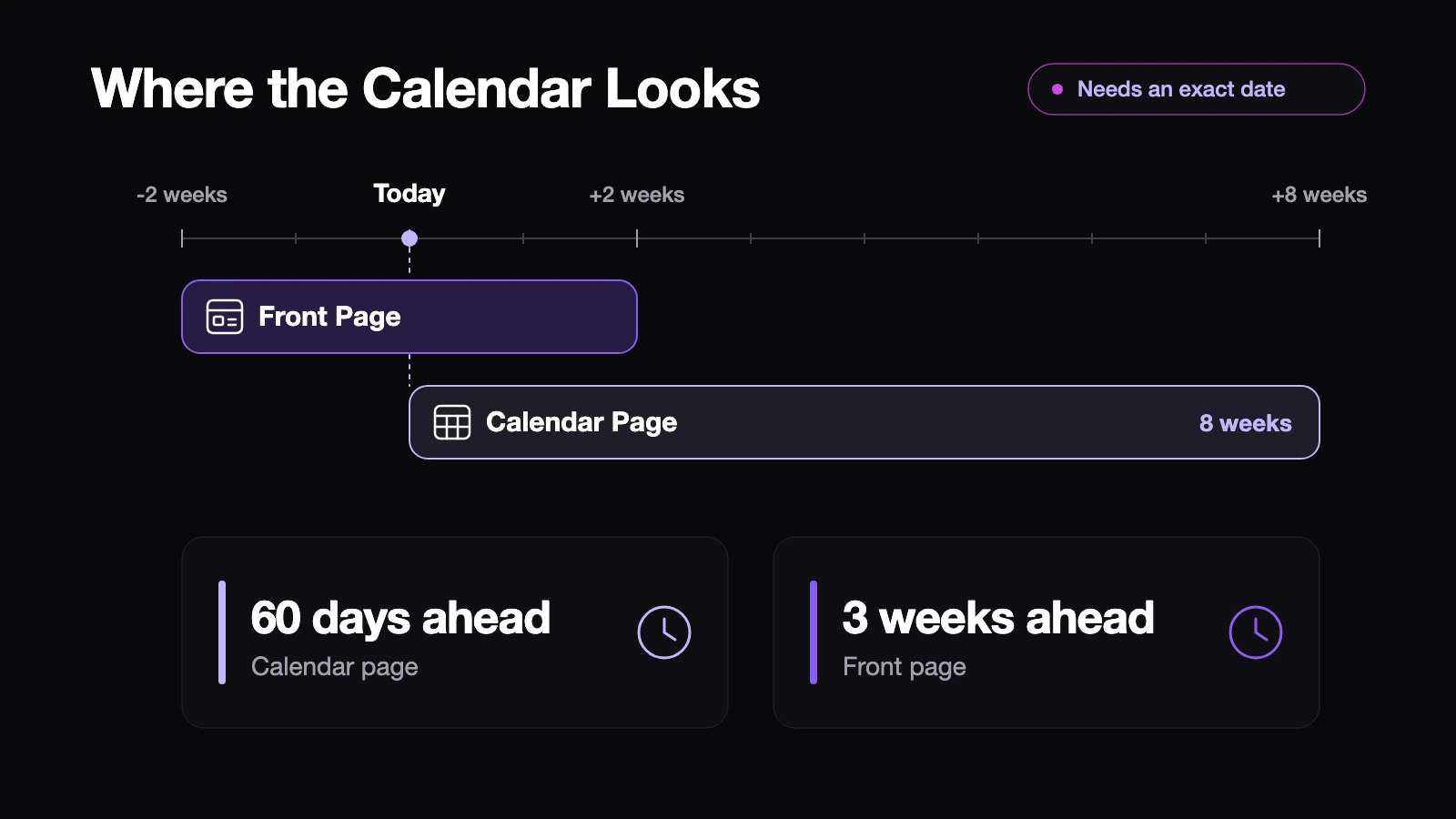
Two places. On the Steam store front page, the calendar covers this week plus two weeks back and two weeks ahead. On its own dedicated page it covers eight weeks. There is no single calendar that everyone sees; each player gets one built for them. Valve's announcement says nobody pays for placement and that nothing on the calendar is hand-picked.
To be eligible, a game needs a visible Coming Soon page with a specific release date, whether it's a full launch or a move from Early Access to 1.0. Once a game qualifies, it can start showing up within about a day. Valve also gives two lead times as a tip: set your date at least 60 days ahead to qualify for the dedicated calendar page, and at least three weeks ahead to qualify for the front page.
How does a game land on someone's calendar?
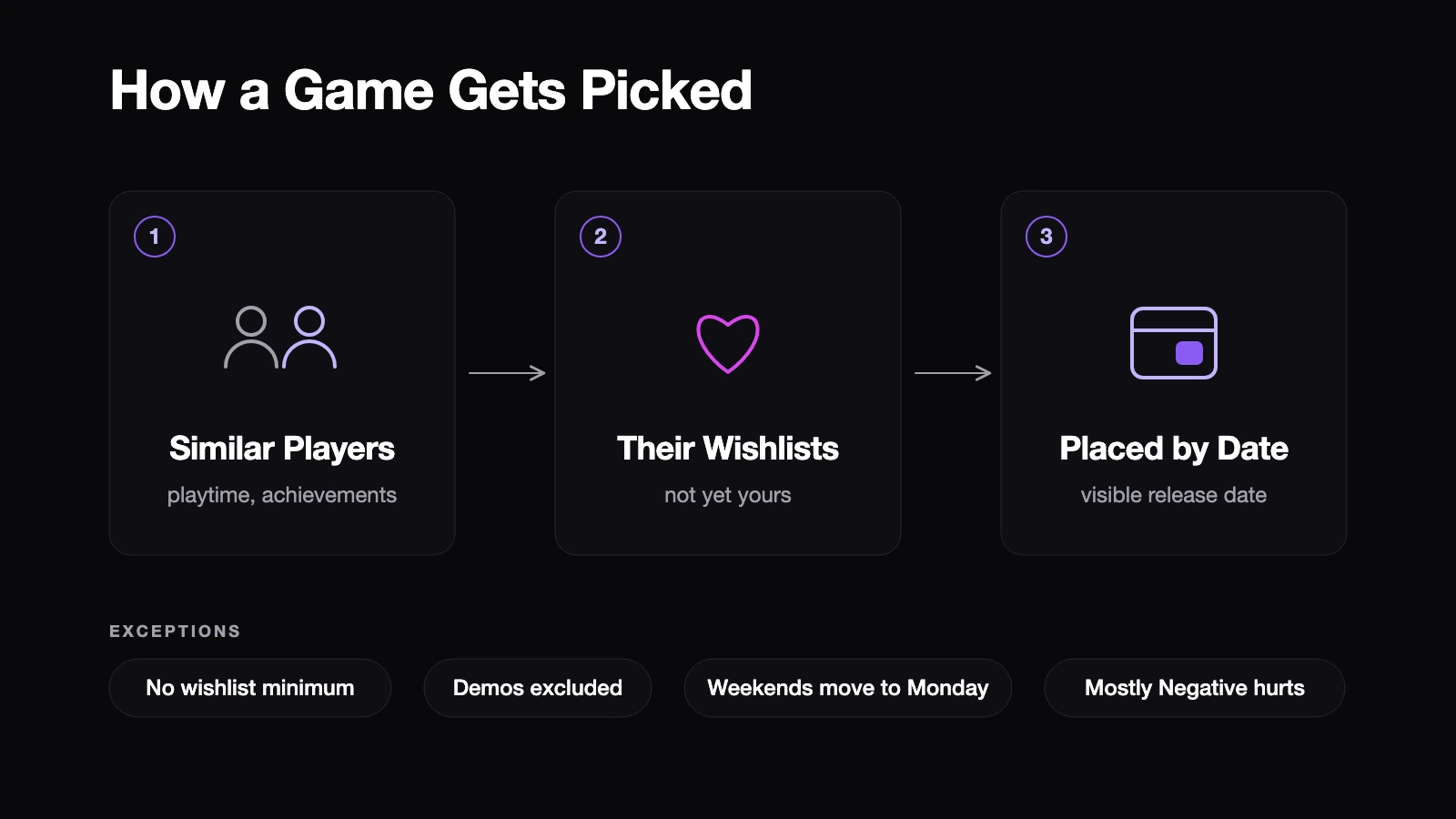
The documentation describes three steps. First, the system finds players with tastes similar to a given player, looking at which games they play, how much they play them, how that playtime compares with other players, and how many achievements they've earned. Second, it picks games those similar players have wishlisted that this player hasn't. Third, it places those games on the calendar by their visible release date.
More wishlists make an appearance more likely, but there's no minimum to clear. Valve says it checks that the wishlists it counts come from real, valid accounts. It also notes that a game with a public date that's within five weeks of launch may already be sitting on some players' calendars.
A few exceptions matter for visual novel makers:
- Demo apps never appear. The calendar works from the full game's release date.
- DLC shows only to players who own the base game.
- A game whose review score falls to Mostly Negative becomes much less likely to be recommended.
- The calendar shows weekdays only, so a Saturday or Sunday release is placed on the following Monday.
- Players who already wishlisted your game see it automatically, unless they've chosen to hide wishlisted games.
Valve's announcement adds that on an average day, players click on more than 2,000 different games in the calendar. Valve offers that number as evidence that people dig well past the obvious hits.
What happens if you delay?
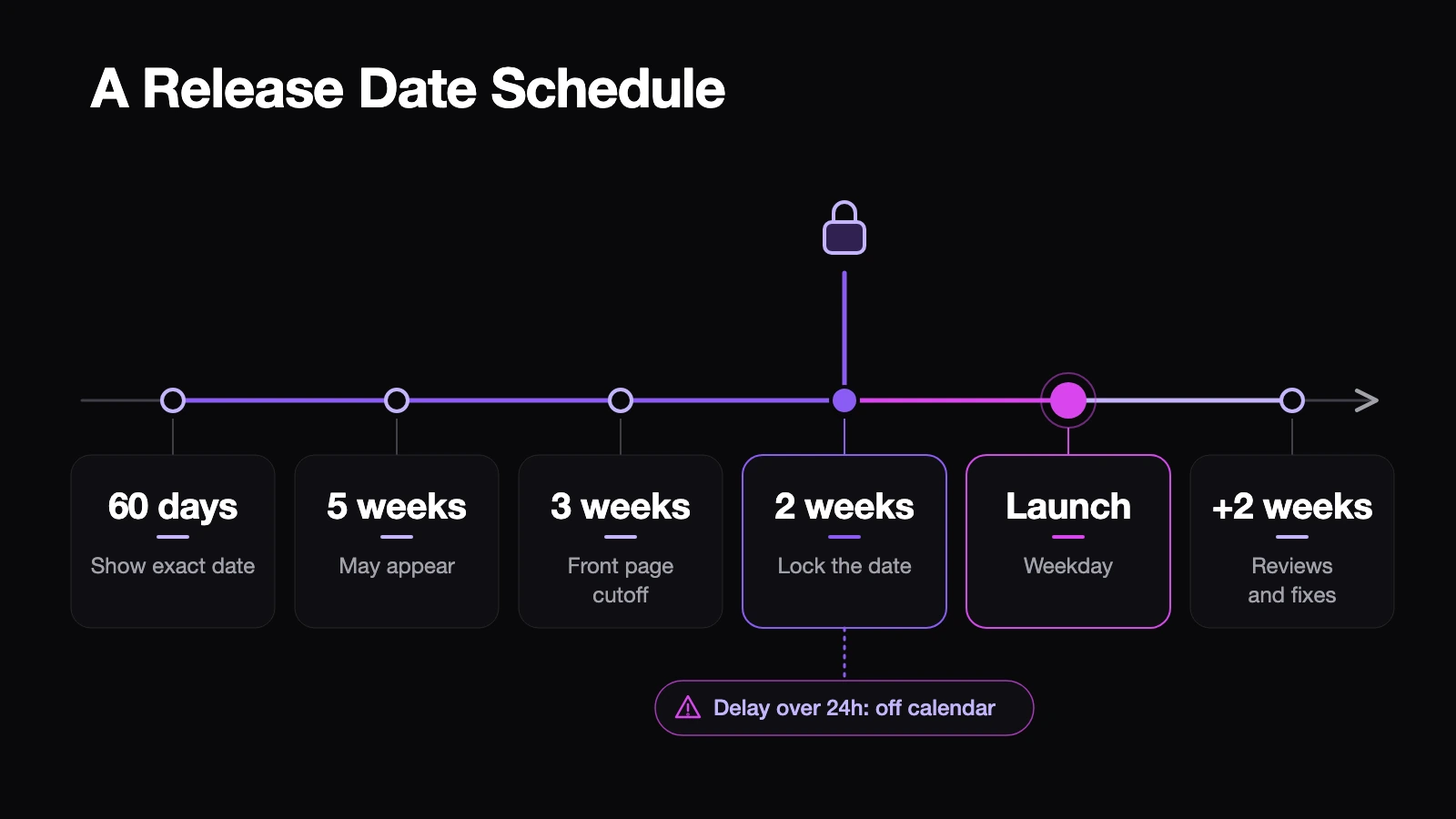
This is the part to plan around. According to the calendar documentation, once your game is within two weeks of launch, pushing the date back by more than 24 hours removes it from the calendar, and it won't come back until the game actually releases. Shifts under 24 hours don't matter, and moving the date earlier doesn't hurt.
Steamworks' release dates documentation is stricter still. It says you can change the date up to two weeks before it. Inside that window, upcoming-release visibility ramps up and the date can no longer be adjusted. Read together, the two pages point to the same rule: your build should be ready enough to lock the date two weeks out.
The same release dates page lists five ways to show the date on the store: an exact date, month and year, a quarter, a year, or no date at all. Behind the scenes you still enter an exact intended date that players don't see. A month-only display sorts your game as if it launched on the last day of that month, and a quarter sorts it to the last day of the quarter. The calendar page asks for a "specific release date" and doesn't say whether a month or quarter display counts. My reading is that switching to the exact date is the safe move once you want calendar exposure. That's an inference from the wording, not something Valve has stated.
What schedule would I use for a small visual novel?
These are my recommendations, built from the numbers on both pages rather than from any process Valve prescribes:
- 60 days out: if you trust your build, publish the exact date. That buys time inside the dedicated page's eight-week range.
- 5 weeks out: with a public date, you may already be on some calendars. Have the store description, screenshots and a Coming Soon announcement ready before this point.
- 3 weeks out: the last point for front-page eligibility. Without an exact date by now, you risk missing the front-page calendar.
- 2 weeks out: lock the date. A later delay drops you off the calendar.
- Launch day: pick a weekday. Weekend launches slide to Monday, and the Steamworks date picker won't let you schedule a weekend in advance anyway.
- The first two weeks after launch: the front-page calendar still shows releases from two weeks back, so keep that stretch clear for early reviews and urgent fixes.
Solo developers who can't commit 60 days out shouldn't force it. Show a month to set expectations, then switch to the exact date at least three weeks ahead. The smaller your wishlist count, though, the more each extra appearance in front of similar players is worth. Treat the two-week lock as a hard deadline in your build schedule, not a soft one.
If you've launched a visual novel on Steam, how many weeks ahead did you publish an exact date? And if you've noticed any change in wishlists or store visits since the calendar became permanent, I'd like to hear about it.