What Do the IFComp 2026 Results Tell Visual Novel Makers About Entry Length?
October 26, 2026
The Interactive Fiction Competition, better known as IFComp, posted its 2026 results on October 24. Members of the public rated 71 entries between September 1 and October 19, and the top three were SCAVS by David Hunter, Tableaux Vivants by Lamp Post Projects, and The Count and the Communist by Tristan Pun.
IFComp isn't a visual novel event. Still, choice-based games compete on the same table as parser games, and the official results page lists each entry's genre, estimated play time, format, average score and vote count. That makes it one of the few public datasets where you can see how a crowd of judges reacted to story games of very different lengths.
I went through all 71 entries, plus the 85 from 2025, with one narrow question in mind. If you plan to put a short visual novel into a judged event like this, what should you decide about its length and its opening stretch? The numbers below come straight from the official results pages. The reading of them is mine, and I'll say so where it matters.
Who finished at the top in 2026?
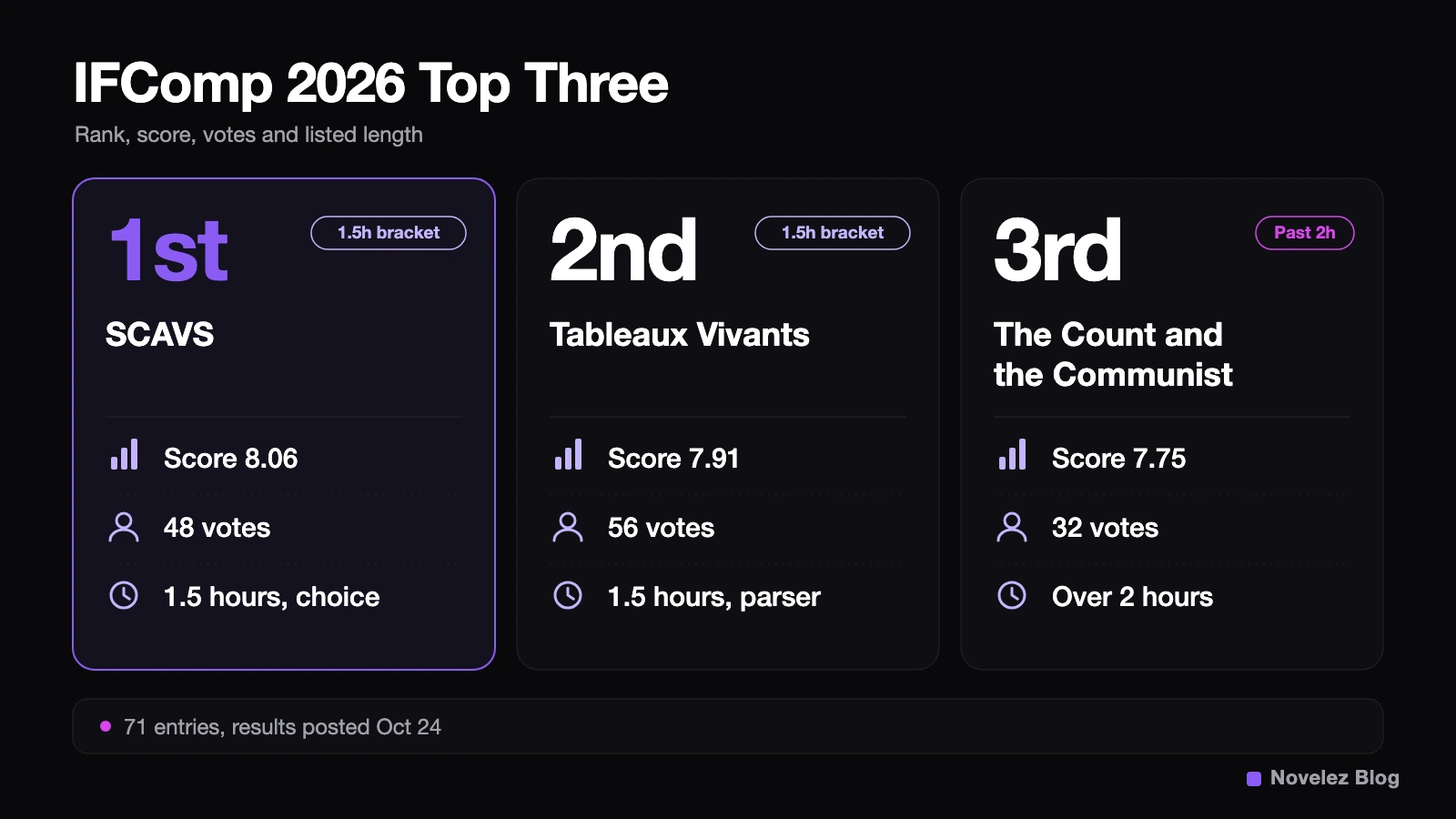
SCAVS won with an average of 8.06 from 48 votes. The author describes it as a choice-based game with a parser-style open world to explore, estimated at an hour and a half. Tableaux Vivants placed second with 7.91 from 56 votes. It is also listed at an hour and a half, it's parser-based, and it comes with in-game hints plus a companion website holding a walkthrough, a command list and a map.
The Count and the Communist took third with 7.75 from 32 votes. It is listed as longer than two hours, and it collected two side honors as well: first place in the Miss Congeniality Awards, where authors vote on each other's games, and the Rising Star award for its author.
Two of the top three sit in the same length bracket. The third runs past the point where judging stops, which brings us to the rule that shapes every entry.
Why does the two-hour rule matter so much?
The IFComp rules say judges must base their rating of each game on at most the first two hours of play. A judge who is still playing at the two-hour mark has to rate the game then and can't change that rating later. Authors may write a game of any length, the rules add, but they should keep this in mind.
Two other rules affect who sees what. A judge's ratings only count once that judge has rated at least five games. And judges aren't obligated to replay an updated version of an entry they've already downloaded, started or rated.
Put together, a long entry is judged on its opening two hours, and a late fix may never reach the people who already have your first build. The Count and the Communist proves a long game can still land near the top. Its score, though, reflects what judges saw before their two hours ran out.
What do the length brackets show?
Here is the 2026 table grouped by the play time each author listed. "Top ten" here means places one through ten, which covers 11 entries because two games tied for tenth.
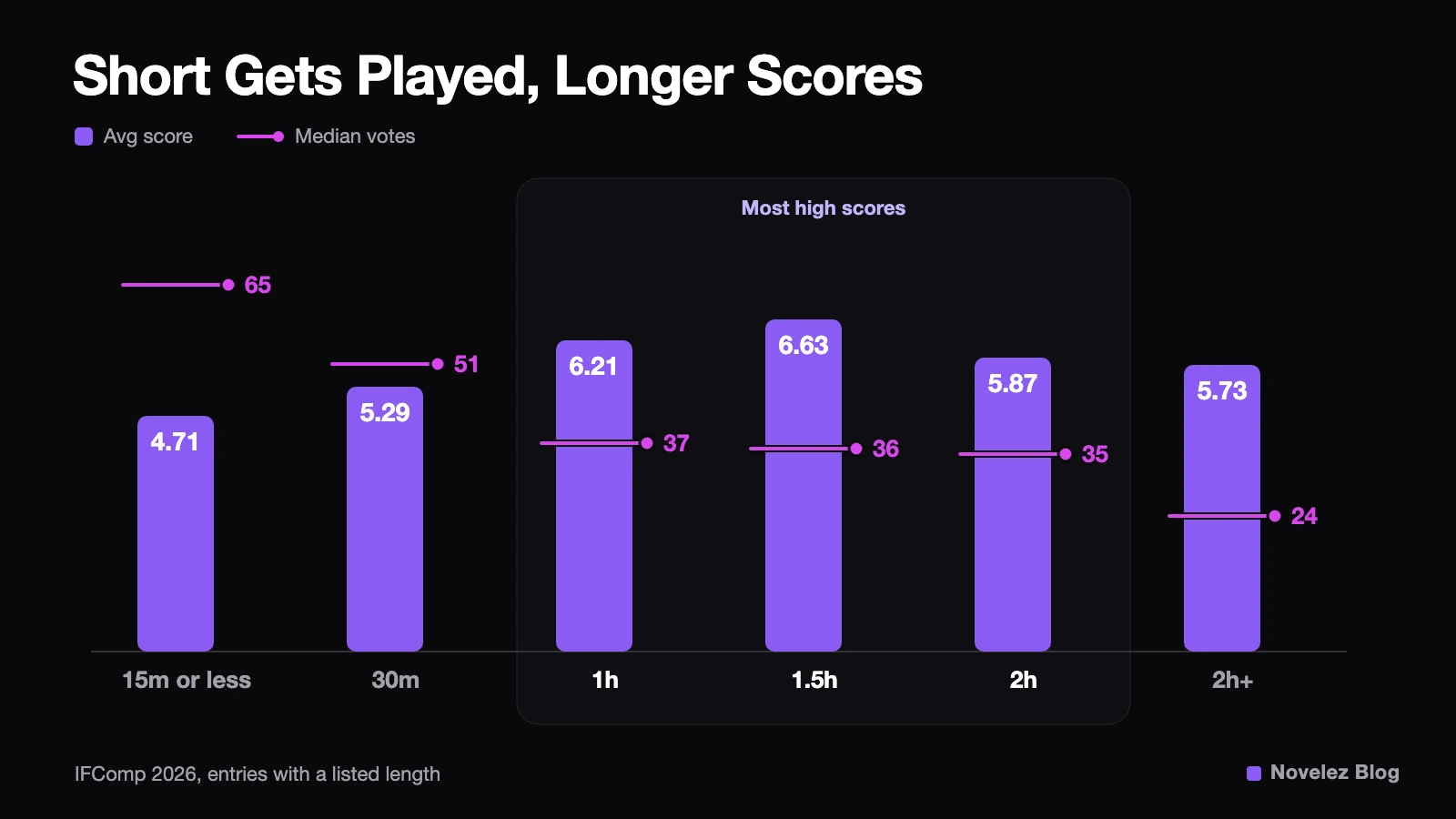
- 15 minutes or less: 13 entries, average score 4.71, median 65 votes, none in the top ten
- Half an hour: 12 entries, average 5.29, median 51 votes, none in the top ten
- One hour: 14 entries, average 6.21, median 37 votes, two in the top ten
- An hour and a half: 5 entries, average 6.63, median 36 votes, three in the top ten
- Two hours: 11 entries, average 5.87, median 35 votes, four in the top ten
- Longer than two hours: 8 entries, average 5.73, median 24 votes, one in the top ten
Eight entries didn't list a length. The 2025 results follow the same shape. Of 85 entries that year, the 33 listed at half an hour or less averaged 5.24 and none reached the top ten, while the 45 listed between one and two hours averaged 6.33. The 2025 winner, Detritus, was listed at two hours.
The vote counts run the other way. The three most-rated entries of 2026, with 86, 81 and 79 votes, were all listed at 15 minutes or less. Short entries get played far more often. They just score lower on average.
Format matters less than people sometimes assume. Choice-based entries were the largest group in 2026 with 36 entries and an average of 5.74, against 22 parser entries averaging 5.18, and four choice-based games made the top ten. A visual novel built on menus isn't starting from behind just because of its format.
How should you read those numbers?
Carefully. Two years of results show a pattern, not proof that adding length raises a score. Several explanations fit the same table. Judges who need five ratings may fill out their list with quick entries and rate those more casually. Short entries are often experiments or first projects. And an average of one-to-ten ratings tends to reward games that leave a fuller impression, which is harder to do in ten minutes.
My reading is that one to two hours is where most high scores sit, but plenty of entries in that range also landed mid-table. Length gives a story room to work. It doesn't earn the score by itself.
The vote counts also suggest a second goal you might care about more. If what you want is for many people to finish your visual novel and tell you what they thought, a short entry reaches more players. Decide which of the two you're after before you pick a length.
What would I plan for the next judged event?
These are my recommendations, built from the rules and the tables above rather than from anything the organizers prescribe:
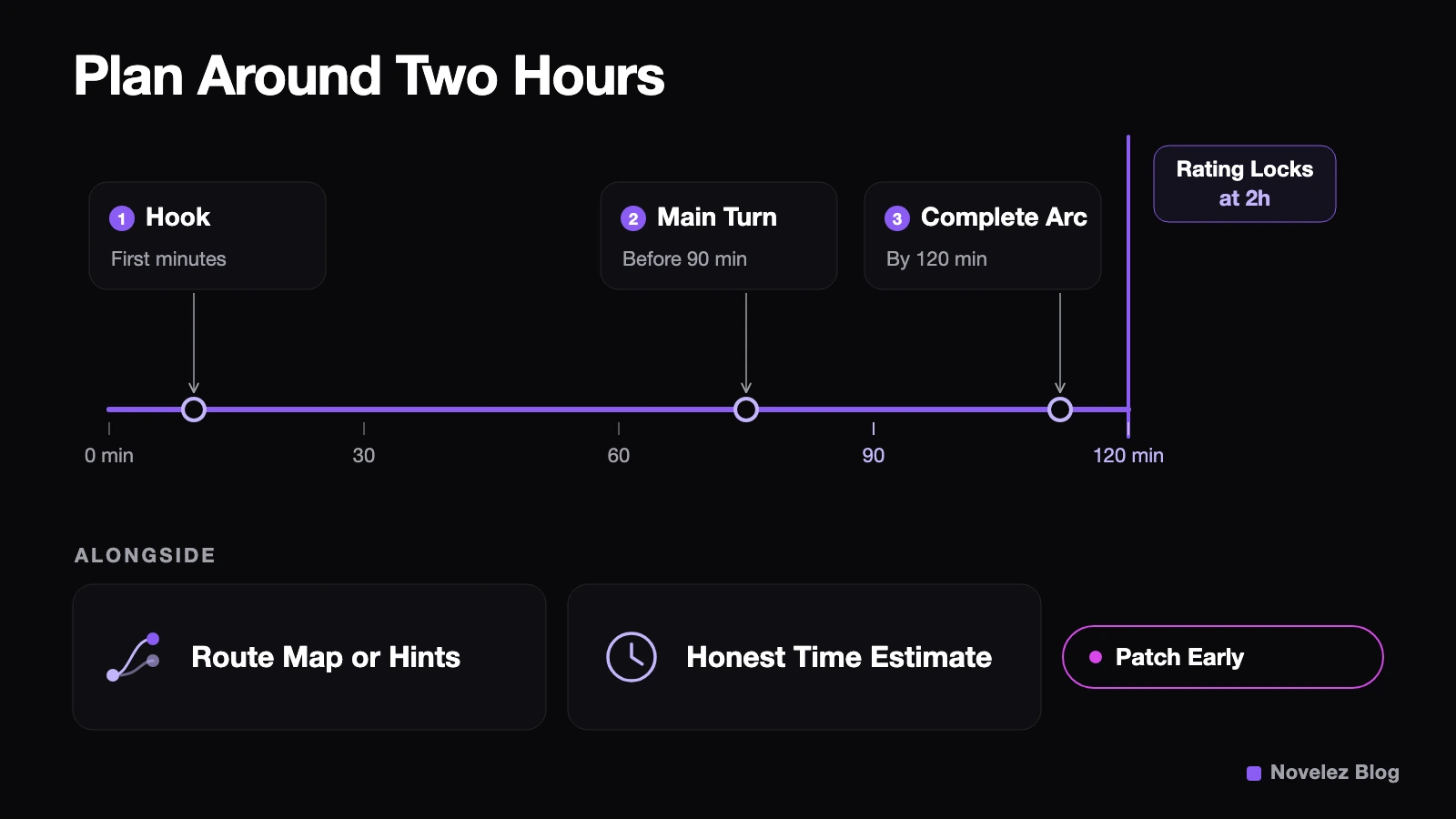
- Aim the main route at roughly one to two hours, and place the turn the story depends on inside the first ninety minutes, so a judge who stops at two hours has seen it.
- If your visual novel runs longer, make the first two hours stand on their own. A chapter ending or a reveal near that mark gives judges a complete arc to rate.
- Ship help with it. Tableaux Vivants paired its puzzles with hints and a walkthrough site. For a visual novel the equivalent is a short route map, or a note saying how many endings exist and roughly how to reach them, so nobody spends their two hours stuck on one branch.
- Put an honest play-time estimate on the entry page. Judges plan around it, and the results page keeps it next to your score for good.
- Fix serious bugs before judging opens. Judges may stick with the version they downloaded first.
If you've entered a jam or competition with a visual novel, how long was your entry, and did most of the useful feedback come from people who reached an ending or from people who stopped early?