How Do You Turn a Web Novel into a Visual Novel?
August 22, 2026
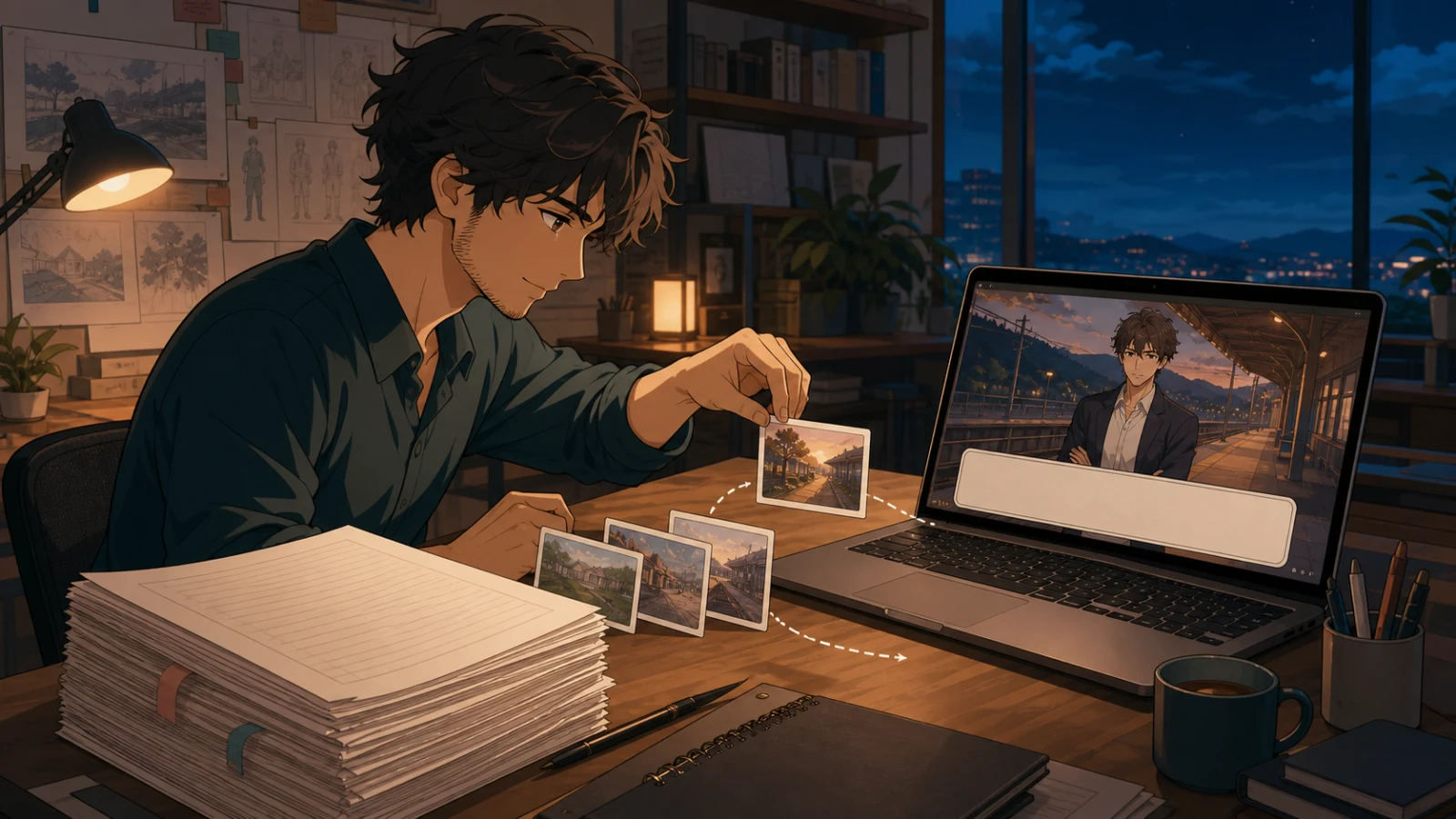
You already have the difficult part: a story with characters, conflict, and enough finished prose for readers to care about what happens next. Turning that web novel into a visual novel can look like a straightforward transfer. Put the dialogue in a text box, generate a few character images, add choices, and call the chapter playable.
That approach usually produces an illustrated transcript, not an adaptation. A web novel controls attention through paragraphs. It can stop for history, summarize a month, describe a room from several angles, and move invisibly through a character's thoughts. A visual novel presents one screen and one beat at a time. The reader sees the background, watches characters enter and react, hears music, and decides when to advance. Text still carries the story, but it now shares the work with staging and time.
The goal is therefore not to preserve every sentence. It is to preserve the reason the reader kept going, then rebuild that experience with fewer words and more visible decisions.
Choose an arc, not the whole series
Do not begin by converting chapter one because it is first. Begin with the smallest stretch that changes something and can stand on its own. A character arrives wanting one thing, meets resistance, and leaves with a new problem, decision, or relationship. That might be one chapter, three short episodes, or half of a longer installment.
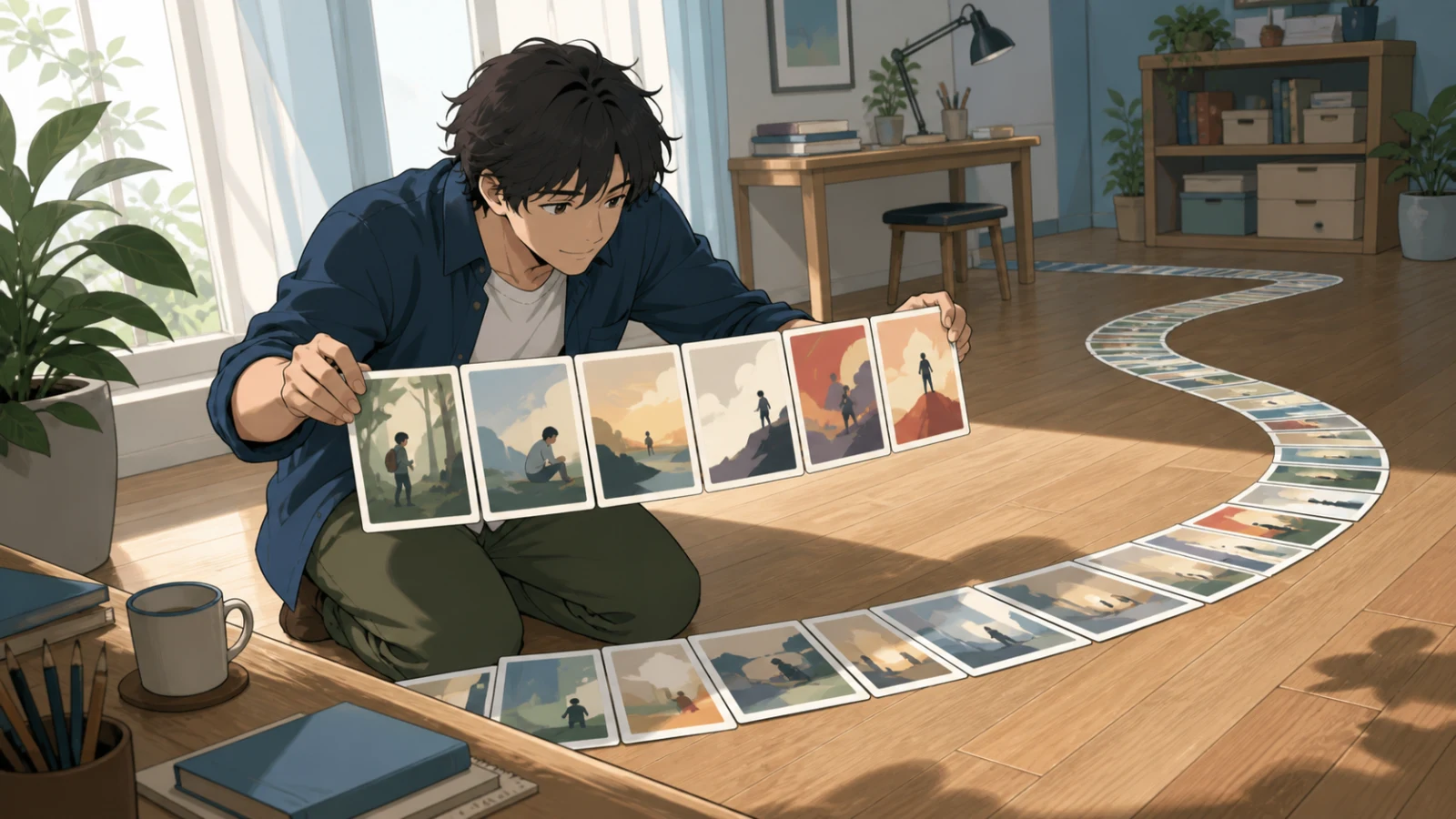
Web novels often open with information that pays off much later: family history, power systems, a map of factions, or several introductions. Serial readers accept that investment because they expect a long run. Someone opening a playable link needs a nearer destination. If the first public section ends before any relationship or situation changes, the adaptation feels like a setup screen that happens to contain dialogue.
Write the selected arc on one page. List the starting condition, the disruption, the decision or reversal, and the final image. If you cannot state those four points without summarizing the entire series, choose a narrower thread. Side characters and lore can wait. They are not deleted; they remain available for the next section after the first one proves it can hold attention.
This is also a production decision. A contained arc reveals how many locations, character poses, expressions, music cues, and scene transitions the adaptation actually needs. Converting twenty chapters before learning that your basic scene rhythm is tiring creates a large revision problem. Adapting one complete unit creates a useful prototype.
Break prose into playable beats
A novel chapter is not automatically a scene. One chapter may contain breakfast, a train ride, a memory, and a confrontation. Conversely, a single conversation may deserve several visual states as people enter, sit, avoid eye contact, and finally speak plainly.
Mark a new playable scene when at least one of these changes: location, time, the people present, the immediate objective, or the emotional pressure. Then divide each scene into beats. A beat is the smallest moment where the screen or the reader's understanding should change. Someone enters. A harmless question exposes a lie. The music drops out. The protagonist notices the object they were avoiding.
This beat list becomes the practical script. For every beat, note who speaks, what the reader sees, what sound changes, and what new fact or feeling lands. Ren'Py separates narration and character dialogue into compact say statements, and scene or character changes are explicit actions around those lines. Other tools use cards or nodes, but the editorial question is the same: does this line deserve its own click, and does the screen give it anything?
Do not make every sentence a click. Three fragments that form one thought can stay together. Do not make every paragraph a screen either. A long block that contains a reaction, a discovery, and a decision has buried three beats in one box. Read the rough scene while tapping through it. The hand quickly notices rhythm that the manuscript view hides.
Let the screen carry what it can
Prose tells readers that the station is nearly empty, that Mina is trying not to look at the clock, and that rain has darkened one shoulder of her coat. A visual-novel scene can show the empty platform, change Mina's expression, place her away from the other character, and use the wet coat as part of the sprite or a special illustration. Repeating all of that in narration makes the screen feel decorative.
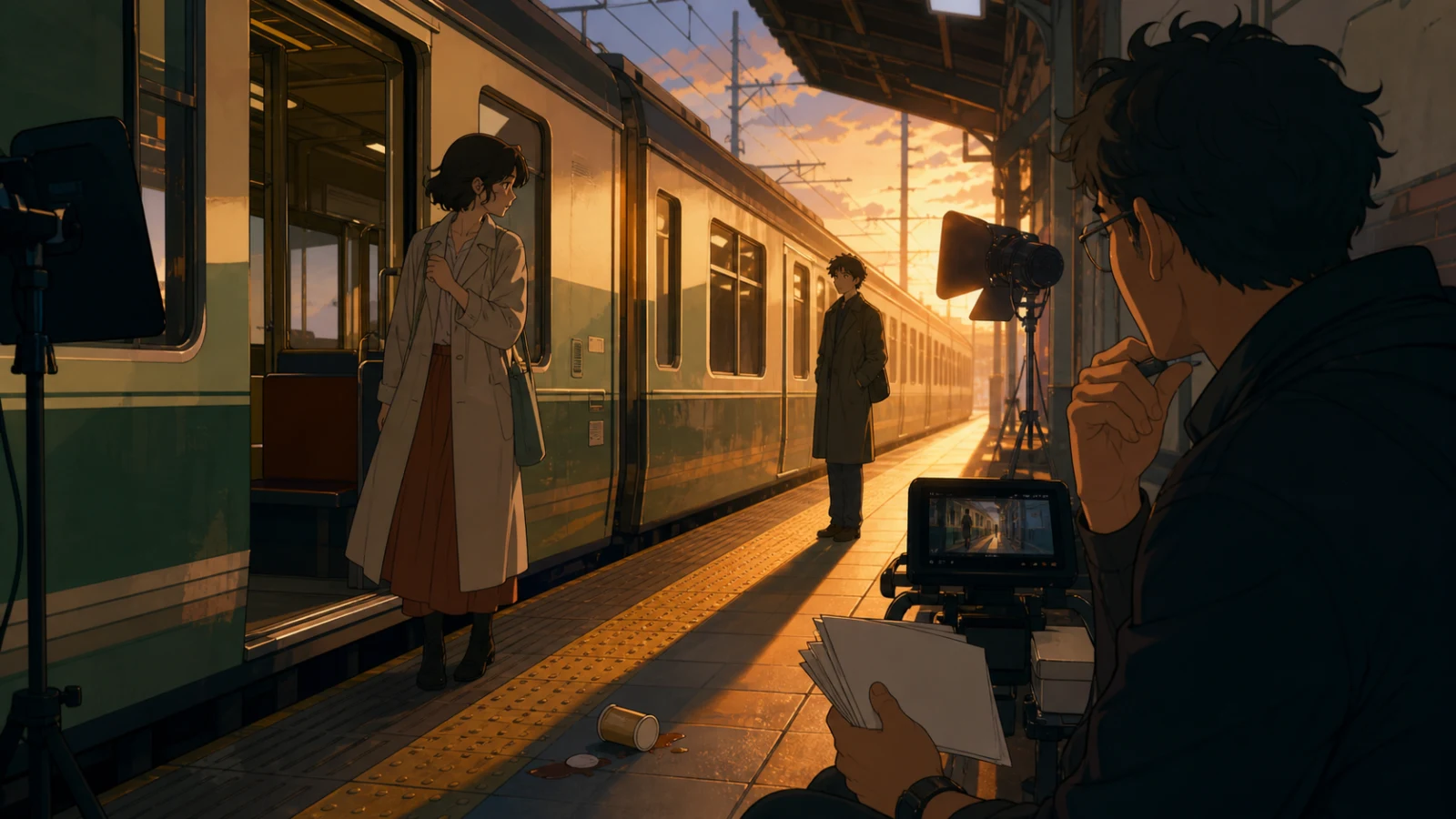
For each descriptive passage, sort details into three groups. Keep words that reveal private interpretation, memory, or a connection the image cannot make. Move visible facts into background, pose, expression, prop, or transition. Remove details that were useful once but no longer affect this scene.
Internal narration still belongs in a visual novel. The mistake is not using it; the mistake is asking it to describe what the reader is already staring at. “The platform was empty” adds little when the platform is visibly empty. “I had chosen the only platform where she could not avoid me” changes the meaning of the image and earns its space.
Dialogue needs a similar pass. Novel dialogue is surrounded by tags and action prose that identify tone. On screen, the nameplate identifies the speaker and the expression can carry part of the attitude. Cut routine tags, but keep actions that change the power in the scene. A character turning a key, blocking a doorway, or setting down an unopened letter is not decoration. It is an event.
Build an asset plan from recurrence
Do not illustrate every paragraph. Build a small visual vocabulary that can support the whole selected arc.
Start with locations. Count the places where a scene actually occurs, then ask whether two can share a background through framing, lighting, or time-of-day changes. A bedroom at dawn and at night may be one base background with two treatments. A café mentioned in a memory does not need art if the memory stays in a few lines of narration.
Next count characters by screen time, not by importance in the full novel. The legendary founder who shapes the world's history may need no sprite in this section. The station clerk with six lines might need one because the conversation is staged face to face. Give recurring characters a neutral pose and only the expressions that the chosen arc uses. Add more after the prototype proves the need.
Reserve special illustrations for moments where composition itself matters: a reveal, an embrace, a fall, a view no reusable background-and-sprite arrangement can express. If the image merely repeats two characters talking in their usual place, the standard scene can do the work.
Temporary art is useful here. Colored silhouettes and rough backgrounds let you test screen balance, entrances, and pacing before you pay for final assets or spend hours generating and correcting them. Readers can judge whether a scene drags without seeing polished hair highlights.
Do not invent choices to justify the format
A web novel does not become a lesser visual novel because its first adapted section is linear. The reader is already interacting with pacing, attention, audio, and staged revelation. Add a choice only where the source contains a decision you are willing to reinterpret through the reader.
There are several honest options. A choice can select which clue to inspect first, change the protagonist's tone, reveal one of two conversations, or branch into different consequences. It does not have to create a new ending. It does need acknowledgment. If both buttons lead to the same line without a changed reaction or piece of knowledge, the choice teaches the reader that future buttons may also be empty.
Adaptation creates a special ownership question. In the novel, the protagonist made a specific decision because that decision defines them. Giving it to the reader can weaken the character or produce an option the original arc cannot support. Keep such moments authored. Place choices where interpretation is flexible, not where the story's identity depends on one action.
Make a rough scene before polishing the script
Choose five to ten minutes from the selected arc and build it with placeholders. Include one location change, one emotional turn, and the ending beat. Do not wait for the complete character set or soundtrack.
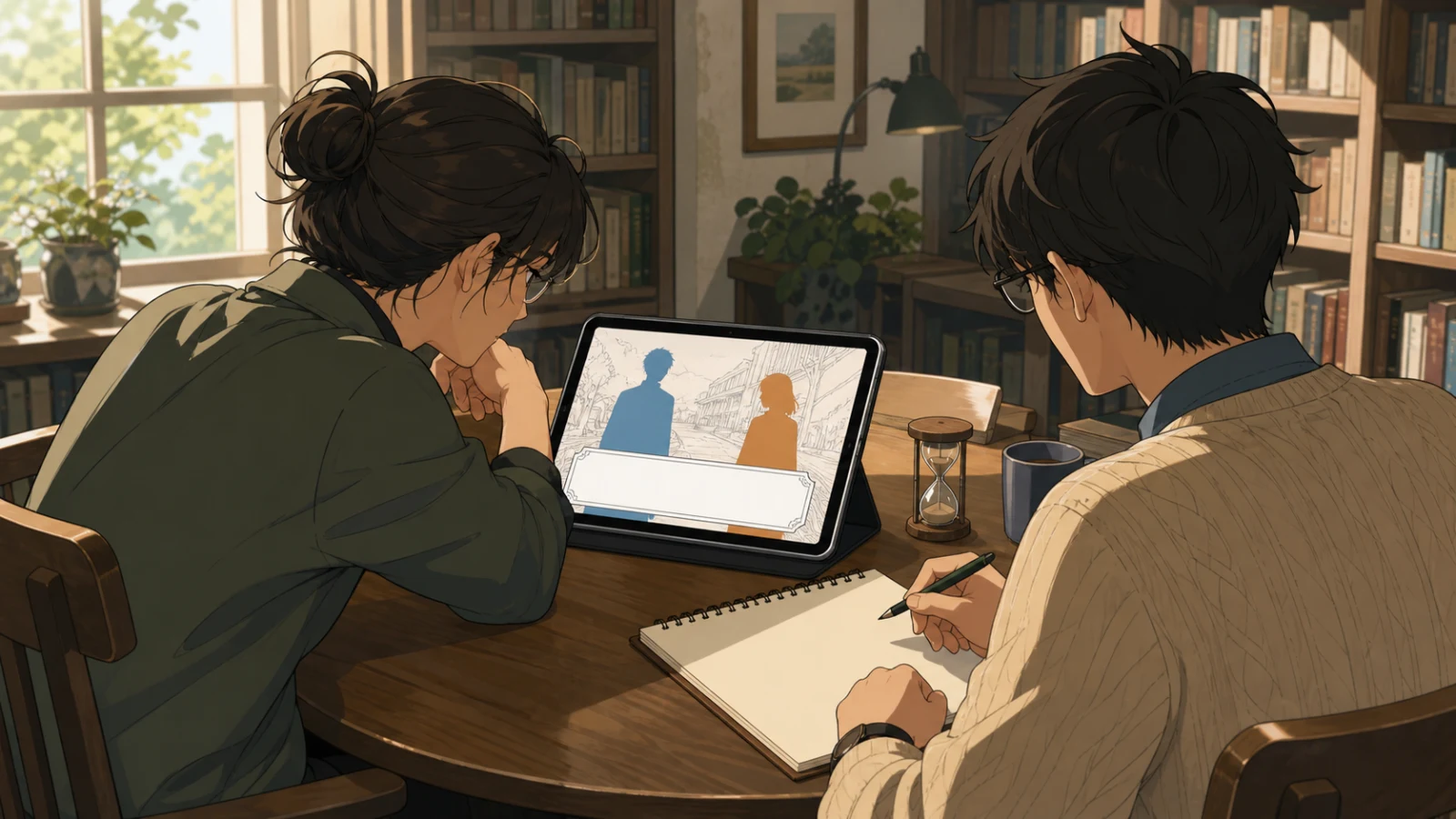
Watch one reader use it without explaining the source novel. Notice where they tap too quickly, pause because they are interested, or stop because they do not know who or what matters. Ask what changed during the scene and what they expect next. If they can only recount background information, the adaptation needs a nearer conflict. If they understand the conflict but miss a relationship, the missing piece may be a line, an entrance, or an expression rather than another paragraph.
Then compare the rough scene with the manuscript. Restore only what the playable version genuinely lost. This prevents a common revision loop where every cut sentence returns because it was good prose. A sentence can be good and still belong to the web novel rather than the adaptation.
Test with sound off once. The scene should remain understandable. Test while advancing at a natural reading speed. Music and transitions should support the beat instead of delaying it. Finally, inspect the script for long runs where the background, character arrangement, and emotional state never change. Those stretches may need a visual beat, a tighter rewrite, or a deliberate quiet moment. Decide which one it is.
Where does Novelez fit?
Novelez does not decide what to cut or turn a prose chapter into a good playable scene automatically. Adaptation still needs a writer who understands why each moment matters.
It reduces the assembly work after those decisions. You can build the selected arc as visible scenes, place narration and character dialogue in order, connect the next scene, and publish the rough version to a link for a reader. The manuscript does not need to be scattered through code before you can discover whether the adaptation works.
That makes a small experiment practical. Duplicate or preserve the source manuscript elsewhere, adapt one contained arc, reuse a compact set of backgrounds and character images, and send the link to a few readers. If the scene rhythm holds, expand from the same structure. If it does not, revise the scene map before producing the rest of the series.
A first adaptation checklist
- The selected section has its own starting condition, disruption, turn, and ending image.
- Every playable scene changes location, time, participants, objective, or emotional pressure.
- Description already visible in the art has been cut or changed into meaningful interpretation.
- Each click carries one readable beat rather than a random sentence fragment.
- The asset list comes from what recurs in this arc, not everyone and everywhere in the full novel.
- Special illustrations are reserved for moments standard staging cannot express.
- Any choice changes action, knowledge, or tone and receives a visible response.
- A five-to-ten-minute placeholder build has been watched with a new reader.
- Missing context was restored selectively instead of copying the chapter back in.
- The first public section ends after something changes, not immediately before it.
Treat the web novel as source material, not a container to empty into another tool. Keep its characters, conflict, and emotional direction. Rebuild the delivery around screens, beats, and visible action. A short arc that feels deliberately playable will represent the original story better than twenty chapters pasted into text boxes.