How Many CGs Does Your First Visual Novel Need? A Moment-First Art Plan
August 3, 2026
How Many CGs Does Your First Visual Novel Need? A Moment-First Art Plan
How many CGs should your first visual novel have?
It sounds like a budgeting question, but it is really a story question. Search around and you will find games with a huge gallery, beloved short works with only a few event illustrations, and creators who finished everything except the art bill. None of those examples tells you which scenes in your story deserve a special image.
Here is a useful starting answer: a focused first visual novel often works with about three to six true event CG moments, while a tiny practice game may need only one or two. That is not a quality standard. It is simply a manageable range for many small projects. The better rule is to count moments that change how the player feels, not scenes that happen to sound important in the outline.
A strong CG plan does not begin with empty gallery slots. It begins with a moment map. Find the emotional turns, check what becomes more rewarding on replay, make sure the routes receive deliberate coverage, and budget one strong base composition for each chosen moment. Crops, expression changes, and lighting variants can come later if they genuinely improve the scene.
🎨 First, what counts as a CG in a visual novel?
In visual-novel planning, a CG usually means a special event illustration created for a particular story moment. It is different from the standard combination of a reusable character sprite over a reusable background.
A sprite-and-background scene says, “These characters are talking in this place.” An event CG can show something that the normal stage cannot carry as well: a hand almost reaching for another hand, a character seen from an unusual angle, a reveal hidden inside the environment, or the stillness after a choice has changed the relationship.
That distinction matters because creators often mix several asset types into one number:
- reusable character sprites;
- facial expressions and pose changes;
- reusable backgrounds;
- item or interface illustrations;
- event CG base compositions;
- alternate crops, expressions, lighting, or aftermath variants.
If you call all of those “CGs,” the budget becomes impossible to read. For this plan, count only unique event compositions as the main CG total. Track variants underneath their base composition instead of presenting every crop as another major illustration.
This also prevents a common mistake: assuming that more gallery thumbnails automatically mean more emotional impact. Five near-identical close-ups may cost time without giving the player five distinct memories.
💓 Choose moments by emotional state change
The strongest first filter is simple: Does the character, relationship, or player understanding feel different after this moment?
A beautiful scene is not automatically a useful CG. A school entrance, café conversation, or city walk may look appealing, but the standard sprite-and-background setup might already serve it perfectly. Save the event art for a beat where the visual itself becomes part of the change.
Consider a small mystery romance. The protagonist meets an old friend, finds a torn photograph, accuses the wrong person, learns why the friend disappeared, and chooses whether to forgive them. All five beats matter to the plot. But perhaps only three truly need special compositions:
1️⃣ The photograph reveal, because the player sees the clue at the same instant as the protagonist.
2️⃣ The confrontation, because physical distance and body language show the relationship breaking.
3️⃣ The final answer, because forgiveness and separation need different emotional afterimages.
The first meeting may still be important. It may simply work better with a carefully staged background, a strong expression, and good timing. CG status is not a reward for a scene being important. It is a production choice about whether a unique composition adds meaning that reusable assets cannot.
Try writing a short before-and-after note for every candidate:
- Before: what does the player believe or feel?
- During: what becomes visible that dialogue alone cannot carry?
- After: what has changed?
If the answer barely changes across the three lines, the scene probably does not need commissioned event art yet.
🔁 Ask whether the image rewards a replay
Visual novels invite players to revisit scenes with new knowledge. A good CG can become more valuable the second time around.
Maybe a character keeps one hand outside the frame during an early promise. On replay, the player understands what they were hiding. Maybe an apparently comforting image uses a reflection that quietly reveals who was listening. Maybe two route endings return to the same location with different posture, distance, or light.
Replay payoff does not mean stuffing every image with secret symbols. It means choosing moments whose meaning can deepen after another route or ending.
Ask these questions:
- Will the player remember this image when a later truth is revealed?
- Does another route change how the player reads the pose or setting?
- Would a variant create a meaningful comparison rather than a cosmetic difference?
- Is this likely to become one of the images a player associates with the whole story?
If a CG is impressive only during its first appearance and disconnected from everything after it, it may still be useful. But if two candidates are competing for the same budget, the one that gains meaning on replay usually does more work for the game.
🌿 Make a moment map before you request art
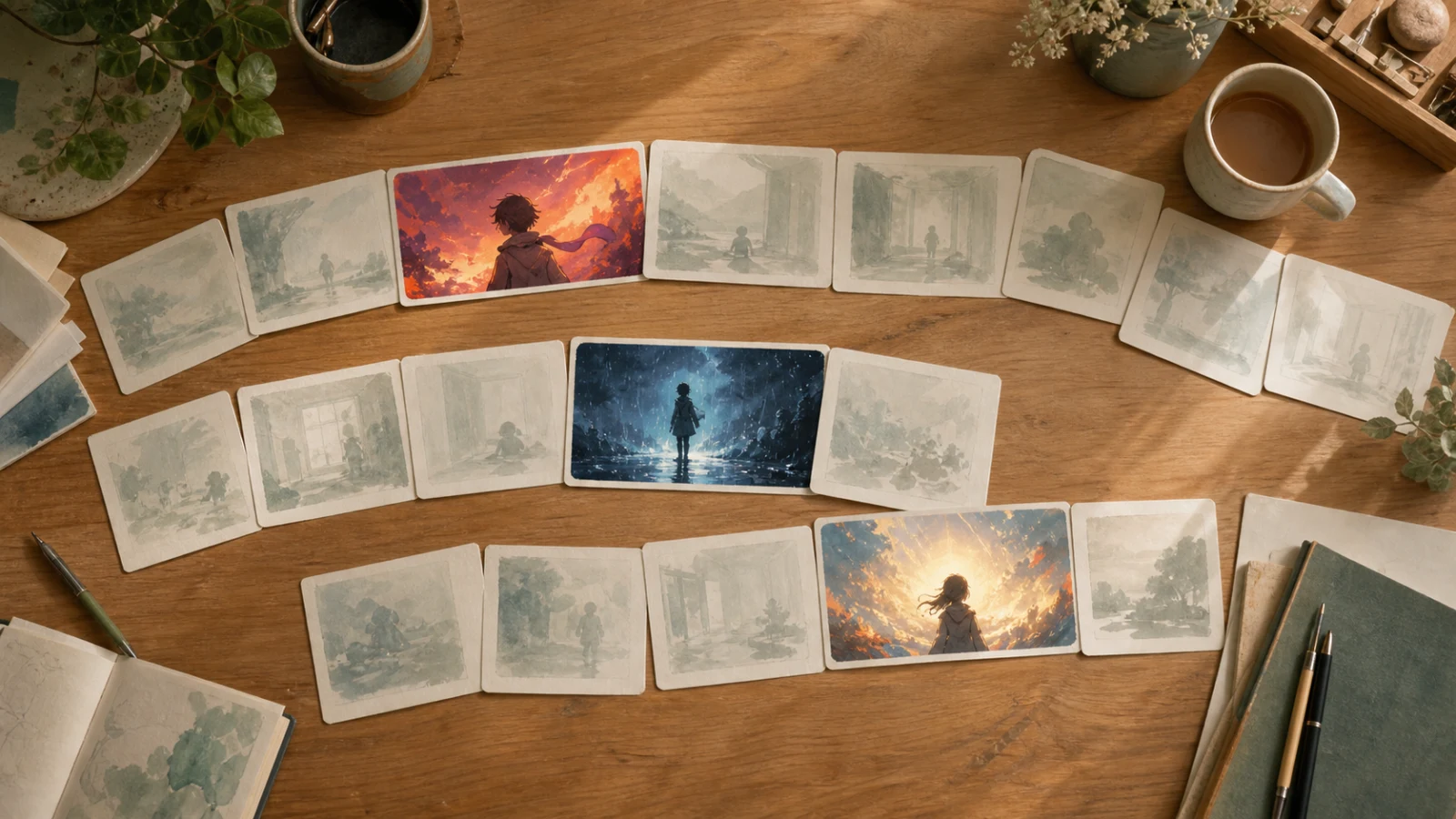
A moment map is a short production sheet that connects story beats to visual purpose. It can be a document, a row of cards, or a simple spreadsheet. The format matters less than the questions.
For each candidate moment, record:
1️⃣ Story position: opening, midpoint turn, route divergence, climax, or ending.
2️⃣ Emotional state change: what is different after the image appears?
3️⃣ Replay payoff: does later knowledge change its meaning?
4️⃣ Route coverage: which players and endings will actually see it?
5️⃣ Base composition: what one image must communicate without relying on a caption?
6️⃣ Optional variants: which crop, expression, lighting, or aftermath change earns its cost?
7️⃣ Fallback: could sprites and a background carry the scene if the CG is cut?
Then look at the whole map. If every candidate sits in the common opening, your routes may feel visually abandoned later. If one side route receives four unique illustrations while the main emotional arc receives none, your art budget may be following novelty instead of story weight.
A practical first-pass rule is to reserve coverage for the beginning, the strongest change in the middle, and the emotional result near the end. That does not mean every route gets an equal number. It means the distribution should feel intentional.
🧭 Route coverage should follow promises, not symmetry
Route coverage is where a simple CG count becomes tricky.
Suppose your game has one shared opening and two endings. A single opening CG reaches every player, so it has excellent coverage. But if both endings rely only on ordinary sprites, the final choice may feel visually smaller than the setup. On the other hand, giving each ending several exclusive images can double the art cost for content many players will see only once.
Start by asking what each route promises.
If the routes represent two genuinely different relationships, each may need at least one image that belongs to its emotional conclusion. If they are light variations on the same central relationship, one shared climax with carefully chosen ending variants might be enough. If a secret route is intentionally a reward, its exclusive CG can be part of that promise, but it should be budgeted as an extra rather than smuggled into the base plan.
Equal numbers are not the goal. Perceived care is the goal. A quieter route can feel complete with one precise image, while a dramatic route may need two because the visual transformation itself is part of the story.
One useful check is to trace the cheapest possible playthrough. Does that player still receive a memorable visual payoff? Then trace the route with the most exclusive art. Is its extra cost justified by the experience, or did it simply contain more easy-to-illustrate scenes?
🖼️ Budget one base composition before counting variants
Once a moment earns a CG, define the base composition first.
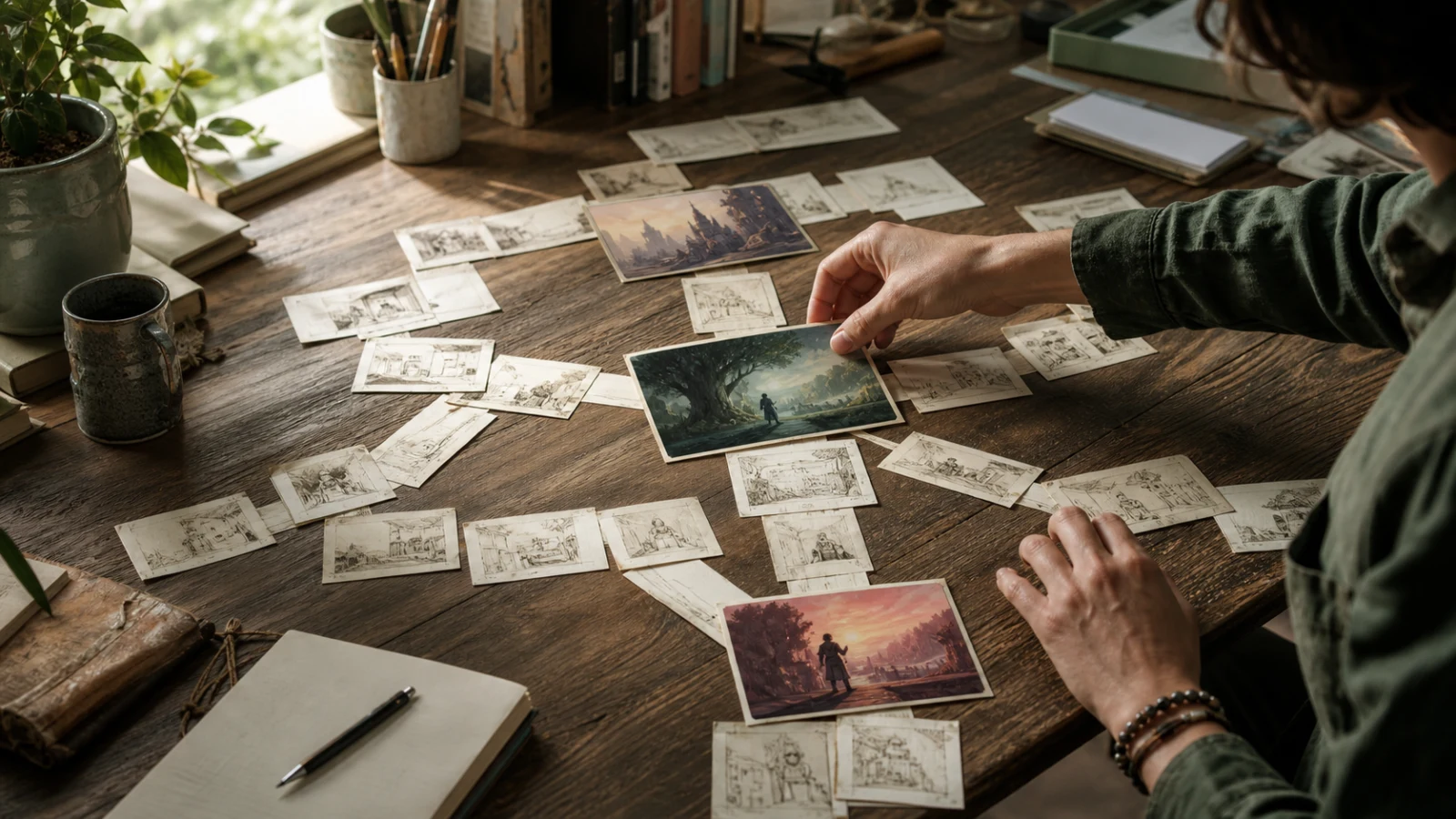
The base composition is the image that must carry the scene even if no alternate version is ever produced. It establishes camera angle, character placement, environment, lighting direction, and the emotional focus. If the base image does not work, extra crops will not rescue it.
For each selected moment, budget:
1️⃣ One complete base composition. It should communicate the event at the normal game frame and survive a clean crop for common screen sizes.
2️⃣ Optional crops. A closer crop can support dialogue rhythm or mobile readability when it comes from the same high-resolution art. Do not treat an automatic crop as a separate commissioned scene.
3️⃣ Optional expression variants. Use them when the emotional shift happens within the same framing and the changed face or gesture is the point.
4️⃣ Optional lighting or aftermath variants. These work when time, danger, memory, or route outcome transforms the meaning of the same space.
5️⃣ A cut order. Decide in advance which variants disappear first if time or money tightens.
This is also where you can avoid a painful commission brief. “Please draw the confession scene” is not enough. Which character owns the emotional focus? Are they moving closer or pulling away? What does the player need to notice before reading the next line? Which details must remain visible behind the dialogue box? What can safely fall outside a mobile crop?
Answer those questions while the scene is still cheap to change.
✂️ More variants do not automatically create more value
Variants are tempting because they appear cheaper than a new illustration. Sometimes they are. Sometimes a “small change” requires repainting hands, clothing folds, hair, shadows, eye direction, and background occlusion.
Only request a variant when it changes one of these things:
- the player's interpretation of the moment;
- the rhythm of a longer scene;
- the route outcome shown in the image;
- the usability of the art across the actual layout.
Avoid ordering variants merely to fill a gallery or make the asset list look generous. A blink, a tiny mouth change, and three almost identical crops can create review work, export work, file naming, implementation, and testing without adding a new memory.
A useful label is base, meaningful variant, or presentation crop. This keeps the count honest. It also helps an artist quote the work correctly because a meaningful pose change is not confused with a simple crop.
🎭 Temporary assets answer the expensive questions early
The best time to discover that a CG arrives too early, stays too long, or hides the important choice is before final art exists.
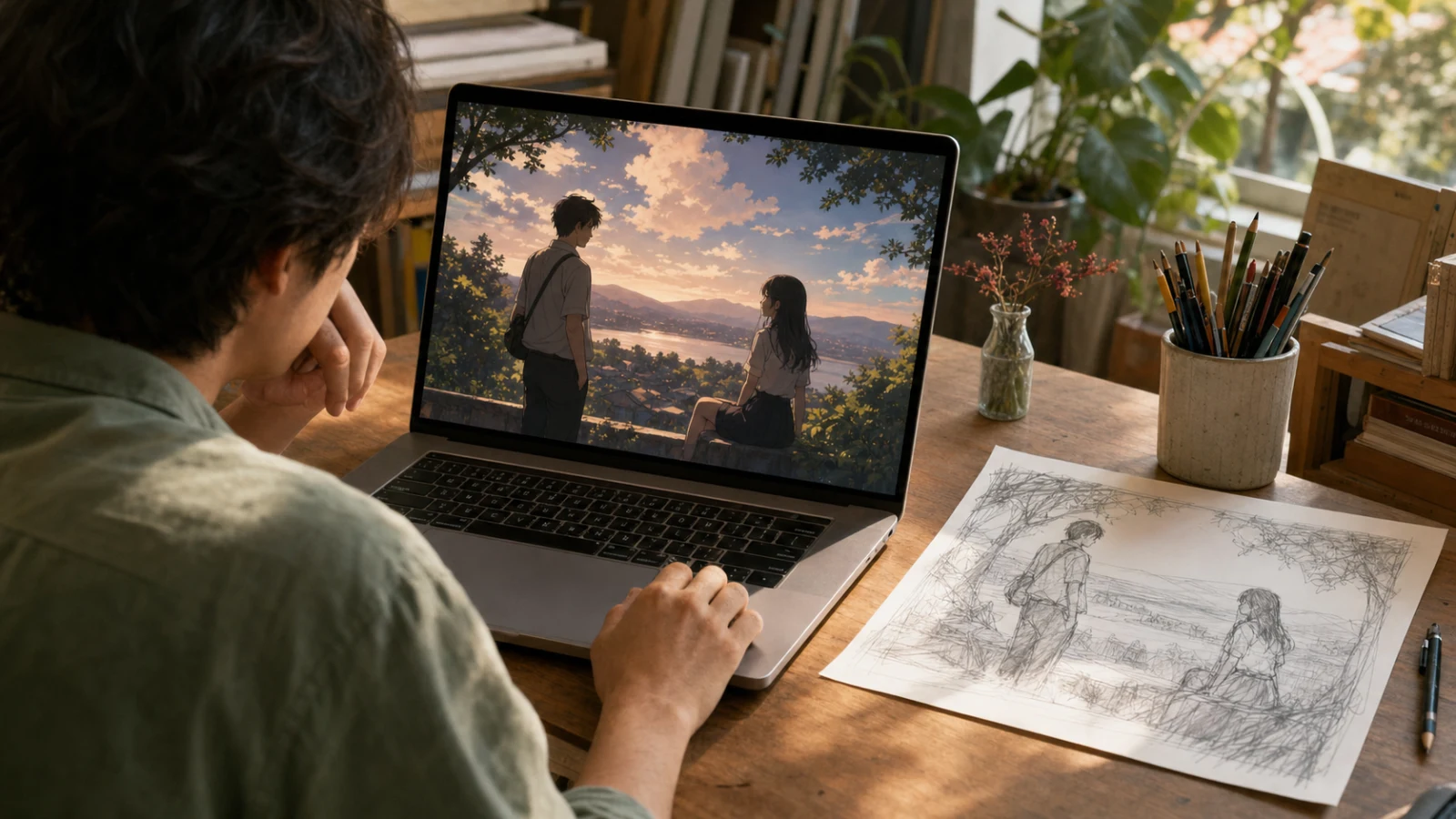
Make a rough placeholder for every planned event image. It can be a flat color sketch, a loose thumbnail, a composition blockout, or even a temporary photo you have permission to use internally. It does not need to be beautiful. It needs to occupy the intended frame and show the intended focus.
Then build the sequence and play it.
Watch for questions that a document cannot answer:
- Does the CG appear before the line that earns it?
- Does the dialogue box cover the hand, clue, or expression that matters?
- Does the image hold for ten seconds or two minutes?
- Does a close crop make the scene more intimate, or merely repetitive?
- Does the next sprite scene feel like a drop in quality, or like a natural return to the normal stage?
- Does every route reach its promised visual payoff?
Run the scene once at normal pace, once quickly, and once on the smallest screen you expect to support. If a planned CG has no clear reveal point, no meaningful hold, and no memory afterward, remove it or return it to the sprite-and-background plan.
That decision is much easier with a rough blockout than with a finished commission.
🌱 Test the art plan in Novelez before commissioning
Novelez gives creators a browser-based, no-code place to arrange scenes, dialogue, choices, characters, backgrounds, and audio. That makes it useful for testing a CG plan as part of the actual story flow instead of reviewing illustrations in a separate folder.
Create the scene, place a temporary event image where the reveal should happen, and preview the surrounding dialogue. In the Flow editor, check which routes reach the moment. In the Timeline and built-in player, check how long the image stays on screen, whether the transition has room to breathe, and whether the choice or consequence lands before the story moves on.
You can begin in the browser, preview the result, and share a web version through the gallery when it is ready. Ren'Py export provides a path toward a PC build if you later want deeper engine work. Advanced features such as Ren'Py export currently have limited free daily use during beta, and the free policy may change.
The important step is the order: story moment, rough composition, playable test, revised brief, final commission. That sequence protects both the art budget and the emotional result.
✅ A copyable moment-first CG checklist
Before commissioning final event art, ask:
- Have I separated event CGs from sprites, backgrounds, and interface art?
- Can I name the emotional state change for every CG candidate?
- Does each image add something reusable assets cannot communicate as well?
- Does at least one image gain meaning on replay?
- Does every promised route receive an intentional visual payoff?
- Have I counted unique base compositions separately from crops and variants?
- Is every optional variant tied to interpretation, rhythm, outcome, or layout?
- Do I know which variants will be cut first if the budget tightens?
- Have I tested temporary versions inside the playable flow?
- Have I checked dialogue-box coverage and a small screen?
- Can the game still ship if one lower-priority CG is removed?
- Does the final art brief describe focus, framing, timing, and crop safety?
If several answers are unclear, do not add more CG slots. Return to the moment map.
Your first visual novel does not need a crowded gallery. It needs a few images that arrive exactly when the player's understanding or feeling changes. Choose those moments, give each one a strong base composition, test them while they are still rough, and commission the final art only after the scene earns it. 🎬
August 3, 2026