How Do You Make a Choice Matter Later? A No-Code Guide to Visual Novel Flags and Variables
August 11, 2026

How Do You Make a Choice Matter Later? A No-Code Guide to Visual Novel Flags and Variables
Your player made a decision in chapter one. Three chapters later, does your story still know about it?
That gap is where a lot of first visual novels quietly lose their power. The choice was well written. The moment felt tense. But the scene twenty minutes later greets the player exactly the same way it would have if they had chosen the opposite, and the decision stops feeling like a decision.
The fix is not more branches. Duplicating the whole second half of your story for every choice is how a project becomes unfinishable. The fix is a small memory layer: a handful of values the story writes down and checks later.
Search for this and you will mostly find engine-specific instructions — how to write a flag in one scripting language, which forum thread explains one editor's syntax. Useful once you have decided what to track, useless before that. This guide covers the decision itself: what to remember, how much, what to call it, where to check it, and how to prove it works.
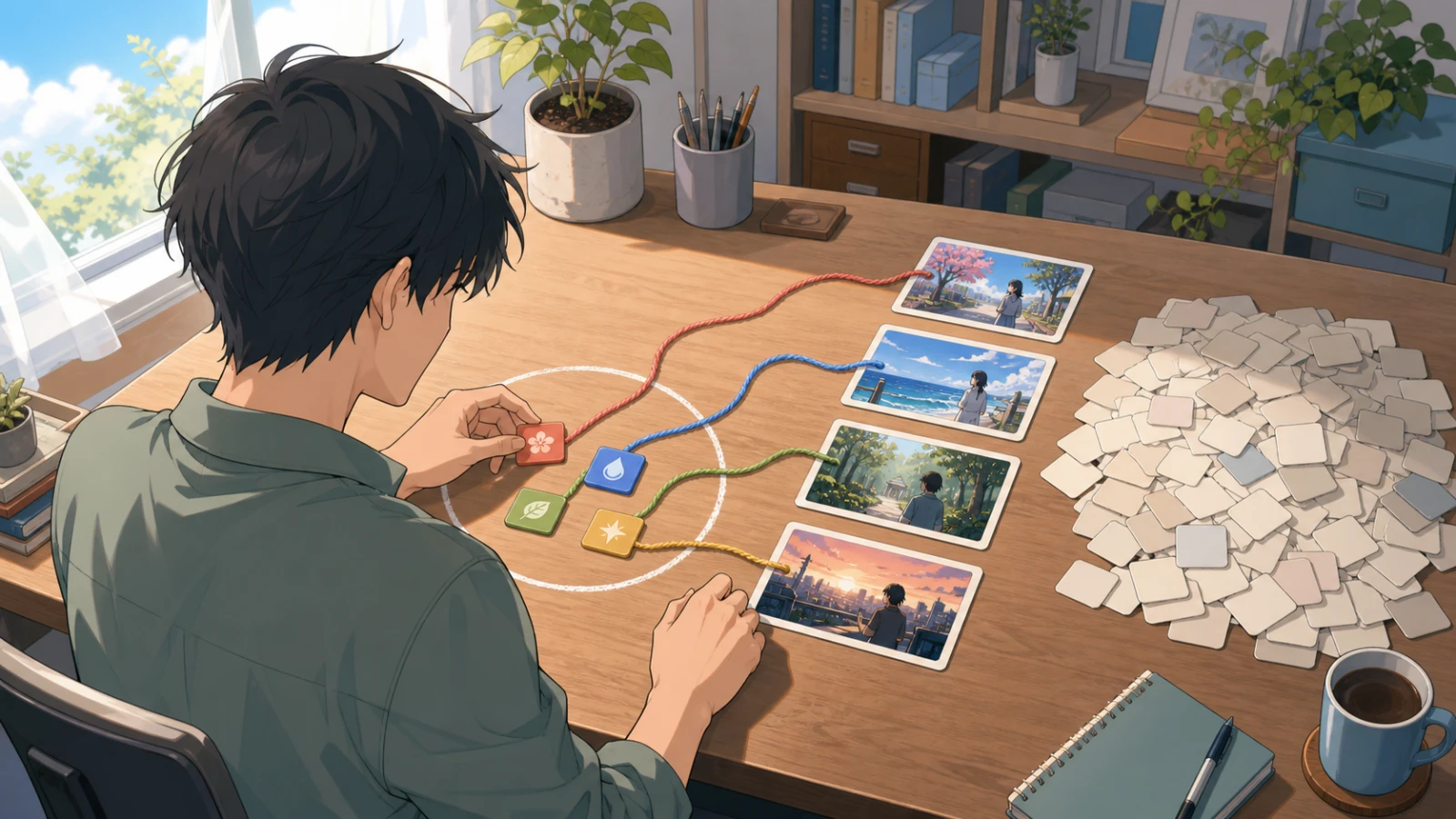
🎯 What should your story actually remember?
Start with the opposite question. Most choices should not be remembered at all.
A choice can pay off immediately — the next line changes, a character reacts, the scene takes a different route to the same door — and that is a complete, satisfying choice. It needs no memory. It costs you nothing to maintain.
Reserve remembered state for decisions that need to return. A decision is worth tracking when you can finish this sentence: "Because the player did this, that later scene should be different." If you cannot name the later scene, you do not have a variable yet. You have a preference.
The decisions that usually earn their memory:
- whether the player learned a specific piece of information;
- whether a relationship has been building warmth or distance;
- whether a promise was made and whether it was kept;
- whether an object, a name, or a secret is now in the player's possession;
- whether the protagonist behaved in a way that later characters would hear about.
Write each one as a plain sentence before you touch the editor. "The story remembers whether Mina told Jun about the letter." That sentence is your variable, in the only form that matters at planning time.
🔢 Do you need a yes/no flag or a number?
Almost everything you will track falls into three shapes, and picking the wrong one is the most common source of pain later.
1️⃣ The yes/no flag. Did this happen or not? Was the letter read, the door unlocked, the apology given? This is the workhorse and it should be your default. It is easy to reason about, easy to test, and it never drifts into a state you did not anticipate.
2️⃣ The counter or meter. How much? Affection, trust, suspicion, money, days remaining. Numbers are seductive because they feel like a real system, and they are genuinely the right tool for something that accumulates across many small moments. But a number has a hidden cost: you have to decide what value counts as "enough," and that threshold only becomes real once you play the whole route. If you use a meter, decide early how many points a typical route can plausibly earn, and set your thresholds from that, not from a guess.
3️⃣ The state label. Which one of a few named situations are we in? Where is the protagonist living, which faction did they side with, which of three people came along tonight. Use this when the options are genuinely exclusive. A single label is far safer than three separate yes/no flags that could accidentally all be true at once.
A useful rule for a first project: prefer flags, allow one or two meters, and reach for labels only when a real either/or exists in your story.
🏷️ Will you understand your own variable names in three weeks?
This sounds like housekeeping. It is actually the thing that decides whether chapter four is pleasant or miserable to build.
Name the fact, not the choice number. told_jun_about_letter is readable a month later. choice_3_option_b is a puzzle you will have to solve every time you see it. When a name states a fact, you can read a condition out loud and immediately know whether it is right.
A few habits that pay for themselves:
- Phrase flags so that true means the thing happened, never the negative.
door_lockedis clear;door_not_unlockedwill eventually trick you. - Keep one naming style for the whole project. Mixing styles costs you nothing on day one and costs you an hour of hunting on day thirty.
- Group by subject when you have several: everything about one character, then everything about one location.
- Keep one plain list — a note, a spreadsheet, one page — with every variable, what it means, where it is set, and where it is checked. Four lines each. This list is the single most useful document in a branching project, and almost nobody writes it until it is too late.
🔍 Where do you actually check the state?
Setting a value is the easy half. The story only feels responsive at the moments you check it.

There are three useful places to check, and they cost very different amounts of work.
Small variations — cheapest, and where most of your payoff should live. Same scene, same structure, one line replaced. A character greets the player by first name instead of a title. A single sentence acknowledges the umbrella they were handed two chapters ago. Nobody has to write a new scene, and players notice these far more than creators expect.
Gates — medium cost. A choice, a scene, or a piece of information only becomes available if the state allows it. This is how you make an earlier decision feel like it opened a door rather than just changing dialogue. Gates are powerful, but always ask what the player sees when the gate is closed. A locked option that is visible but unavailable reads very differently from one that simply never appears — both are valid, but pick deliberately.
Endings and route splits — most expensive. Every split multiplies what you have to write, test, and finish. This is exactly where a meter or a couple of flags checked together earns its keep: rather than branching early and maintaining two long parallel paths, let the paths converge and check the accumulated state once, near the end, to decide which conclusion the player has earned.
The healthy shape for a first project is many small variations, a few gates, and one late check that selects between a small number of endings.
⚖️ How many variables does a first project need?
Fewer than you want. Three to five is a realistic and genuinely sufficient budget for a first release.
The reason is not laziness. Every variable you add multiplies the number of states your story can be in, and every state is something you eventually have to play through to know it is not broken. Two flags give you four combinations. Five give you thirty-two. Ten give you over a thousand, and you will never see most of them, which means you will never know what they look like.
So set a budget before you start building, and treat it as real. When a sixth idea arrives, ask whether it can be handled as an immediate reaction instead, or folded into a variable you already have. Most of the time it can. A trust meter can absorb three separate "was the protagonist kind here" flags without losing anything the player can perceive.
And be honest about which variables actually change what the player sees. A flag that is set but never checked is not a feature — it is a note to yourself that costs you testing time. Either give it a payoff or delete it.
🧪 How do you prove the memory actually works?
Reading your own condition list will not catch the failures. The bugs in a state system are silent: nothing crashes, the scene just quietly plays the wrong version, and it looks completely normal to anyone who does not know what should have happened.

Build a small tracking sheet — one row per variable, one column per checkpoint — and fill it in while you play, not from memory afterward. Then run these tests:
1️⃣ Both sides of every flag. Play the path where it is true, then the path where it is false, and look at every scene that checks it. Most state bugs are found here, in the branch the creator considered obvious and never opened.
2️⃣ The never-touched path. Play straight through avoiding every optional scene. Does anything later assume information the player was never given? This is the most commonly broken path in a branching story, because it is the one the creator least enjoys playing.
3️⃣ The threshold edges. If you use a meter, deliberately reach one point below your cutoff and one point above. Confirm that the outcomes are actually different and that both feel earned rather than arbitrary.
4️⃣ Read the condition out loud. "If Mina told Jun about the letter, show the warmer greeting." If saying it plainly makes you hesitate, the condition is probably checking the wrong variable — this catches inverted logic faster than staring at a screen does.
5️⃣ Watch a real player, and ask what the story remembered. Do not ask whether they liked it. Ask what they think their earlier decision changed. If they cannot name anything, your state layer is working invisibly, which is the same as not working. Turn one of those quiet variations into something the story says out loud.
🌱 How does Novelez help with this?
Novelez is a browser-based, no-code visual-novel creation tool. You can arrange scenes, dialogue, choices, conditions, assets, and timing in the visual editor, and preview the result in the built-in player.
That matters for state work specifically, because the slow part of this job is not setting a value — it is checking whether the right version of a scene appears. Being able to set a condition and immediately play the scene it controls turns a guessing game into a two-minute check. You can jump to the later scene, confirm both versions, and adjust the condition without rebuilding anything.
The practical order: name the fact, pick the shape, keep the list short, check it in many small places and a few big ones, then play both sides before you build anything else on top.
✅ A state-tracking checklist
Before you build the second half of your story, check:
1️⃣ Can you name the later scene that each variable changes?
2️⃣ Is each one a yes/no flag unless it genuinely accumulates?
3️⃣ Does every name state a fact you will still understand in three weeks?
4️⃣ Do you have a written list of what is set where and checked where?
5️⃣ Are you under your variable budget, with every unused flag deleted?
6️⃣ Is most of your payoff in cheap variations rather than expensive branches?
7️⃣ Have you played both sides of every flag and the path that skips everything?
A story that remembers does not need more branches. It needs a few things worth remembering, checked in places the player will notice.
August 11, 2026