How Do You Design Sound for a Visual Novel? A Practical Cue Map
July 29, 2026
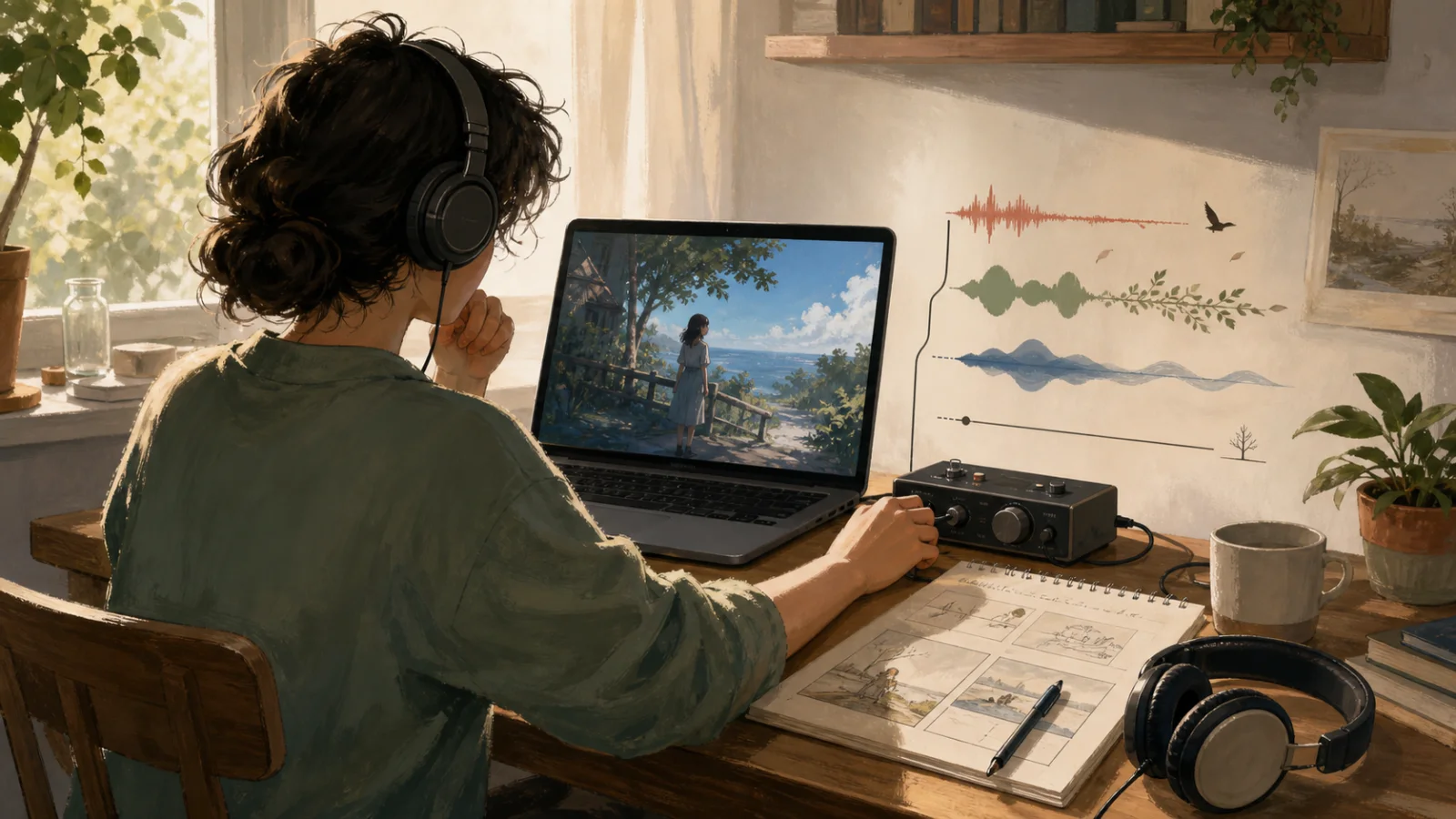
Have you ever added a beautiful music track to a visual-novel scene and somehow made the scene feel less emotional?
The song may be good. The problem is often that it arrived without a job. It starts because the scene starts, loops because it can, and keeps playing while dialogue, footsteps, rain, choices, and dramatic reveals all compete for the same space.
Sound design is not “put music everywhere.” It is deciding what the player should notice, what the scene should feel like, and when the story needs room to breathe.
You do not need a giant library or a professional studio to make a first visual novel sound intentional. You need four layers—silence, ambience, music, and sound effects—and a small cue map that tells each layer when to enter, change, or leave.
Here is a practical way to build one.

🎧 Start with the scene, not the playlist
Before searching for tracks, write one sentence about what the player should feel during the scene.
Not the plot summary. The experience.
- “This café feels safe until the empty chair becomes impossible to ignore.”
- “The train platform is ordinary, but the character knows this is the last goodbye.”
- “The player should relax enough that the door knock feels wrong.”
That sentence becomes your sound brief. It tells you whether the scene needs warmth, distance, pressure, loneliness, or no music at all.
Then mark the emotional turns:
1️⃣ Entry: What does the player hear before anyone speaks?
2️⃣ Normal rhythm: What makes the place feel alive without demanding attention?
3️⃣ Turn: Which line, action, or reveal changes the meaning of the scene?
4️⃣ Decision: Does a choice need focus, tension, or complete silence?
5️⃣ Exit: What should linger after the scene changes?
Now you are choosing sound for story beats instead of decorating a timeline.
🗺️ Make a cue map you can actually read
A cue map can be a tiny table in your notes. One row per important scene is enough.
For each scene, record:
- Scene purpose: comfort, suspicion, reunion, pressure, release.
- Ambience: rain on glass, distant traffic, room tone, evening insects, or none.
- Music: track or mood, where it starts, and where it stops.
- SFX: only the actions the player should notice.
- Silence beat: a deliberate gap before or after the key line.
- Transition: continue, fade, cut, or replace when the next scene begins.
Imagine a late-night kitchen scene:
- The room starts with refrigerator hum and faint rain.
- No music plays while two characters avoid the real subject.
- A cup touches the table after the confession.
- The ambience drops for one line.
- Music enters only after the other character answers.
- The track continues into the next scene because the emotional question is still open.
That is a design. “Sad piano from the beginning” is only a mood label.
Keep the cue map small enough to change. If every line has an effect, revision becomes exhausting and the important moments lose contrast.
🌧️ What should ambience do?
Ambience answers a quiet question: Where are we when nobody is speaking?
It can make a painted background feel occupied. A café has air conditioning, cups, soft movement, and a world beyond the frame. A forest has wind, insects, leaves, and distance. A bedroom at night may have almost nothing—and that “almost” matters.
Good ambience usually sits below conscious attention. The player notices it most when it disappears.
Use it for:
- continuity across several dialogue exchanges;
- a sense of time, weather, and distance;
- contrast between locations;
- tension created by removing a familiar sound;
- covering a transition without forcing music to do every job.
Avoid stacking every possible sound. Rain, thunder, traffic, clock ticks, fluorescent buzz, footsteps, and music may all be realistic, but realism is not the same as clarity.
Choose the one or two environmental details that tell the story. A clock can make waiting painful. A train announcement can remind us that time is running out. Rain can make a room feel private. If a sound does not change the reading of the scene, it may not need to be there.
🎵 When should music start—and stop?
Music is powerful because it frames meaning before the player has finished reading.
That also makes it easy to overuse.
Try entering music on a change, not automatically on a location:
- after a character finally tells the truth;
- when a familiar place becomes unfamiliar;
- after the player commits to a choice;
- when a repeated motif returns with a different meaning;
- during the transition out of a scene rather than under the entire conversation.
Stopping music is a cue too. A clean cut can feel shocking. A gentle fade can release tension. Letting a track continue across a scene change can connect two moments that the visuals separate.
Do not use a new track for every emotion. A small set of recurring themes often feels more coherent. Change the context, timing, or arrangement before you expand the library.
And protect the dialogue. If the track has a busy melody, sharp rhythm, or strong vocal-like lead in the same range as speech, the player may feel tired even when there is no voice acting. The music should support reading, not win a contest against it.
🚪 Which sound effects deserve a cue?
Sound effects are most useful when they direct attention.
A door opening is not automatically important. The door opening behind the protagonist while they are lying is.
Prioritize:
- actions that change the scene;
- off-screen events the artwork cannot show;
- objects that become clues;
- repeated sounds that gain meaning;
- tactile moments such as a phone buzz, cup set down, lock turning, or train departing.
Keep variations for frequent sounds so repetition does not become mechanical. But do not collect twenty versions before the scene works with one.
Also watch the relationship between text and audio. If the narration says “The glass shattered” and the effect fires far too early, the player learns the event before reading it. If it fires long after the line, it feels disconnected. Place it where the action becomes present—often immediately after the revealing phrase or on the next deliberate beat.
🤫 Why is silence part of the mix?
Silence is not an empty track. It is contrast.
After several minutes of ambience and music, removing both can pull the player closer than adding a louder cue. A silent choice can feel heavier. A confession without a swelling soundtrack can feel more honest. A room tone returning after a shock can tell us that the world kept moving.
Mark silence in the cue map so it survives production. Otherwise every gap tends to be “fixed” later.
Useful silence beats include:
- one line before a reveal;
- the moment after a choice is confirmed;
- a pause after a sound that happened off-screen;
- the last shot before an ending;
- a scene where the character is listening for something that never comes.
The goal is not to make the game quiet. It is to make loud and quiet moments mean different things.
⚖️ How do you balance a scene without a studio?
Use an ordinary listening pass.
Start with dialogue readability and build outward:
1️⃣ Play the scene at a comfortable device volume.
2️⃣ Set ambience low enough that you stop actively noticing it.
3️⃣ Add music until the mood is clear, then pull it back slightly.
4️⃣ Add important SFX so they are distinct without startling the player accidentally.
5️⃣ Replay the choice and transition points.
6️⃣ Test once on headphones and once on ordinary speakers.
7️⃣ Test at a low volume where only the most important elements should survive.
You are not mastering an album. You are checking hierarchy.
Also listen for loops and endings. Does the ambience click when it repeats? Does music restart every time the player revisits a node? Does a sound from the previous scene continue by mistake? Does the ending stop cleanly?
Those small problems are more damaging than not owning a larger sound library.
📜 Can you use any “royalty-free” track?
No. “Royalty-free” does not mean “free for every use,” and “free download” does not prove you have publishing rights.
Before using an asset, record:
- creator or library name;
- original source URL;
- license name or exact permission;
- whether commercial use is allowed;
- whether attribution is required;
- whether modification is allowed;
- the date you downloaded it;
- a local copy or screenshot of the license terms.
Check whether the license covers a playable game, a web release, a downloadable build, trailers, and future paid distribution. Those may be treated differently.
Do not rely on a search-result snippet, a reposted file, or a track copied from another video. If the source and permission are unclear, leave it out.
Keep credits in one production document from day one. Reconstructing them at launch is miserable.
🧪 What should your browser playtest cover?
Do not judge audio by opening files one at a time. Play the story in sequence.
Test:
- a quiet dialogue scene;
- a scene with an important SFX;
- a choice with music before and after it;
- a location change with different ambience;
- a return to an earlier node;
- one ending;
- one long reading stretch.
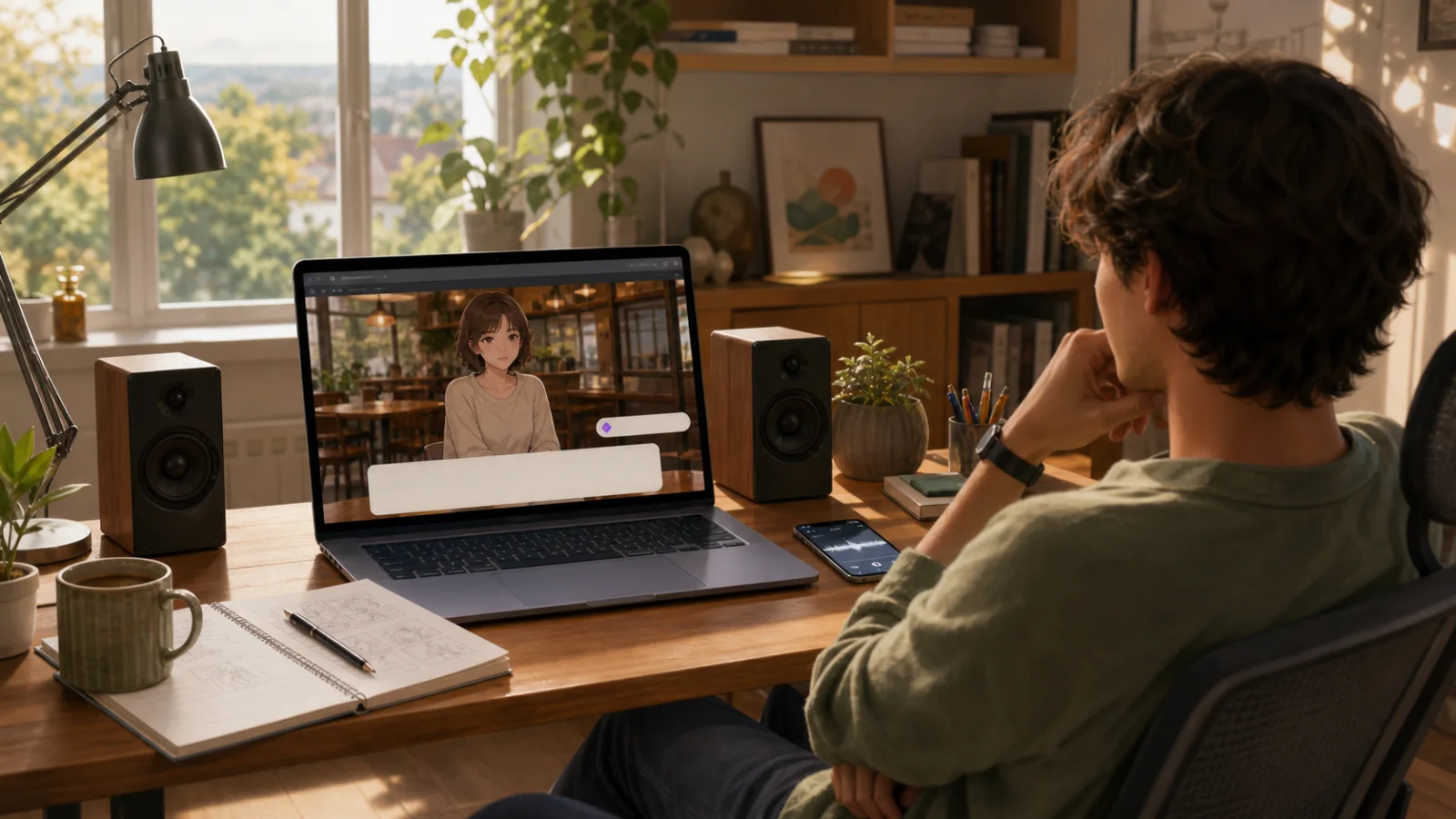
Ask a second listener three simple questions:
1️⃣ Which sound did you remember?
2️⃣ Did anything make the dialogue harder to read?
3️⃣ Was there a moment that felt strangely empty or too busy?
Do not ask whether the soundtrack was “good.” Ask whether the story was clear.
🌿 Where Novelez fits
Novelez lets you organize visual-novel assets, including music, and place audio actions alongside scenes and dialogue in a browser-based no-code editor. Its Flow and Timeline views help you see where a cue belongs, while the built-in player lets you preview the playable sequence before sharing it.
That makes a cue-map workflow practical:
1️⃣ Outline the scene beats.
2️⃣ Add only the ambience, music, and effects those beats need.
3️⃣ Preview the branch in the browser.
4️⃣ Revisit nodes to catch accidental restarts or missing stops.
5️⃣ Share the web version when the mix reads clearly.
Novelez can also export to Ren’Py as a path toward a PC build, where you can continue refining engine-level audio behavior.
✅ A copyable first-pass sound checklist
Before publishing a playable build, confirm:
- every important scene has a one-sentence emotional brief;
- ambience identifies place without crowding the dialogue;
- music enters because something changes;
- music also has a planned stop or transition;
- SFX direct attention to meaningful actions;
- at least one deliberate silence beat is preserved;
- repeated nodes do not restart or stack audio unexpectedly;
- loops and scene endings are clean;
- licenses and attribution requirements are recorded;
- the mix has been tested on headphones, speakers, and low volume;
- a second listener can follow the story without being distracted by sound.
Start with one scene, one ambience layer, one music cue, and one meaningful effect. Make those four decisions clear before collecting fifty files.
The best visual-novel sound design is not the one the player notices every second. It is the one that makes the story feel present. 🎧
July 29, 2026