How Many Words Should Your First Visual Novel Be? A Scope-to-Playtime Guide
August 1, 2026

How Many Words Should Your First Visual Novel Be? A Scope-to-Playtime Guide
How many words should your first visual novel be?
If you have searched for one perfect number, you have probably found answers that range from a tiny weekend story to a novel-sized epic. That is not very helpful when you are trying to decide what you can actually finish.
Here is the practical answer: your first visual novel should be long enough to deliver one complete emotional turn, but short enough that you can write, build, revise, and playtest every path. For many first projects, a focused script of roughly 5,000 to 15,000 displayed words is a useful working range. It can support a satisfying short experience without quietly becoming a year-long production.
That range is a planning tool, not a rule. A tense mystery with long pauses may feel substantial at the lower end. A fast comedy may move through the same number of words much more quickly. Choices, animation, exploration, voice acting, and repeated routes all change the experience.
So do not begin with “How many words do successful visual novels have?” Begin with a better question: What experience am I promising, and how much production can I responsibly finish?

🎯 Start with the promise, not the word count
A short visual novel does not need to feel incomplete. It needs a clear promise.
Maybe the player will spend one stormy evening deciding whether to trust a stranger. Maybe they will investigate one missing letter. Maybe they will have three conversations with one character and discover whether those small choices changed the ending.
Those ideas are naturally compact because each has:
1️⃣ One central relationship or question.
2️⃣ One meaningful change by the end.
3️⃣ A limited cast and location set.
4️⃣ A small number of consequences you can truly test.
Compare that with “a school romance featuring six characters, a mystery conspiracy, ten endings, and a secret route.” The second idea may sound exciting, but its word count is only the first cost. It also asks for more sprites, expressions, backgrounds, variables, save-state checks, route transitions, and revision passes.
For a first release, write down the smallest version of the promise that would still feel emotionally complete. If the story works with one protagonist, one important partner, three main scenes, and two endings, start there. You can always build a larger second project with what you learn.
⏱️ How do words turn into playtime?
A plain reading estimate often begins around 180 to 220 words per minute for English prose. That would put 10,000 words near 45 to 55 minutes of pure reading.
But a visual novel is not a plain document.
Players wait for character changes. They notice a new background. They listen to music. They pause before a choice. They reread a suspicious line. A dialogue box may reveal text gradually. Scene transitions create breathing room. Some players use auto mode; others click quickly.
That is why the simple division is only your starting point:
Estimated reading minutes = displayed words ÷ assumed reading speed
Then add time for the parts that make the work playable:
- choices and decision pauses;
- scene and character transitions;
- deliberate silent beats;
- optional menus, journals, or investigations;
- replaying shared scenes to reach another route;
- slower reading on mobile or in a second language.
For an early plan, use a range instead of a single promise. A 10,000-word linear story might be described internally as “about 45 to 75 minutes,” then corrected after a real playtest. The wider range is more honest than pretending every reader moves at the same speed.
Also count displayed story words, not design notes, image prompts, code comments, file names, or discarded drafts. If the player cannot read it in the final experience, it should not inflate the playtime estimate.
🌿 What is a useful first-project size?
Think in production bands, not prestige categories.
A tiny proof: roughly 1,500 to 5,000 words
This is useful for learning the whole pipeline. You can test one hook, one or two choices, a compact asset set, and one ending or a light variation. It may play in 10 to 30 minutes depending on presentation.
The risk is not that it is “too short.” The risk is that you treat it like a fragment. Give it a beginning, pressure, choice, consequence, and final image. A complete ten-minute story is stronger than the first chapter of a game that never ships.
A focused first release: roughly 5,000 to 15,000 words
This is the sweet spot for many solo beginners. It gives you enough room for setup, relationship movement, a meaningful branch, and an ending that has time to land. It is also small enough that you can replay every path repeatedly while revising.
Try three to six core scenes, one main variable if you need it, and two clearly different endings. Share as much setup as the story allows, then let the final stretch show the consequence of the player’s choices.
A larger short visual novel: roughly 15,000 to 30,000 words
This can support deeper characterization, more locations, or several substantial branches. It can also multiply art, implementation, and testing faster than expected.
Choose this range because the story needs it, not because a smaller game feels less legitimate. If you have not completed a playable project before, build and test a vertical slice early. Ten polished minutes will expose production problems more clearly than another twenty pages of outline.
🌳 Why branching words cost more than linear words
Suppose your draft contains 10,000 words. If almost every player sees the same scenes, that number maps reasonably well to one playthrough.
Now suppose half the script belongs to mutually exclusive routes. The total script may still be 10,000 words, but one player may see only 6,000 or 7,000 words before an ending. Meanwhile, you still have to edit and test all 10,000.
This creates three different counts:
1️⃣ Total script words: everything you must write and maintain.
2️⃣ Unique playthrough words: what one route shows a player.
3️⃣ Replay words: shared material a returning player must see again.

A simple scope sheet can track all three. For every scene, mark whether it is shared, conditional, or exclusive to one route. Then add the words that appear on the longest likely first playthrough.
Be careful with “small” choices. If a choice changes only one reply, its cost is modest. If it changes the next three scenes, character expressions, variables, and ending logic, it is not a small choice anymore.
For a first visual novel, a strong pattern is:
- a shared opening that teaches the situation;
- a few choices that reveal the player’s attitude;
- one controlled divergence where consequences become visible;
- two endings that feel different for a clear reason.
This gives the player agency without forcing you to build several nearly separate games.
🧩 Scope by scenes before you draft every line
Word budgets become easier when you attach them to scenes.
Start with five cards:
1️⃣ Opening: What changes today?
2️⃣ Connection: Why should the player care?
3️⃣ Pressure: What makes the easy answer impossible?
4️⃣ Choice and consequence: What does the player reveal or risk?
5️⃣ Ending: What is different now?
Give each card a rough purpose and a flexible word allowance. Do not make every scene the same size. A quick arrival may need only a few hundred words. The decisive conversation may need far more. The point is to notice early when a side scene is consuming half the project.
When the draft grows, cut in this order:
- repeated setup the player already understands;
- choices that produce the same emotional result;
- extra characters doing a job an existing character could do;
- locations that require new art but add little story value;
- lore that never changes a decision or consequence.
Protect the emotional turn. Shortening a story should make its promise clearer, not erase the reason to play it.
🎮 Measure the build, not just the document
The only reliable playtime estimate comes from a playable version.
Put the script into a real scene flow, even with temporary art. Then run at least three passes:
1️⃣ Normal first read: do not rush, and pause naturally at choices.
2️⃣ Fast replay: notice how much repeated material sits between the player and a new ending.
3️⃣ Slow clarity pass: check whether important choices need more context or breathing room.
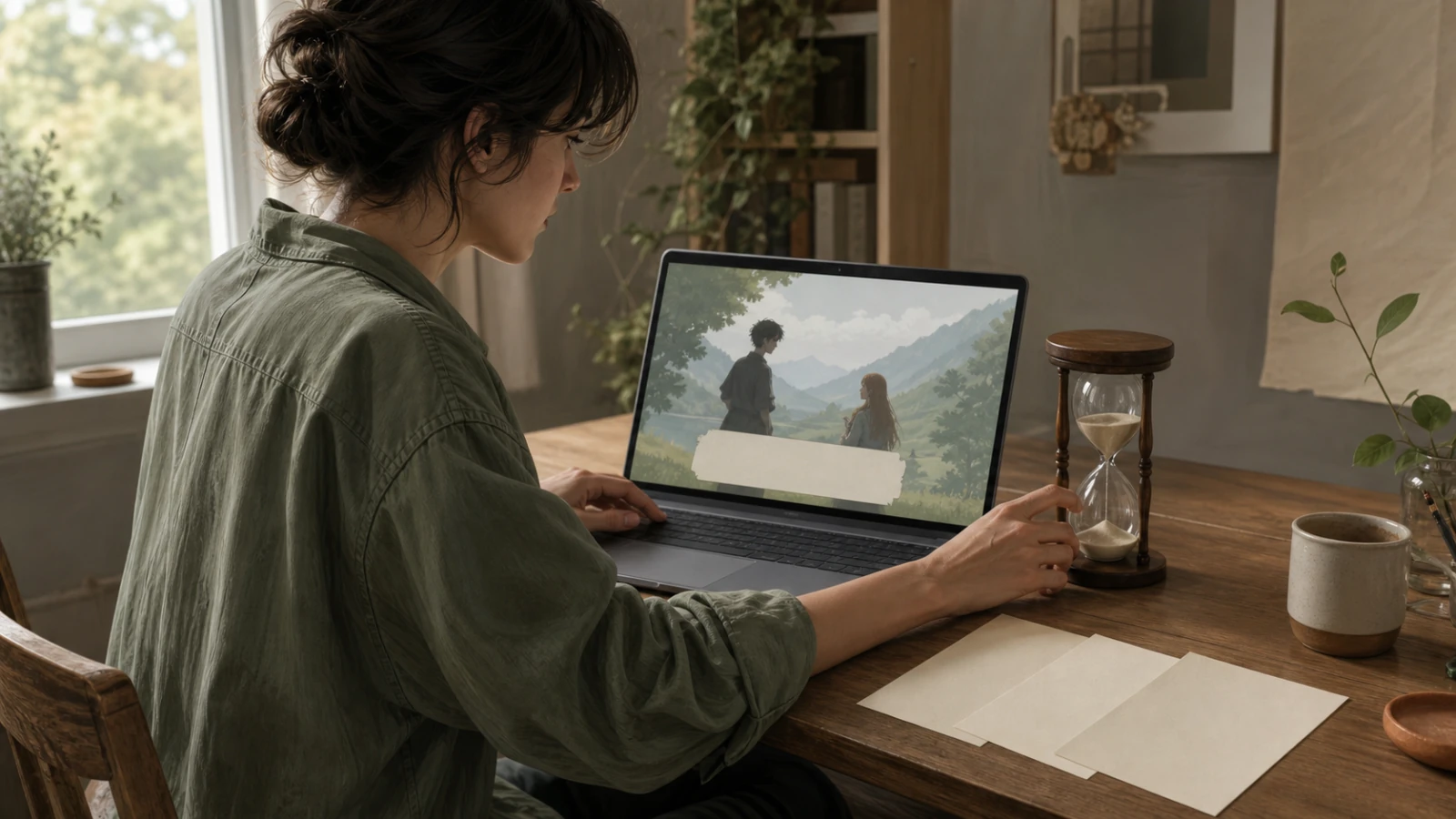
Record the time to each ending, not only the longest route. If one ending arrives in fifteen minutes while another takes an hour, make sure that difference feels intentional.
Ask a second reader to test without your explanation. Writers click faster because they already know every line. A new reader pauses at names, clues, art changes, and decisions you no longer notice.
If the measured playtime is too long, do not immediately speed up text display. Look for repeated scenes, late exposition, and branches with weak consequences. If it is too short, do not add filler. Add a stronger setup, one revealing interaction, or enough space for the ending to feel earned.
🌱 Where Novelez fits
Novelez gives creators a browser-based, no-code way to arrange scenes, dialogue, choices, characters, backgrounds, and audio. The Flow editor makes the route shape visible, while the Timeline and built-in player let you check how the writing actually feels as a playable sequence.
That matters for scope because a manuscript can hide production cost. A flow view quickly reveals when one choice has become an entire parallel route, and a browser preview reveals whether a “short” conversation actually takes several minutes with transitions and decisions.
You can start in the browser, preview the story, and share a web version through the gallery. Ren'Py export provides a path toward a PC build when you are ready to continue at engine level. Advanced features such as Ren'Py export currently have limited free daily use during beta, and the free policy may change.
✅ A copyable scope-to-playtime checklist
Before committing to the full script, answer these questions:
- Can I describe the complete emotional promise in one sentence?
- What is the target word range for the whole script?
- How many words will one likely first playthrough show?
- Which scenes are shared, conditional, or route-exclusive?
- How much repeated content sits between endings?
- How many characters, backgrounds, and expression sets does the scope require?
- Can I build the first ten playable minutes before finishing every line?
- Have I timed one normal read, one fast replay, and one slow clarity pass?
- Does each branch produce a visible consequence?
- Can I personally replay every path after each major revision?
If the last answer is no, the project is probably too large for a first release.
Choose the smallest word budget that can deliver the full promise. Build it. Time it. Let a new reader play it. Your first visual novel does not have to be huge. It has to be finished, tested, and worth reaching the ending. 🎬
August 1, 2026