Visual Novels and AI — What's Going On Right Now?
June 20, 2026

You've probably been hearing a lot about making visual novels with AI lately.
But there's always a debate right next to it. Some say "AI-made games shouldn't count," others say "this is the future of creativity." So who's right?
Today, instead of vague impressions, let's lay out what actually happened in 2026 — with sources. We (Novelez) are a tool that helps people make visual novels, so we think it's only right to look at this honestly.
🚫 The Creator Community Started Drawing a Line
The most visible shift is in game jams, where creators gather.
In 2026, several visual novel jams on itch.io banned generative AI outright — for writing, art, and scripting.
1️⃣ Make Visual Novel Assets Jam 2026: prohibits using generative AI to write, illustrate, script, or produce submission components.
2️⃣ "Worst Visual Novel Ever" Challenge 2026: bans AI-generated assets and writing with no exceptions. Organizers said the point is "to use your human free will to make something AI could never make."
3️⃣ Appx. N Jam 2026: disallows AI content of any kind.
The reasoning is simple: AI-generated content is low-effort and doesn't showcase or build a creator's skill — which misses the whole point of a jam.
(Sources: itch.io jam rules — Make Visual Novel Assets Jam 2026 / Worst Visual Novel Ever Challenge 2026 / Appx. N Jam 2026)
💸 The Backlash Against "Fully AI" Products
The community got sensitive for a reason — there have been real flashpoints.
1️⃣ Blood in the Ice (a visual novel) — made almost entirely of AI-generated assets and content, yet priced at $100. Many felt that was far too expensive for something leaning on automated generation. (Source: ingamenews, 2026)
2️⃣ Identity V / NetEase (a games-industry case) — in April 2026, players alleged AI-generated imagery in trailers and promo assets. What inflamed it was that artists were reportedly laid off around the same time, so the community designated April 23 as a boycott day. (Source: BitTopup News, 2026) It's not a visual novel, but it's the textbook example of the "AI is replacing artists" fear boiling over.
3️⃣ An AI novel's award was revoked (a literary case) — an AI-written isekai novel won a contest's Grand Prize and Reader's Choice, then had its book publication and manga adaptation cancelled. (Source: AUTOMATON WEST, 2026) Also not a VN, but a signal of how far "AI works winning and getting commercialized" is accepted.
See the common thread? The backlash isn't really about "they used AI" — it's about low effort, replacing artists, and overpricing.
🟦 Platforms Moved Too — Steam's AI Disclosure Policy
The platform side changed as well.
On January 16, 2026, Valve updated Steam's AI disclosure form. (Source: PC Gamer, 2026)
Two key points:
1️⃣ It's now two-tier: separating "pre-generated" AI content baked into the game from "live-generated" content created while the game is running.
2️⃣ Efficiency tools are exempt: AI dev tools like code helpers don't need to be disclosed. The focus is "content consumed by players," not "efficiency tools used behind the scenes."
And a notable line — Valve explicitly acknowledged there's consumer demand to know whether the anime artwork in a visual novel was drawn by a human or generated by a model. In other words, a visual novel with AI content is expected to disclose it.
🧭 So What's the Core of It?
If we boil it all down:
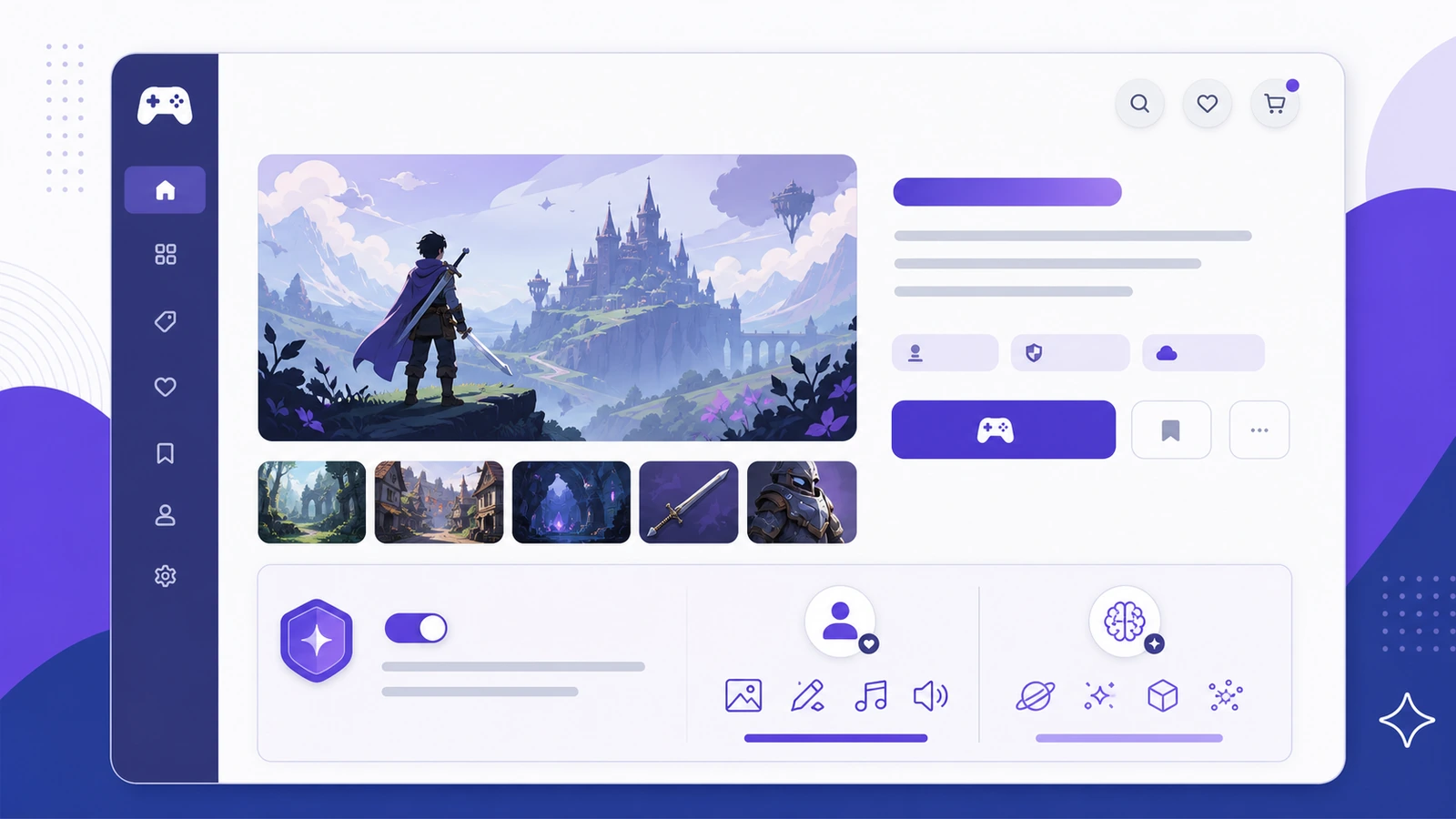
Fully-AI products (low effort, replacing artists, high price) draw strong backlash, while tools that "assist" creation are relatively accepted. And the line between them is transparency. Consumers want to know: "Did a human make this, or did AI?" Steam exempting efficiency tools while emphasizing consumer disclosure points the same way.
🌱 Where Does Novelez Stand?
Let's be honest. Novelez is a tool that helps you make visual novels without coding. So we want to be clear about where we stand in this debate.
Novelez is not here to replace artists. It's here to open a path — "a way to turn your story into a game" — for people who had a story but couldn't even start because art and code felt out of reach. As we said in our last post, AI is the tool; a human creator should always be at the center.
We feel the same about transparency. When you publish your game somewhere (say, Steam), being upfront about AI usage isn't something to hide — it builds trust. And platform rules are heading that way too.
The conversation around visual novels and AI will stay noisy for a while. But one thing is clear: the direction of "helping more people tell human stories" has a solid place to stand, even in the middle of the debate.
Your story — give it a try. 🎬