SAG-AFTRA Has a New Pitch Agreement. Can Your Visual Novel's Pitch Demo Use Union Voice Actors?
November 10, 2026
If you're building a pitch demo for a visual novel and hoping to send it to publishers, you've probably wondered whether it should have voices. Until now, that question had an awkward answer if the actor you wanted was a member of SAG-AFTRA, the US actors' union. Under the union's Global Rule One, members can't take acting work from a producer who hasn't signed an agreement with the union, and a full production contract is a lot to take on when you haven't raised any money yet.
On November 5, SAG-AFTRA announced a contract aimed squarely at that stage: the Pre-Funding Pitch Interactive Media Agreement. This matters to you mainly if you want English voices from US union performers; it doesn't change how you'd hire voice actors in Korea or elsewhere. Below I separate what the union and four trade outlets confirm from my own suggestions for a visual novel pitch, which I label as mine.
What does the agreement actually cover?
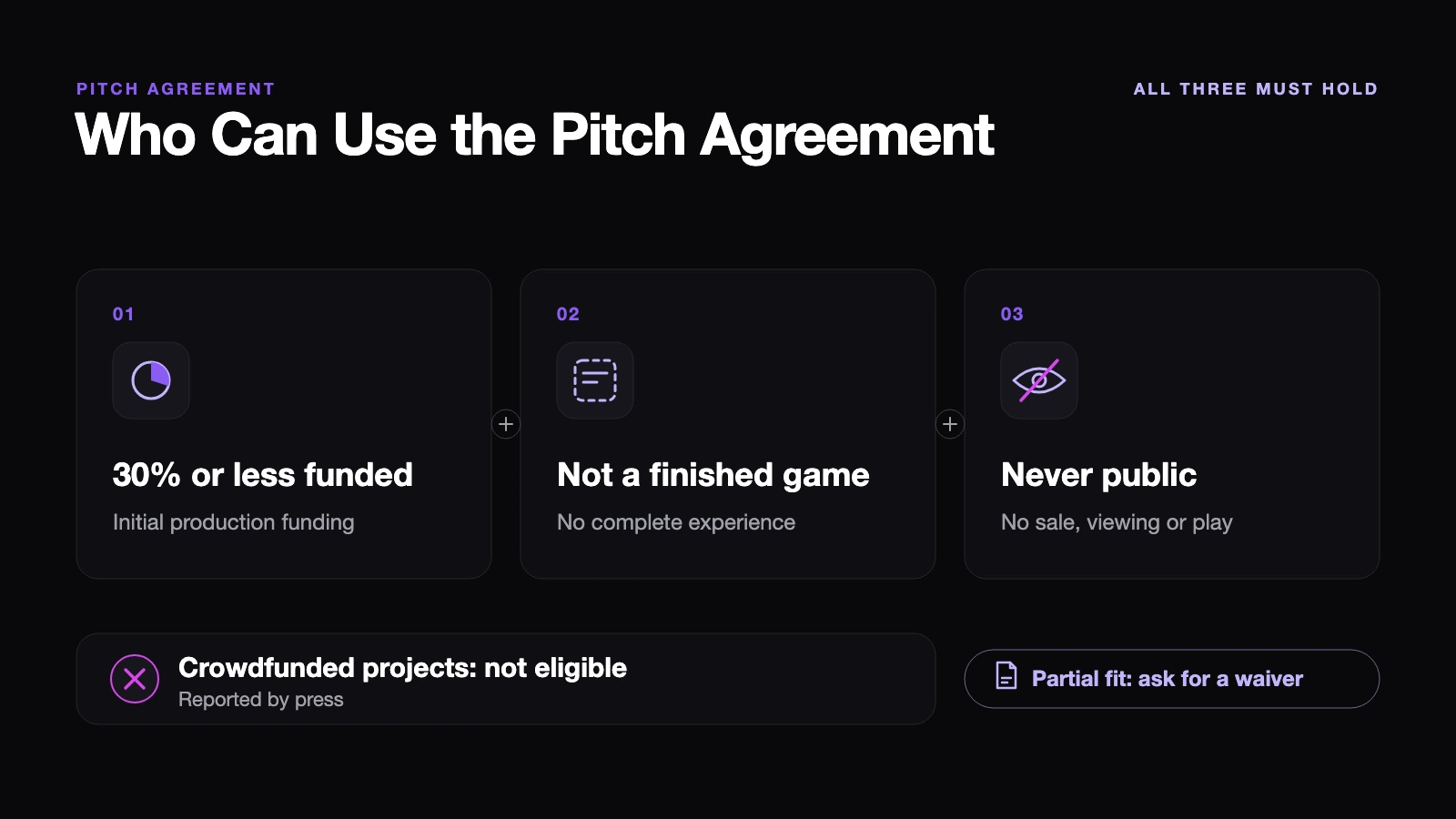
According to SAG-AFTRA's own announcement, the agreement covers demos, vertical slices, trailers, teasers, sizzle reels and playable prototypes made for the exclusive purpose of seeking production funding. To use it, a project has to meet three conditions:
- No more than 30% of its initial production funding is secured.
- The material doesn't give the experience or impression of a complete interactive project.
- The material is not commercially released, and not made available for public viewing or gameplay.
GamesIndustry.biz and VGC also report that crowdfunded projects are not eligible. A project that meets some but not all of the conditions can ask the union for a waiver. SAG-AFTRA's chief executive Duncan Crabtree-Ireland said the deal can "give devs that extra edge to get the backing they need" (SAG-AFTRA). Game Developer notes that there were previously no specific union guidelines for using union actors in a pitch.
Some things I couldn't confirm. None of the announcements or reports I read give pay rates, say whether pitch recordings can later be reused in the finished game, or explain how a studio shows its funding level. The union has posted the agreement itself as a PDF, but it wouldn't load for me on November 10, so I haven't read the full text.
Why does this matter more for a visual novel?
A visual novel pitch has no combat or puzzles to carry it. What a publisher sees in the first few minutes is mostly characters talking, so a good performance can do more for a visual novel pitch than for most genres. That's my reading, not something the union says.
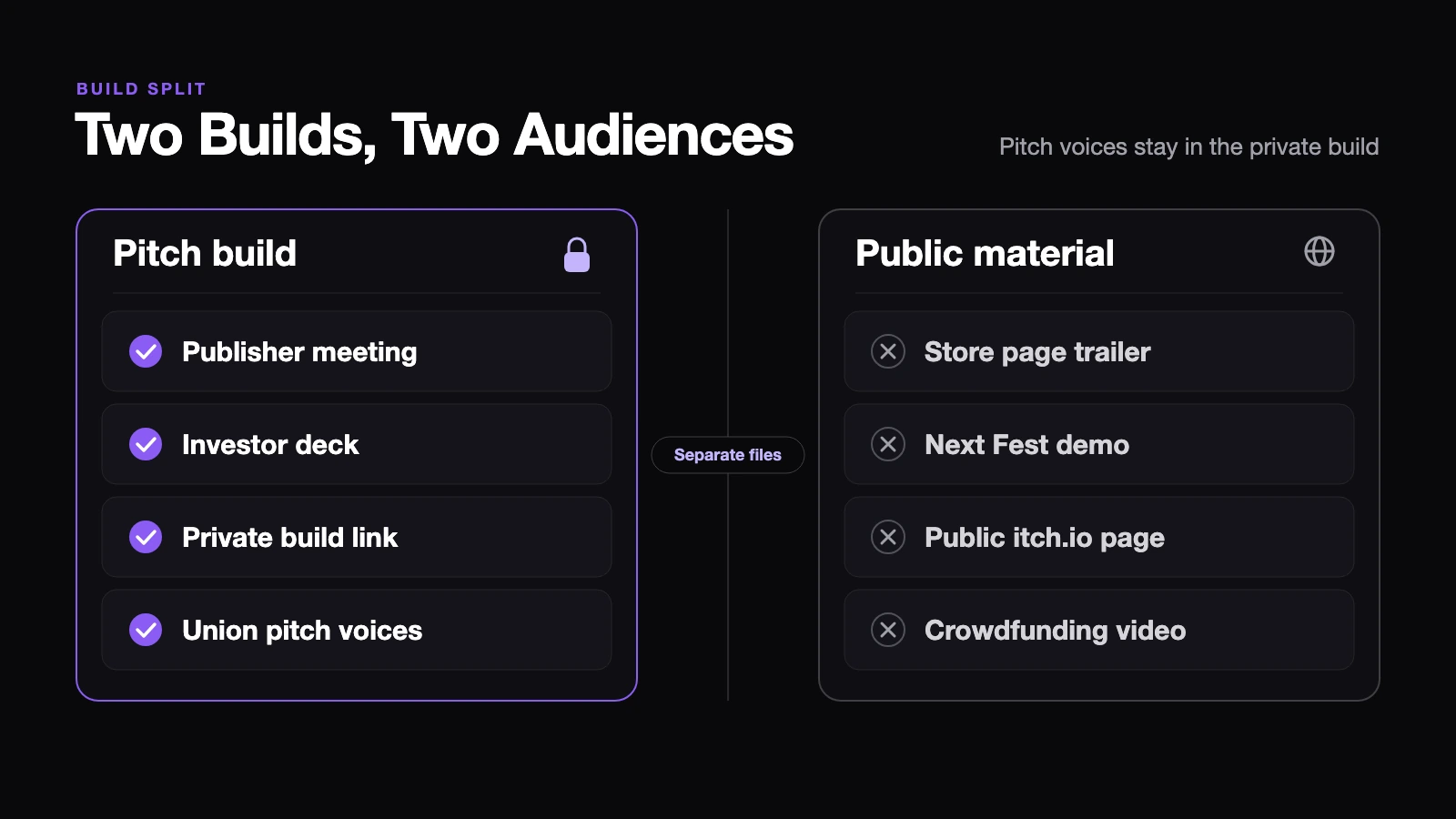
Here's the catch I'd stress. The agreement fits teams who send a private build to publishers and investors. It doesn't fit anything the public sees: your Steam store page trailer, a Next Fest demo, a public itch.io page, a crowdfunding video. If you were hoping to record lines once and use them in both places, you'll need a different arrangement for the public side from the start.
How would I prepare a voiced pitch build?
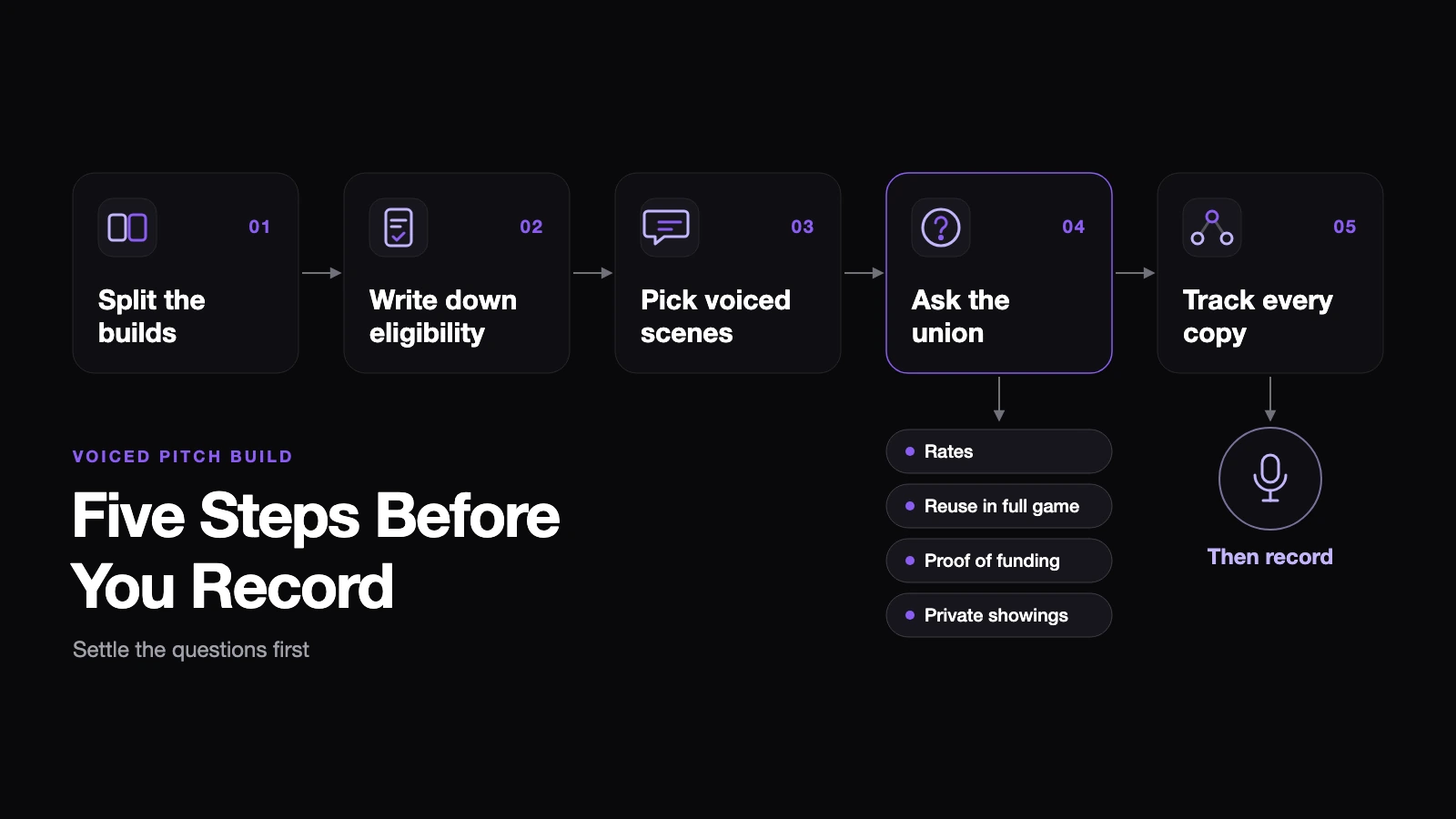
This is the order I'd follow. The steps are my suggestions; the conditions they protect come from the announcement.
- Split the builds. Keep the pitch build and any public demo as separate files with separate names. Lines recorded under this agreement go into the pitch build only.
- Write down your eligibility. Note the share of initial production funding you've secured today, what the pitch build contains, and who will receive it. If a crowdfunding campaign is part of your plan, this is where it shows up.
- Pick the voiced scenes carefully. A visual novel with every route and ending voiced starts to look like a finished game. I'd voice the scenes where the main characters first appear and the lines around the first real choice, and leave the rest as text.
- Ask the union before you book a session. Four questions have no public answer yet: the rates, the terms for reusing recordings in the full game, how to show your funding level, and whether a closed showing at an industry event counts as public.
- Track every copy. Send the build through a private link per recipient rather than one shared link, put a line such as "Pitch build, not for distribution" on the title screen, and keep a log of who got it and when.
What happens once the money comes in?
The announcement doesn't describe a handover. Once your secured funding passes 30%, the project no longer meets the agreement's first condition, so I'd expect full production to move onto a standard union contract. That's an inference, so confirm it with the union. It's also the natural moment to decide whether the actors from your pitch stay with the project.
The agreement doesn't make voiced pitches cheap or automatic. What it does is give small teams a defined way to put union performers in front of a publisher without pretending the pitch is a finished game.
Have you pitched a visual novel to a publisher before? Did you include voices, and did it change the conversation? If you're planning a pitch now, I'd like to hear which scenes you'd voice first.