Webtoon Creators — Have You Ever Turned Your Characters Into a Story People Can Play?
June 24, 2026
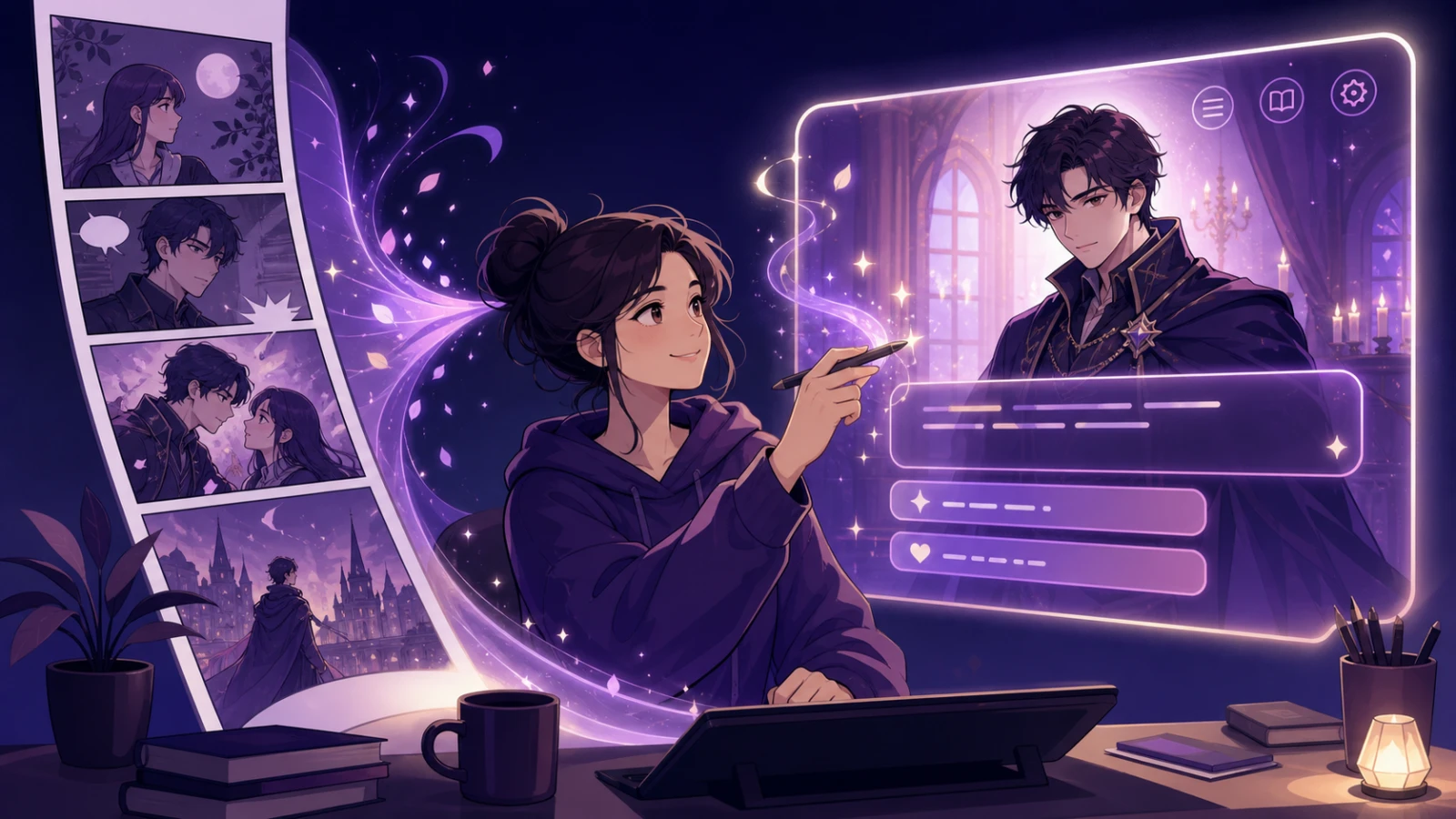
If you draw webtoons, you've probably felt this at least once: "There's so much more to this character that I never got to show in the main story…"
A serialized comic has fixed lengths and pacing. So the scenes that are absolutely alive in your head but never made it onto the page just keep piling up. That side character's past, the story of two characters before they ever met, the "what if they'd chosen differently" route… exactly the kind of thing fans beg for in the comments: "Please give us a spin-off for these two."
Today let's talk about one way to bring those precious unused stories to life: turning your webtoon characters into a story people can play — a visual novel. It sounds grand, but it actually fits webtoon creators surprisingly well. Let me walk you through why.
🎬 Where Is Webtoon IP Headed Right Now?
The hottest phrase in webtoons these days is "IP expansion."
A hit webtoon becomes an anime, a game, a drama. Ever since Solo Leveling paved the way, this trend has only sped up. In 2026, countless webtoons are being turned into games and anime. Even webtoon companies themselves are pushing fans from "reading" toward "playing" — letting them chat with characters, unlock hidden side stories, and collect items.
But here's the slightly bittersweet part. Most of this dazzling expansion is about big IP and big studios. Multi-million-dollar game production, huge production committees… for a creator just finding their footing, or an individual artist, that can feel like a faraway world.
So here's what I really want to say: "Does IP expansion really belong only to big studios?" Actually, no. There's one form of expansion that's the closest within reach — something you can start at a small scale, even on your own. That's the visual novel.
🧩 Webtoons and Visual Novels Are Basically Siblings
Why a visual novel specifically? Because the two forms are strikingly alike. Practically siblings.
Think about it. A webtoon runs on characters + art + story. A visual novel is exactly the same: appealing characters, atmospheric art, dialogue and stories that move the heart. The ingredients almost completely overlap.
1️⃣ Both are driven by a character's emotional arc. Webtoon readers laugh and cry over a single expression or line. That's precisely what visual novels do best.
2️⃣ Both "speak through pictures." As a webtoon creator, you already have character designs, expressions, backgrounds. You're already holding the ingredients a visual novel needs.
3️⃣ The one decisive difference is "choice." A webtoon is read along a set path, but in a visual novel the reader chooses, and the story branches. And that "choice" is exactly what webtoon readers have always craved in the comments — "I would've picked this option," "I hope these two end up together."
So going from webtoon to visual novel isn't learning something entirely new. It's closer to taking what you already have and adding one bit of magic: choice.
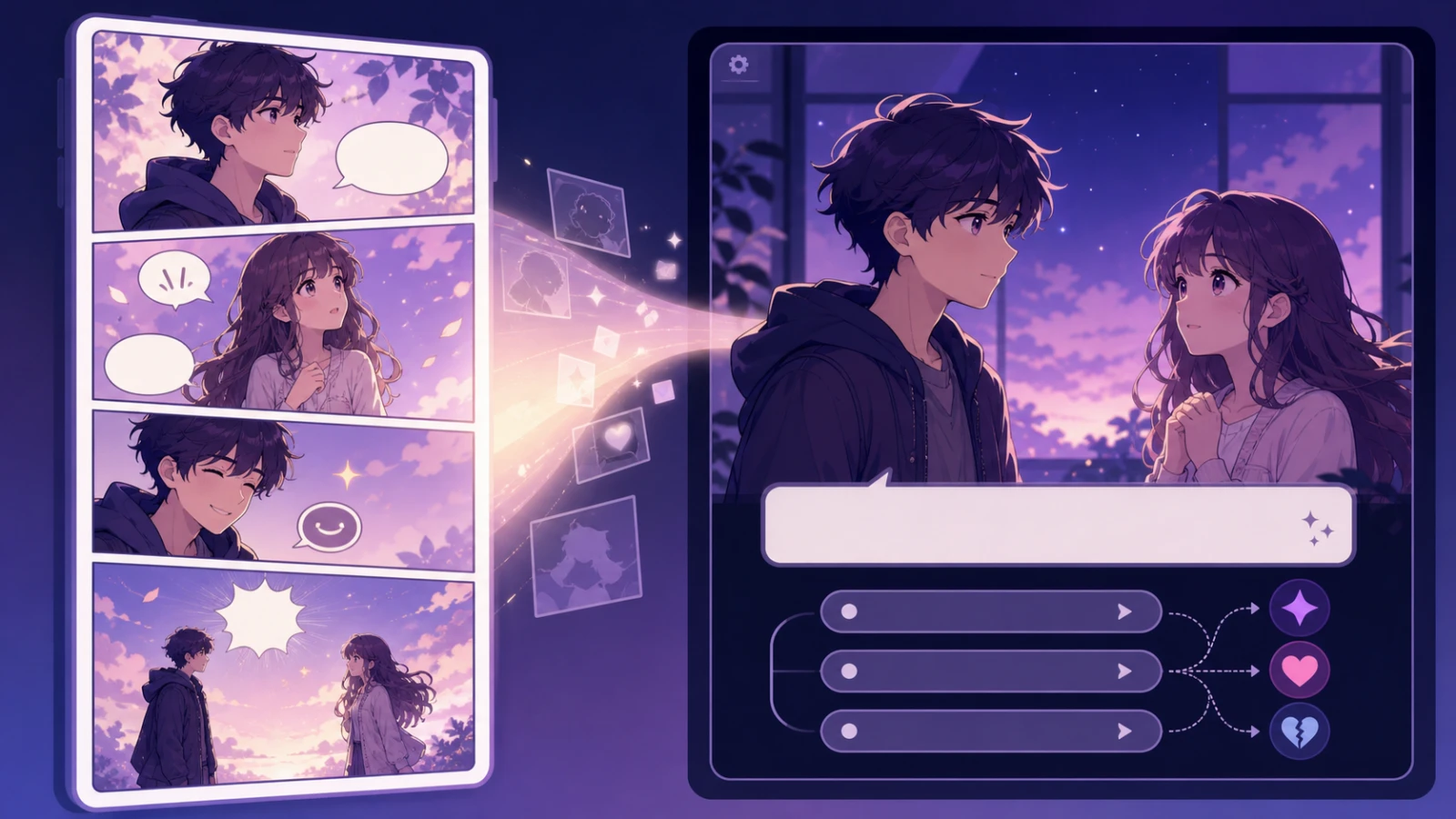
📣 Use ① A Playable Teaser to Promote Your Webtoon
The first use is promotion.
When you're launching a new webtoon, or want more eyes on an ongoing one, make a short visual novel as a "sampler." For example:
1️⃣ A prequel slice — a short episode of how the leads first met, before the main story begins. By the end, players are wondering, "So what happens in the actual webtoon?"
2️⃣ A character intro demo — a short scene where you talk with a main character. When players speak to them directly, they bond with the character so much faster.
3️⃣ A mystery-teasing spin-off — a mini game that lightly touches a mystery hinted at in the main story, so fans get excited and share it.
These teaser games are fun on their own, and at the end you can naturally place a "go read the webtoon" link. It's far stronger than promoting with text or images. People remember "something they played and came to love" much better than "something they were told to read." Someone who came to love a character by playing is far more likely to follow them all the way to the webtoon.
🌱 Use ② Extend Your IP's Life with Spin-Off Stories
The second is that very feeling I mentioned at the start — releasing the stories you never got to tell.
Serialization has to follow the main thread, so side branches, no matter how good, can't all fit. When you let those precious stories out as visual novels, your work's world grows wider and deeper.
1️⃣ Side stories — spin-offs for supporting characters or secondary couples. You can give a full story to someone who passed by in just two or three panels.
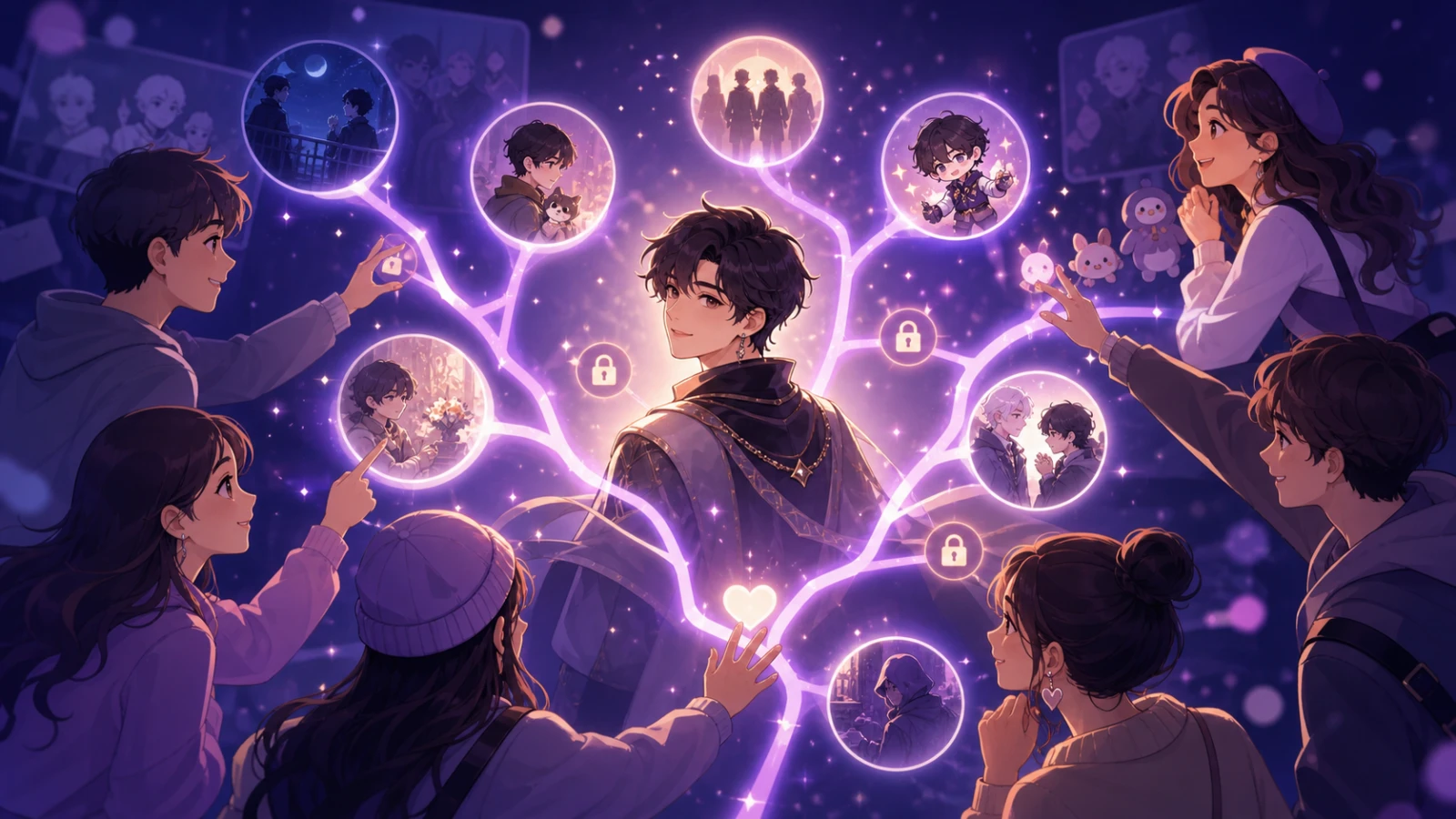
2️⃣ "What if" routes — "What if they'd chosen differently?" The main story has only one ending, but a visual novel can show every branch. This is what fans go wild for.
3️⃣ Individual character routes — make a route focused on one character, and that character's fans will adore it. You can give them the screen time the main story never could, like a gift.
This extends your work's lifespan. Even while serialization is on break, fans have somewhere to stay; even a finished work draws new readers who hear "there's still more to see." Instead of using an IP once and being done, you keep it alive and breathing.
💞 Use ③ Turn Fans From "Readers" Into "Players"
The third might be the biggest change of all, because your relationship with fans shifts.
In a webtoon, the reader "watches" the story. That's a great experience. But in a visual novel, the fan "participates." They speak to characters directly, choose how to treat them, and that choice changes the story.
That difference is bigger than it sounds. When your favorite character smiles because of a choice you made, or a relationship grows closer because of one line you picked — that becomes not "a story I watched" but "a story I helped make." The affection built that way runs much deeper and lasts much longer.
And webtoon fans already have a strong urge to participate. They dissect every episode's clues in the comments, draw fan art, shout "please get these two together." A visual novel is the perfect vessel for that energy. You're offering fans who only got to watch a place where they can actually take part.
🚪 "But Isn't Making a Game Really Hard?"
By now you're probably thinking: "Sounds good, but I can't code."
Fair. That used to be a big wall. Making a visual novel usually meant installing an engine, learning script syntax, doing something close to programming. For a creator already busy drawing, that's a huge burden.
But these days there are plenty of no-code tools. Our Novelez is one of them — it helps you build a visual novel right in your web browser, with no coding and no complicated installs.
And webtoon creators have one special advantage. The most time-consuming part of a visual novel is actually the art — and you already have your characters and artwork. Others have to create characters from scratch; you can bring in the characters already in your hands and just add "choice and story." You've got a head start.
So you don't have to think of it as grand "game development." Give your characters dialogue, set down a few forks, let players choose. That's plenty to start with.
🤖 So How Far Can AI Help?
These days you can't leave AI out of the conversation. Let me be honest: AI is a good assistant. But you're always the lead.
AI is useful for quickly drafting dialogue for a stuck scene, sketching the skeleton of a side story, or tossing out ideas when you ask "what would this character say here?" It eases the blank-page paralysis of getting started.
But webtoon creators already have the most powerful weapon: your own art style, characters, and world. AI can't make that for you. What expression that character wears, how they talk, what wound they carry — you know that best. AI only assists on top of it.
So the best setup is this: keep your characters and world at the center, and let AI help with the repetitive, labor-heavy parts. That frees you to focus on what you do best — story and emotion.
🌟 So, To Sum Up
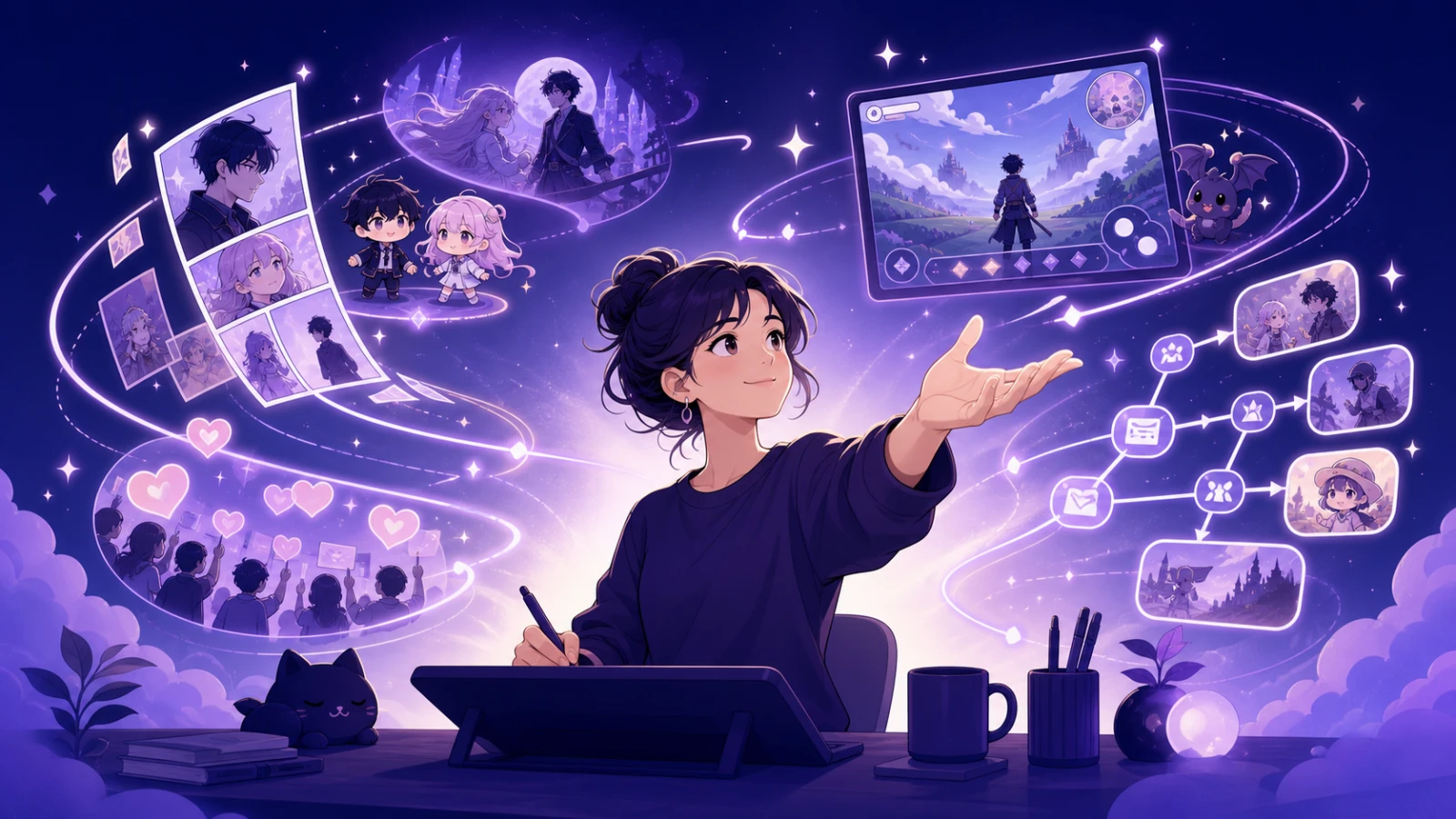
Let's gather the reasons a webtoon creator might want to try a visual novel.
1️⃣ Promotion — a playable teaser brings new readers all the way to your webtoon.
2️⃣ Secondary creation — untold side stories and "what if" routes extend your work's life.
3️⃣ Fan participation — turn fans who only watched into fans who actually play.
4️⃣ A head start — you already have characters and art, so you begin ahead of others.
5️⃣ A lower barrier — no code, right in the browser. It's not some grand development project.
All the love and time that went into a webtoon is too precious to spend once and let drift away. You're opening one more stage for those characters: a story that can be played. And your fans will surely be glad.
If there's a story still waiting in your head, start with exactly that one. Your characters — shall we let your readers meet them in person this time? 🎬