Which Branching Shape Fits Your Visual Novel?
October 20, 2026
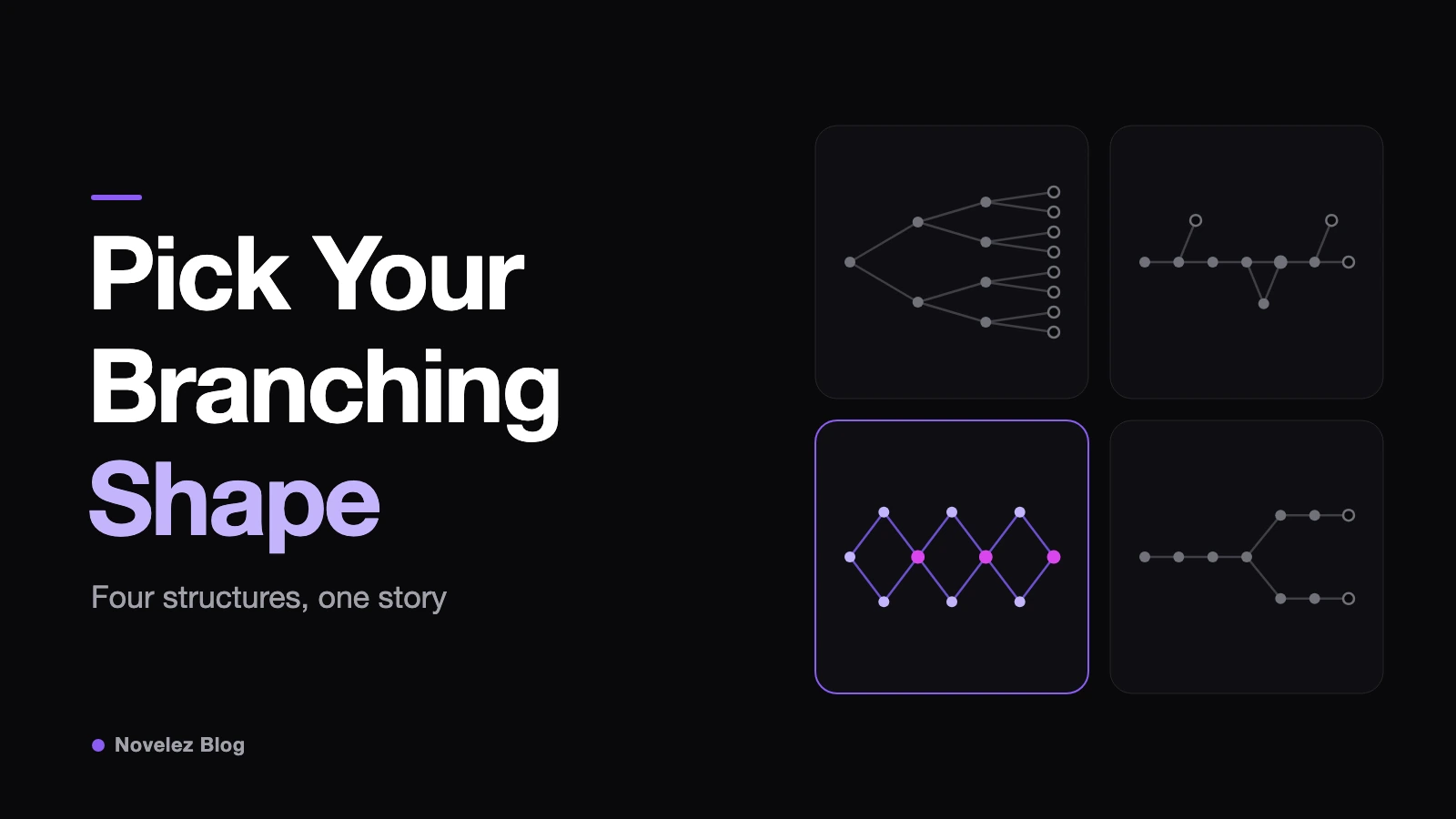
Most visual novel creators do not choose a branching structure. They discover one. The first choice splits the story in two, the second splits each half again, and somewhere around the third choice the writer counts the scenes still to be written and quietly starts merging paths that were never meant to merge. The shape of the story was decided by accident, one choice at a time.
It helps to pick the shape on purpose, and the interactive fiction community already has good names for the options. In his 2015 essay Standard Patterns in Choice-Based Games, critic Sam Kabo Ashwell sorted choice-based works into recurring structures. Four of them show up in visual novels again and again. Below, each one gets the same test: four two-way choices, and a count of what that costs to write. The scene counts are my own worked example, not figures from Ashwell.
What do the four shapes look like?
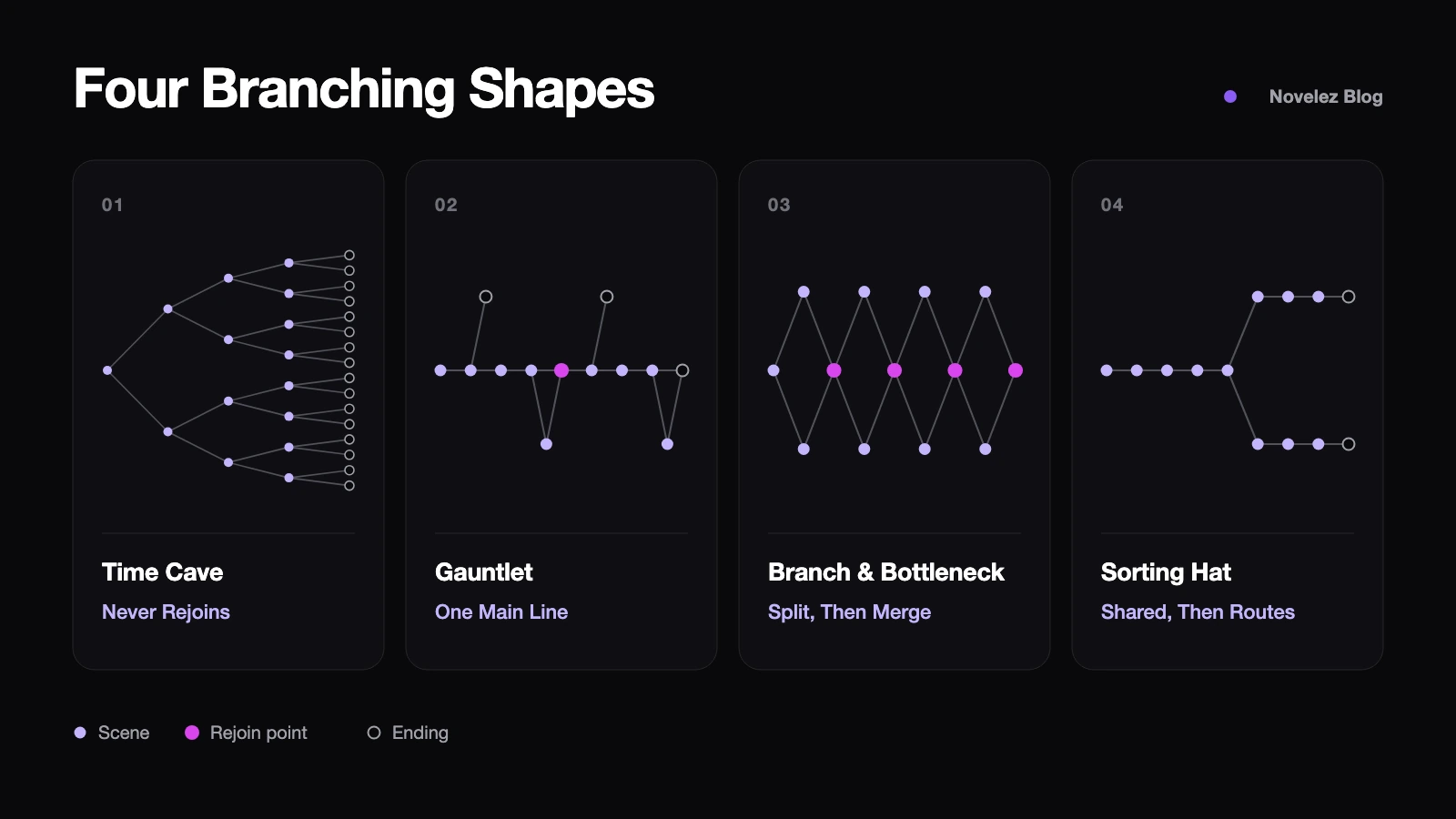
Time Cave. Every choice splits the story and nothing ever merges back. Each pick sends the player somewhere new, so endings multiply as fast as branches do. Ashwell describes time caves as short per playthrough but built for replay: broad rather than long. The trade is that most players miss most of what you wrote.
Gauntlet. One main path runs from start to finish. Side branches are short: they end in failure, or they rejoin the main path almost immediately. Mystery and horror visual novels lean on this shape because a wrong move that ends the story creates tension. Ashwell calls it perhaps the easiest structure to write. Players do notice that there is one intended route.
Branch and Bottleneck. Paths split at a choice and then meet again at an event every version of the story shares. To keep the earlier split from becoming meaningless, the game records what the player chose and uses it later. Dan Fabulich of Choice of Games calls this delayed branching: choices do not fork the story right away, they shape the outcome of later decisions. His warning about merging without memory is blunt: merging branches that way "robs the interactive novel of its interactivity" (Choice of Games).
Sorting Hat. A shared opening collects the player's choices, and at one point the game uses them to assign a major route. After that the route runs fairly straight. Ashwell lists Katawa Shoujo as an example, and the common route plus character routes found in many romance visual novels is the same idea. The cost is that you are effectively writing one extra story per route.
Real projects blend these. A sorting hat's common route often contains small branch-and-bottleneck sections, and a character route might end with a gauntlet of bad endings. Still, the backbone should be a decision you make, not a side effect.
What does each shape cost to write?
Take a story with four choices, each offering two options, and count one scene as one block of background plus dialogue.
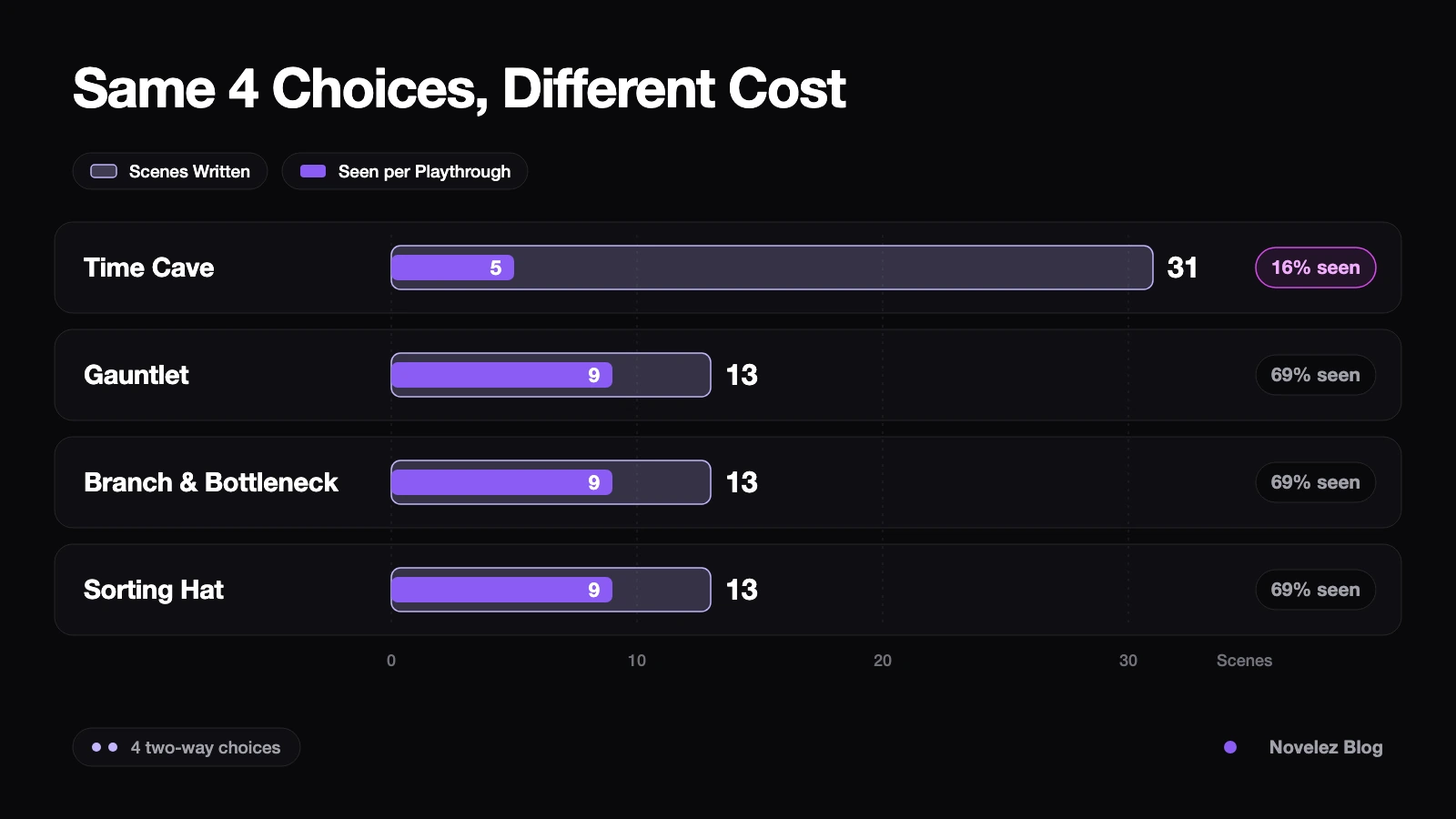
A time cave starts with one scene and doubles at every choice: 1, 2, 4, 8, 16. That is 31 scenes and 16 endings, but a single playthrough shows only 5 of them, about 16 percent.
The other three come out at 13 scenes each. Branch and bottleneck is one opening scene plus, for each choice, two branch scenes and one shared scene. A gauntlet is a 9-scene main path with one short side scene at each choice. A sorting hat is a 5-scene common route, where the first three choices only record values and the fourth, read together with them, opens one of two 4-scene routes. In all three, one playthrough shows 9 of the 13 scenes, about 69 percent, and in the sorting hat the second playthrough reveals the other route.
The gap grows with every choice you add. A fifth two-way choice takes the time cave to 63 scenes, while branch and bottleneck moves only from 13 to 16.
None of this makes the time cave a bad choice. Three choices give you 15 scenes and 8 endings, which suits a jam game or a short experiment where collecting endings is the whole point. The pain comes from starting a long story as a time cave and switching shapes halfway through.
Which shape fits the visual novel you are making?
Start from what the player should feel, then pick the structure that delivers it.
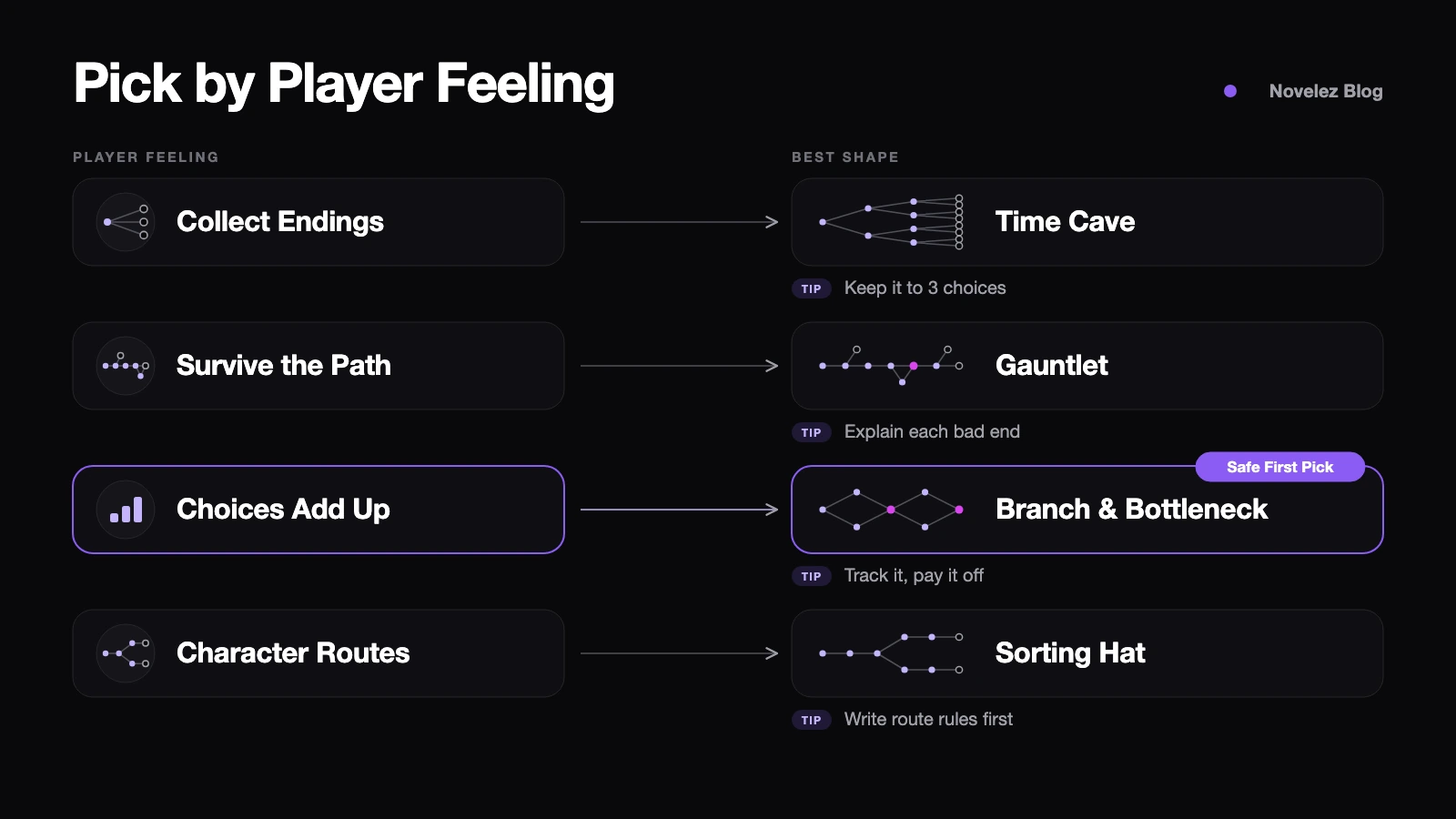
- Collecting endings, short and strange. Use a time cave, and cap it at about three choices so the scene count stays finite.
- Survival and tension, one true path. Use a gauntlet. Make each bad ending say what went wrong, so failing feels like information rather than a wall.
- Choices that add up to a character or a relationship. Use branch and bottleneck. At every merge point, store the choice in a variable, and pay at least one of those values back later in dialogue or an ending.
- Character routes and replay value. Use a sorting hat. Write down early which values open which route, before the common route is finished.
If this is your first branching visual novel and you are writing it alone, my recommendation is to start with branch and bottleneck. The scene count grows in line with the number of choices, and a shared scene can later grow into its own route, which turns the story into a sorting hat without a rewrite. That is a judgment based on the counts above, not a rule.
How do you build these shapes in Novelez?
Novelez does not choose a structure for you, and its documentation does not describe structure templates. Its default branching behavior does lean toward branch and bottleneck, though. According to the Novelez story structure documentation, pressing Make branch on a Choice block creates a branch chapter for each option and ends each one with a Go to chapter block that returns to a rejoin chapter named after_choice. Add a Variable block in each branch to record the pick, and you have delayed branching.
A sorting hat is built with the Condition block. The Condition block documentation says branches are checked from top to bottom, the first true one wins, and an else branch at the end is the safe pattern. It also recommends a single simple comparison per branch, so for complex route rules you chain Condition blocks or precompute a value into another variable.
Time caves and gauntlets depend on closing every branch. As the Go to chapter documentation explains, a chapter with no Ending or Go to chapter at its end runs straight into the next chapter in the list, and the player sees lines from a branch they did not pick. In Flow view that case is drawn as a red dashed line labeled "continues (unchosen branch!)", so one pass over the graph after you finish the structure catches open branches quickly.
Which of the four is your current visual novel closest to? And if its shape changed while you were writing, at which choice did the scene count start to feel out of hand?